
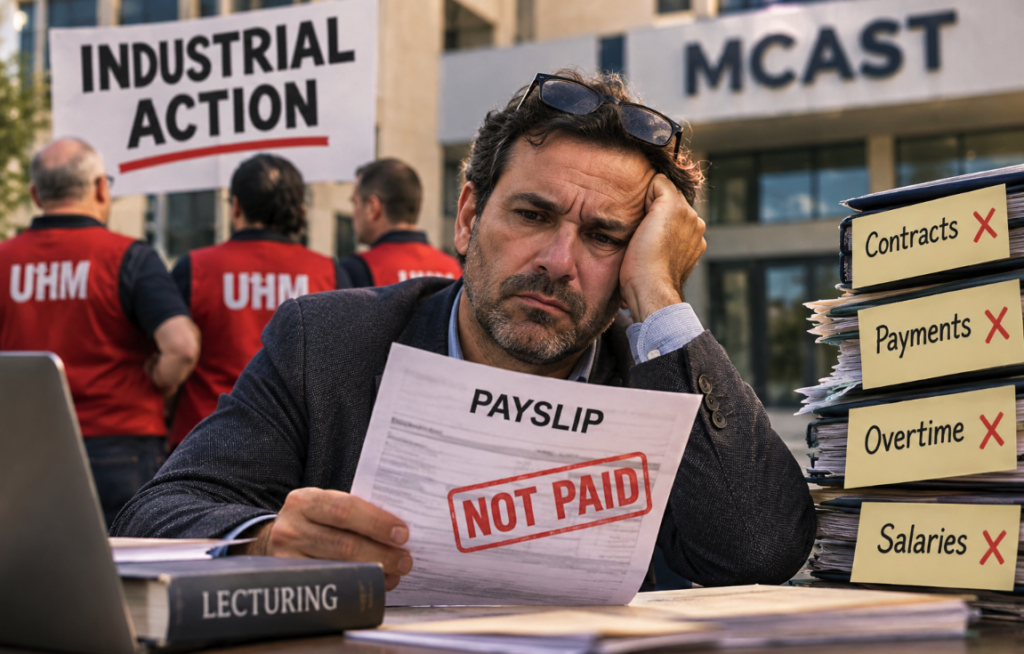
There is a peculiar form of injustice when you turn up for work, do your job, fulfil your obligations and then discover that you are not getting paid because somebody else has decided to go on strike.
That is reportedly what has happened at MCAST, where part-time lecturers have been left without their October salaries amid an industrial dispute between the institution and the UĦM, which represents administrative and support staff. The union has instructed administrative employees not to answer telephone calls or emails, or process and approve contracts and payment claims. The predictable consequence is that lecturers, who have absolutely nothing to do with the dispute, have been caught in the crossfire. Full-time lecturers have also been left waiting for overtime payments.
The unofficial motto appears to be: you strike, I get shafted.
Let’s not pretend that the right to industrial action is somehow immune from abuse simply because it is a recognised workers’ right. Over the years, we have seen how industrial action can be manipulated, used as a bargaining weapon for purposes that go well beyond the immediate dispute, and deployed with remarkably little consideration for those who end up paying the price. The right to withdraw one’s labour does not automatically confer the right to hold everyone else hostage. And when the consequences fall on people who have no involvement whatsoever in the dispute, we should be asking some rather uncomfortable questions about proportionality, responsibility and the limits of collective power.
These lecturers are not negotiating the collective agreement. They are not responsible for the disagreement between MCAST management and the union. They have performed their work and earned their wages. Yet they are being made to finance, quite literally, a dispute that is not theirs.
Since when did somebody else’s industrial dispute become a legitimate reason for withholding my salary?
A union has every right to represent its members and pursue better conditions. But there is a difference between putting pressure on an employer and depriving unrelated employees of money they have already earned. The former is industrial pressure. The latter is collateral damage, and it should not be casually accepted as an inevitable consequence of collective bargaining.
Nor should MCAST be allowed to wash its hands of the matter.
What sort of administrative system does a public educational institution operate if a dispute involving its administrative staff can bring salary payments to a standstill? Are there no alternative arrangements? No contingency procedures? No way of ensuring that people who have done their work are paid on time?
Perhaps there are technical or legal complications. If so, management should explain them. Paying salaries is not some optional administrative courtesy that can be suspended whenever the machinery of industrial relations grinds to a halt.
There is also a wider question about proportionality. Industrial action should be directed at those responsible for the dispute, not at colleagues who happen to work in another department. If the people suffering the consequences are neither the employer’s decision-makers nor parties to the negotiations, one has to question the fairness of the tactic.
We should stop treating every industrial directive as inherently legitimate simply because it comes from a trade union. Collective power, like political power, requires accountability. The fact that an organisation represents workers does not place its decisions beyond criticism, any more than the fact that an institution is publicly funded excuses its management from responsibility.
The union says negotiations have reached an advanced stage. Good. Then let those negotiations conclude. MCAST must explain why alternative payroll arrangements have not been put in place and ensure that all outstanding payments are settled without further delay.
You can defend workers’ rights without accepting that other workers should pay the price for exercising them.
The right to withdraw one’s labour should never become a licence to withhold somebody else’s wages.
You strike, I get shafted. That may be an effective slogan for expressing frustration, but it is a rather poor principle on which to run a public institution.
Source
Times of Malta – MCAST part-time lecturers left unpaid amid union dispute