

There is a particular convenience in political life when one can tell a story in Parliament, assign responsibility to somebody else, and hope that the people listening will never hear the other side.
The future of Birkirkara Police Station appears to offer a textbook example.
During a parliamentary discussion, Home Affairs Minister Glenn Bedingfield blamed the Birkirkara Local Council for the failure to relocate the police station to the Civic Centre. His explanation was that the Council itself was impeding the move.
It was a rather straightforward accusation: if the police station could not move, the Council was to blame.
Except that, on 25 November, the Council published a statement that raises some rather awkward questions about the Minister’s version of events.
The Council’s account is not simply a denial. It provides context, sets out the practical limitations of the proposed location and, crucially, refers to correspondence with the Minister dating back to 31 August 2026.
According to the Council, the Civic Centre has no available space to accommodate the police station. This is hardly surprising when one considers the services already operating from the building: the primary healthcare clinic, podiatry services, POYC, Servizz.gov, health offices, Active Ageing services, the Regional Library and the Council’s own administrative facilities.
These are not empty rooms waiting to be occupied. They are public services being used by the community.
The Council also states that the Police Corps had previously been invited to discuss the possibility of using the premises, but no concrete proposal followed. In the meantime, the available space was allocated to other services.
More significantly, on 31 August, the Council formally wrote to the Minister requesting a plan for the future of the police station. It asked that Birkirkara retain a dedicated, operational and accessible police station, and that the Council be involved in discussions if an alternative location was required.
What was the response?
According to the Council, the Minister referred to his intention to organise the presence of police officers in Birkirkara. However, no details were provided about where the station would be located, how the service would operate or when any arrangements would be implemented. No preliminary plan had been presented.
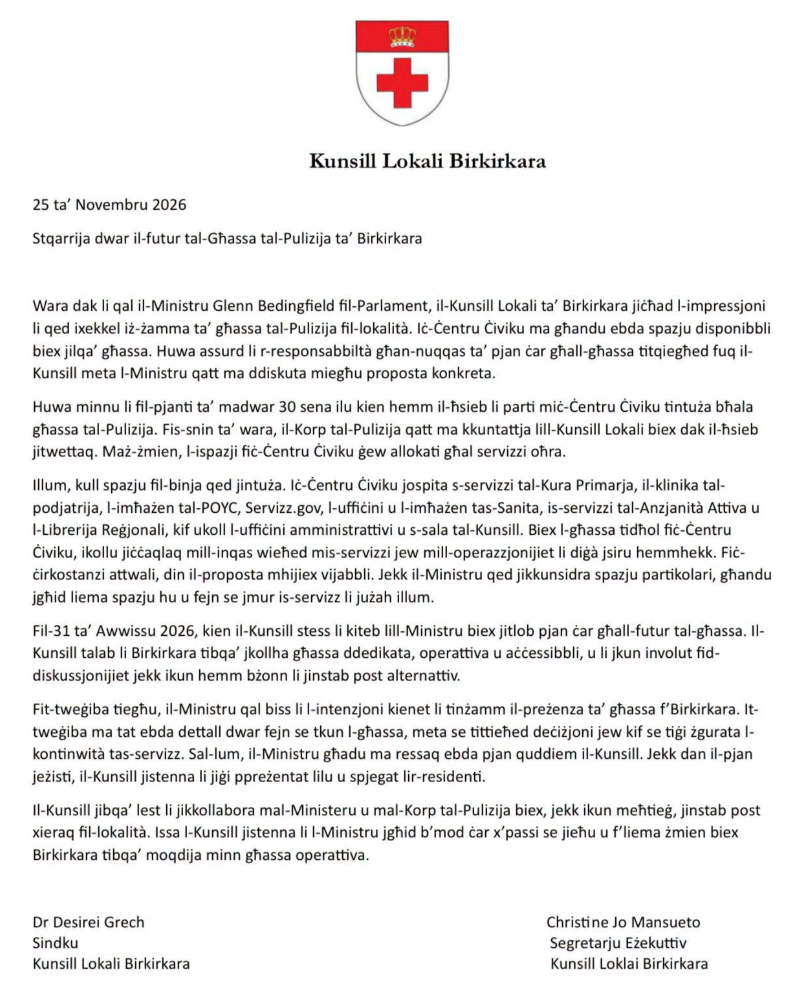
Now, perhaps the Minister would like to explain how this correspondence fits into the version he chose to present in Parliament.
If the Council had already explained that the Civic Centre had no available space, and had formally requested a relocation plan almost three months earlier, why was this context absent when the Minister attributed responsibility to the Council?
Was Parliament given the complete picture? Were residents?
There is a fundamental difference between a local council obstructing a proposal and a local council explaining that a proposed location is simply not suitable. There is also a difference between refusing to cooperate and asking the Government to produce an actual plan.
The distinction matters, particularly when the subject is a police station serving not just Birkirkara, but the wider Ninth Police District, covering Attard, Naxxar, Balzan, Lija, Iklin and Għargħur. The station’s future affects a population of more than 70,000 people.
The building’s future is already complicated by a long-running property dispute and a planning application seeking to convert the premises into a guesthouse with a rooftop pool. The Government’s responsibility to ensure continuity of policing services should therefore be beyond question.
But instead of explaining what arrangements are being made, the Minister chose to point a finger at the Local Council.
And this is precisely where the issue becomes one of political accountability.
Ministers are entitled to defend their decisions. They are entitled to disagree with local councils. What they are not entitled to do is present a selective version of events, leave out relevant correspondence and expect the public to accept their account as the complete story.
Of course, the Council’s statement is also its own account, and the correspondence should be made public so that residents can judge the matter for themselves.
The Minister should have little difficulty doing so. He can publish his letter of reply, explain what concrete proposals were put forward and clarify what plans exist for the station’s relocation.
Until then, the Council’s statement leaves a rather uncomfortable question hanging in the air: was the Council really obstructing the relocation, or was it simply asking the Minister to come up with a workable solution?
Birkirkara deserves a police station, not a blame game.
And Parliament deserves more than a carefully edited version of events.
Selective amnesia may be politically convenient. It is not an acceptable substitute for ministerial accountability.
Sources
Times of Malta – Busy Birkirkara police station earmarked for a guest house with pool
MaltaToday – Birkirkara police station serving 70,000 could become guesthouse.