
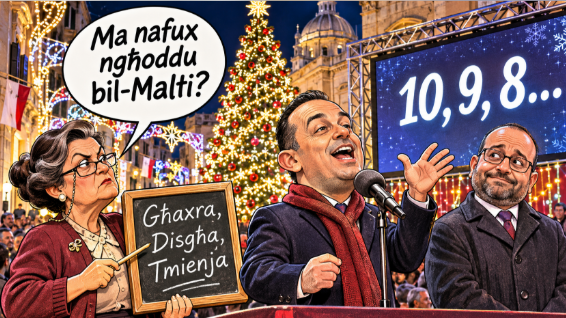
There is something rather peculiar about celebrating Maltese culture while seemingly going out of one’s way not to speak Maltese properly.
On Wednesday evening, Valletta officially welcomed the Christmas season. The lights were switched on, the Christmas tree illuminated, the Nativity crib unveiled and the usual festivities accompanied the occasion. The event was presided over by the Minister for Arts, Culture and National Heritage, Malcolm Paul Agius Galea, and the chairman of the Valletta Cultural Agency, Jason Micallef.
The audience was addressed as “Maltin u Għawdxin”.
What followed was an extraordinary demonstration of linguistic confusion.
The master of ceremonies conducted the presentation in English, frequently switching between English and Maltese, producing a rather unfortunate hybrid that did neither language any favours. This was not simply a case of choosing English as the language of communication. It was the unnecessary and, at times, rather painful bastardisation of Maltese through awkward code-switching.
And then came the countdown.
Ten. Nine. Eight. Seven…
In English. Naturally.
One has to wonder what exactly prevented the organisers from counting down in Maltese: Għaxra. Disgħa. Tmienja. Sebgħa. Sitta. Ħamsa. Erbgħa. Tlieta. Tnejn. Wieħed.
Was that really so difficult?
I can already anticipate the defence. Perhaps there were foreigners in the audience. Perhaps tourists would not understand. Perhaps English was considered more inclusive.
With respect, put a sock in it.
Counting to ten is among the first things foreign workers learn when they arrive in Malta. It is hardly an unreasonable linguistic challenge. And as for tourists, I would imagine that hearing a countdown in the native language of the country they are visiting would be rather more interesting than yet another generic English-language presentation.
Nobody is suggesting that English should be excluded from public events in Malta. It is one of our official languages, an important part of our educational and professional environment, and a perfectly legitimate means of communicating with international audiences.
But surely there is something rather odd about addressing a Maltese audience as Maltin u Għawdxin, only to conduct the actual presentation and countdown in English.
Especially when the occasion is explicitly presented as a celebration of Maltese Christmas traditions.
The Valletta Cultural Agency’s own publicity describes this year’s decorations as drawing on nostalgia, local craftsmanship and the traditions of Christmas in Maltese homes. The tree is called Is-Siġra tan-Nanna. The decorations evoke traditional Maltese craftsmanship, while the Nativity crib is intended to reflect the relationship between our past and present.
All very commendable.
But culture is not simply a collection of decorative objects, traditional motifs and carefully curated nostalgia. Language is culture. It is how a community expresses itself, remembers its history, tells its stories and passes its identity from one generation to another.
Which makes the choice of language at the official launch all the more curious.
Jason Micallef, who chairs the Valletta Cultural Agency, has previously been vocal in defending what he considers to be Maltese cultural identity and traditions. In 2024, when Valletta’s controversial Christmas tree attracted criticism, he defended its design as an expression of Maltese traditions which he believed were in danger of being lost.
One would imagine that the Maltese language would feature rather prominently among those traditions worth preserving.
Standing alongside him was the Minister for Arts, Culture and National Heritage, Malcolm Paul Agius Galea. This is the same Minister who has recently found himself at the centre of a serious dispute with sections of the cultural and creative sector following his remarks about artists, creativity and artistic expression.
We have already questioned the Minister’s understanding of the portfolio he occupies. This latest occasion raises a different, albeit related, question about the meaning of cultural representation.
Perhaps the organisers simply considered English more convenient. Perhaps they wanted to accommodate an international audience. There may be an entirely practical explanation.
But convenience is not always a sufficient reason to abandon the obvious.
Nobody is asking for English to disappear from Malta. Nobody is arguing that visitors should be made to feel unwelcome, or that every public announcement must be delivered exclusively in Maltese.
The point is much simpler.
If we are celebrating Maltese culture, why should Maltese be treated as an optional extra?
We seem increasingly comfortable presenting our national identity through decorations, symbols, costumes and carefully worded publicity, while neglecting one of its most fundamental expressions. We defend traditions when they make attractive photographs, but appear less instinctive about using the language that gives those traditions their meaning.
A country does not demonstrate cultural confidence by constantly explaining its identity to others in a language other than its own.
And there is nothing particularly progressive, inclusive or international about treating Maltese as though it were somehow inadequate for a public celebration in the capital of Malta.
So, to the organisers of Christmas in the Capital: Maltin u Għawdxin is a perfectly good way to address the audience.
Perhaps next time, we could try speaking to them in Maltese as well.
Source
TVM – Ellie Portelli ta’ 10 snin tixgħel id-dwal tal-Milied fil-Belt
Valletta Cultural Agency – Facebook