
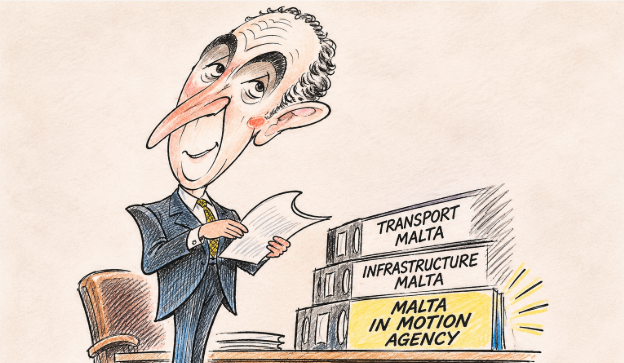
There is an episode of the classic British political comedy Yes, Minister that deserves a repeat viewing by anyone involved in Malta’s public administration.
In Jobs for the Boys, Sir Humphrey Appleby, the master of Whitehall’s administrative manoeuvring, delivers a wonderfully succinct observation while discussing the creation of yet another quango: “It takes two to quango, Minister!”
The episode is a brilliant satire of political patronage and the curious ability of government institutions to multiply rather than disappear. When a character proposes abolishing quangos, the solution eventually offered is to establish a super-quango to investigate them. Naturally, the man who wanted to abolish them is invited to join it.
Forty-six years later, the joke feels rather less like fiction and rather more like a description of how things are done in Malta.
We already have Transport Malta. We already have Infrastructure Malta. And now, apparently, we need Malta in Motion – a new agency to coordinate the work of the existing structures.
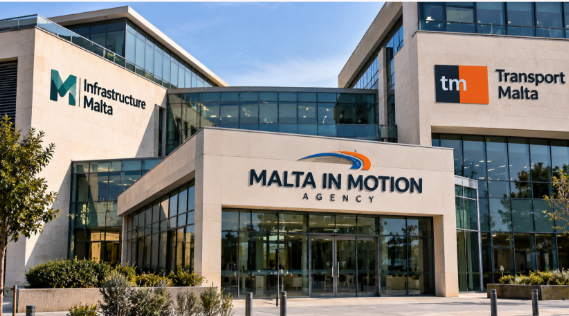
Quangos are no longer simply being created. They appear to be breeding on their own.
Transport Minister Chris Bonett announced in Parliament that the Government intends to establish a dedicated agency in 2027 to oversee the Malta in Motion programme. The initiative is intended to integrate several modes of transport, including buses, ferries, walking, cycling, parking and a proposed rapid transit system.
The Government’s stated objective is to bring these different elements together under a coordinated, long-term plan. Fair enough. An integrated transport strategy is precisely what Malta needs.
But does delivering that strategy really require another public entity?
Transport Malta is already the national authority responsible for regulating, coordinating and developing all forms of transport in Malta. Its responsibilities cover land, sea and air transport, including transport policy, road safety and sustainable mobility.
Infrastructure Malta, meanwhile, is the agency entrusted with developing, maintaining and upgrading roads and other public infrastructure. It was established in 2018, when the Roads and Infrastructure Directorate of Transport Malta was transferred to the new agency, allowing the two entities to concentrate on their respective responsibilities.
So we have one authority responsible for transport regulation, coordination and policy, and another responsible for infrastructure development and maintenance.
Now we are proposing a third body to oversee a programme that involves many of the same areas.
One has to wonder what exactly has been happening all this time.
If the existing institutions cannot coordinate their responsibilities effectively, is the answer really to create another institution sitting somewhere between them? Or should we perhaps be asking why the existing structures, with their respective boards, management teams, directorates and publicly funded employees, cannot deliver the coordination that taxpayers are already paying for?
The problem is not that Malta needs a long-term transport strategy. It does. The problem is that the Government seems increasingly inclined to answer every administrative challenge by creating another administrative structure.
And the financial implications should not be an afterthought.
How many employees will this new agency have? Who will run it? Will personnel be transferred from existing entities, or will new positions be created? What will its annual operating costs be? Will it have its own board, chief executive, offices and administrative support? Most importantly, what powers will it have that the existing authorities do not already possess?
These are not unreasonable questions. They are the minimum information the public should expect before another publicly funded entity is established.
The Opposition has already questioned the proposed division of responsibilities, pointing out that Malta will have three entities under two ministries involved in the transport sector. Who, for example, will decide on new bus routes and additional buses? Transport Malta or Malta in Motion? And who will be responsible for ensuring that the necessary infrastructure is delivered? Infrastructure Malta or the new agency?
These are not merely organisational details. They go to the heart of accountability. When a project is delayed, costs escalate or a promised service fails to materialise, who will ultimately be responsible?
The Government may argue that a dedicated agency will provide focus, continuity and coordination. That is a legitimate argument. But it still needs to explain why those objectives cannot be achieved by giving the existing institutions clear responsibilities, proper direction and measurable targets.
Perhaps the answer is that creating a new agency is administratively easier than reforming the ones we already have.
And this is where the familiar Maltese phenomenon of institutional expansion becomes particularly uncomfortable.
Over the years, successive governments have created an extensive ecosystem of authorities, agencies, foundations, corporations and other public bodies. Some serve legitimate and necessary purposes. Others risk overlapping responsibilities, duplicating administrative functions and creating reporting structures that are difficult for anyone outside the system to understand.
The public is entitled to question whether this proliferation is genuinely improving the delivery of services or simply expanding the machinery of government.
It also inevitably raises the question of appointments. Every new entity brings with it the possibility of new management positions, board appointments and employment opportunities. That does not mean that the proposed agency will necessarily become a vehicle for political patronage. But given Malta’s long-standing experience with political appointments in public entities, transparency over its structure, recruitment and governance should be a prerequisite, not an afterthought.
And perhaps that is the most revealing part of the Yes, Minister episode. Its satire was not simply about the number of quangos. It was about a system in which institutions could become ends in themselves, and where the machinery of administration acquired a remarkable ability to protect and perpetuate its own existence.
Malta’s transport system desperately needs better planning, more reliable public transport and a coherent long-term strategy. Commuters do not need another agency name on a letterhead. They need buses that arrive, ferries that provide practical alternatives, roads that work and a transport system that reduces the daily misery of congestion.
Before giving birth to yet another public entity, perhaps the Government should first demonstrate that the two it already has can deliver.
Otherwise, we may soon find ourselves needing a fourth agency to coordinate the three agencies responsible for coordinating transport.
At this rate, the only thing moving efficiently in Malta’s transport system will be the proliferation of public entities.
One agency gives birth to another, and the taxpayer is left to raise the family.
Sources
Times of Malta – Too many cooks: PN questions plans for Malta in Motion agency
Times of Malta – Driving licence surrender scheme did not get desired response, Bonett says
Transport Malta – Malta in Motion Overview
Yes, Minister – Series 1, Episode 7: Jobs for the Boys – Episode transcript