
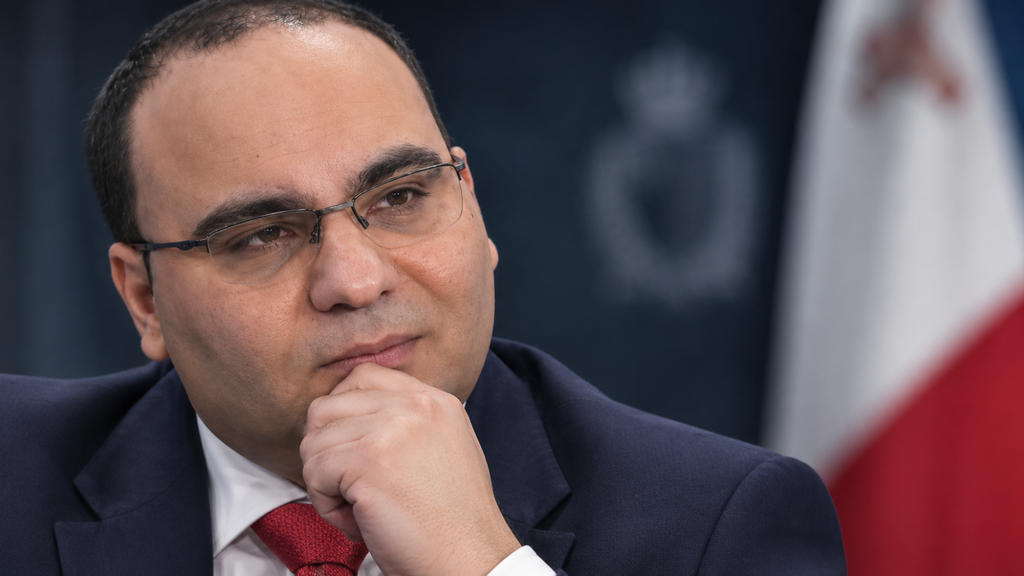
There is something rather convenient about discovering the consequences of a policy after spending years helping to shape it.
Finance Minister Clyde Caruana has been particularly vocal in recent weeks about Malta’s dependence on foreign labour. His argument is that businesses have consistently opted for cheaper labour rather than investing in machinery, technology and productivity. The result, he says, is an economic model that places an unsustainable burden on the country’s infrastructure and public services.
He is not wrong about the diagnosis. But there is a rather important part of the story that seems to be missing from his explanation: his own role in creating the conditions he now wants to correct.
Caruana was Executive Chairman of Jobsplus from 2014 until November 2020. He was not a detached observer of Malta’s labour market. He was heading the national employment agency during the years in which the country’s reliance on imported labour expanded dramatically. He subsequently became Minister for Finance and Employment, retaining responsibility for employment policy until February 2024.
This is not some historical footnote. It is directly relevant to the policy debate taking place today.
Last week, former minister Evarist Bartolo recalled how Caruana had warned the administration about the risks associated with an excessive dependence on foreign labour. Indeed, Caruana himself has previously acknowledged that he had been warning about the need to change Malta’s economic model for years, even while maintaining that he had no regrets about his earlier advocacy for bringing more foreign workers into the country.
That raises a rather obvious question: if the dangers were understood, why were they not addressed when there was still time to do so?
Caruana has been Finance Minister since November 2020. This is not a newly appointed minister inheriting an economic mess from his predecessors. He has been at the centre of economic policymaking for years, with access to the information, the machinery of government and the Cabinet table.
What did he do with that knowledge?
Why did he not insist on a proper long-term population and labour-market strategy? Why did he not push for infrastructure investment and productivity targets to accompany the expansion of the workforce? Why did he not challenge policies which encouraged economic growth through ever-increasing labour supply, even as the country’s capacity to accommodate that growth came under mounting pressure?
And if he did raise these concerns, as he now says he did, what happened? Were his warnings ignored? Did he disagree with his ministerial colleagues? Did he consider the policies being pursued shortsighted but accept them as the price of maintaining the Government’s economic growth figures?
The public deserves to know.
The Government’s latest measures impose additional costs on third-country nationals, including higher work permit fees and a €400 annual infrastructure contribution, while withdrawing certain benefits such as free public transport and childcare for those who do not qualify for long-term residence. The Finance Minister has defended the package as part of a necessary effort to change the country’s economic direction and recover some of the costs associated with population growth.
But changing an economic model is not the same as sending a bill to the people who were brought here to sustain it.
If the intention is to discourage employers from relying excessively on low-cost labour, why are so many of the immediate financial burdens being placed on the workers rather than on the businesses whose recruitment decisions are supposedly responsible for the problem? And where is the comprehensive transition plan that will help those businesses invest in automation, technology, training and higher productivity?
The Malta Chamber has questioned whether the measures are sufficiently calibrated to achieve the transformation being promised. Its concerns about additional costs, recruitment difficulties and the absence of adequate consultation deserve serious consideration. Equally, businesses cannot expect the public to subsidise indefinitely an economic model whose wider costs they have not had to absorb.
There is responsibility on both sides. But the Government cannot spend years encouraging volume-driven growth, celebrate the resulting economic figures, and then present the consequences as though they were an unexpected discovery.
Nor can the Finance Minister conveniently separate himself from the policies pursued during the years in which he was responsible for employment and economic strategy.
The real question is not whether Malta needs a different economic model. It plainly does. It is why the Government waited so long to act, why warnings were not translated into policy, and why those now being asked to pay for the correction are not necessarily those who made the decisions that created the problem.
Economic transformation requires political courage, long-term planning and accountability. It cannot be achieved by rewriting the history of how we got here.
Before telling the country who should pay for Malta’s economic transformation, Clyde Caruana should explain why, with years of experience and authority behind him, he allowed the country to reach the point where such a painful correction became necessary.
Sources
Times of Malta – Labour-intensive, low productive sectors should pay higher taxes – Clyde Caruana
Times of Malta – Employers need to act to stem population growth, says finance minister
Malta Chamber of Commerce – The Malta Chamber rejects claim that businesses prefer cheap foreign labour to investment
Times of Malta – Ministers were blindsided by controversial TCN measures
MaltaToday – Cabinet blindsided by budget measures against non-EU workers