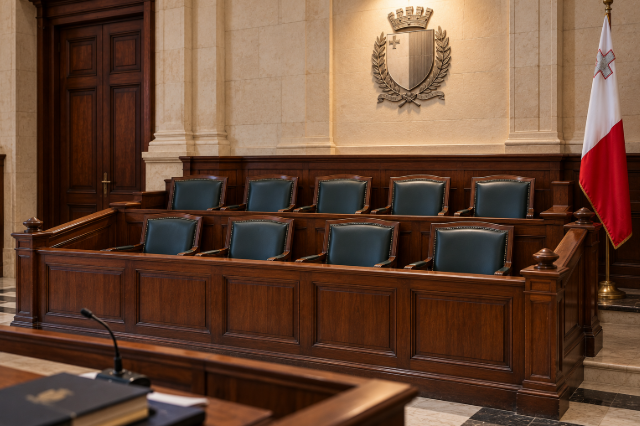
A criminal trial depends on a simple promise: the accused will be judged on the evidence, by people capable of considering it impartially. In the trial of Yorgen Fenech, that promise has become the subject of deeply troubling questions — not because we dislike the verdict, but because we need to understand how the jury was selected and protected from improper influence.
Before the trial began, a telephone survey was conducted asking respondents about Fenech, Daphne Caruana Galizia, the murder investigation, political allegiances and other matters directly connected to the case. Times of Malta reported that the survey had been commissioned by Fenech’s uncle, Ray Fenech, and that the questions had been vetted by members of the defence team. The survey was conducted after the list of potential jurors had been published. The trial judge reportedly rebuked the defence over the timing and disclosure of the exercise.
The defence has denied targeting people on the jury list, maintaining that the survey used randomly generated telephone numbers to assess the impact of adverse publicity. Pollster Vincent Marmarà has also denied targeting prospective jurors. Those denials must be acknowledged. The available reporting does not establish that the defence successfully selected, or manipulated the selection of, any juror.
But that does not dispose of the question.
The issue is whether a party to a criminal trial should be able to commission research on public attitudes towards a case at precisely the moment when prospective jurors have been identified — and what safeguards should apply if the research could reveal information useful in profiling them.
Pre-trial surveys are used in some jurisdictions, particularly in the United States, to assess prejudice and inform legal strategy. They are not automatically evidence of wrongdoing. Yet Times of Malta‘s fact-check found that such research is comparatively rare and largely unregulated in Europe. There is a difference between measuring public opinion and gathering information that might help a party anticipate, identify or influence the people who could decide a case.
That difference needs to be addressed openly, not dismissed with the observation that something is not expressly prohibited.
The controversy has become more serious following revelations about jurors’ social-media histories and messages exchanged after the acquittal. One juror reportedly wrote that “not even her children mourn her”, referring to Caruana Galizia. Other material concerned hostile comments about the journalist and the case. The existence of such messages does not, by itself, prove that the verdict was improperly reached. Nor should a distasteful opinion automatically be equated with legal bias. But the disclosures raise legitimate questions about how potential conflicts and prior views are identified before jurors take their seats.
The danger is that these controversies become another excuse for competing camps to declare the verdict illegitimate or beyond scrutiny according to their existing convictions. Neither response helps.
Fenech is entitled to the presumption of innocence and to a fair trial. The jury’s acquittal cannot be overturned by public anger, social-media campaigns or suspicion. Equally, the public is entitled to expect that the selection process is protected from improper interference and that credible concerns are examined through proper legal channels.
The answer is not to allow politicians, journalists or campaigners to decide who is fit to sit on a jury. Nor is it to presume that every survey commissioned by a defence team is sinister. It is to establish clear rules: what pre-trial research is permissible, what must be disclosed to the court, how prospective jurors may be approached, and what happens when a survey risks contaminating the jury pool.
Where necessary, the law should provide for independent scrutiny and proportionate sanctions. Courts must also have the practical means to investigate concerns before a trial begins, rather than being left to deal with the consequences afterwards.
The rule of law is not merely the right to a verdict. It is the right to a process that deserves public confidence, even when the verdict is deeply unpopular.
We should neither presume that the jury was manipulated nor assume that everything was in order. We should insist on answers, evidence and safeguards strong enough to make either conclusion defensible.
A jury must be free to decide the case. The public must be able to trust that nobody has been allowed to game the process by which that jury comes into being.
Sources
- Times of Malta – Survey held on eve of Yorgen Fenech trial was questioned by judge
- Times of Malta – Fact-check: Are pre-trial juror surveys ‘used across the world’?
- Times of Malta – Juror’s WhatsApp message about Daphne Caruana Galizia’s children
- MaltaToday – Caruana Galizia family disputes defence claim over juror list
- The Shift – Who was being surveyed, and why?