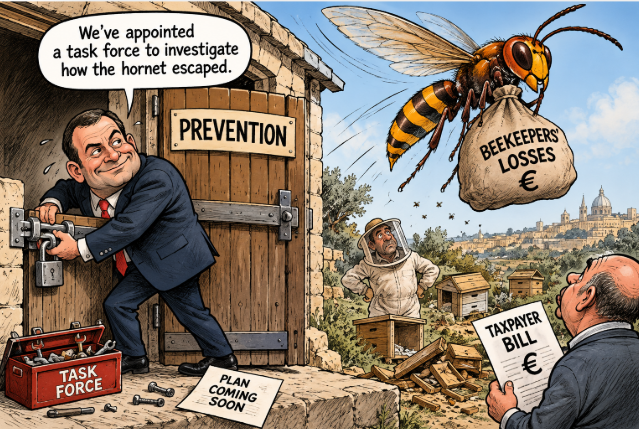
The Government’s promise of a solution in the coming weeks raises an uncomfortable question: what exactly has it been doing until now?
Malta’s oriental hornet infestation is an indictment of a government that appears to have spent years reacting to warnings rather than acting on them. Now, after beekeepers have suffered mounting losses and experts have called for a coordinated response, Robert Abela promises a solution in the coming weeks.
The hornet, it seems, has bolted. The Government is still looking for the stable door.
This is not simply bad luck, nor can it be dismissed as an unforeseen ecological problem. The warnings were there. The expertise was available. What is missing is a convincing explanation of why a coordinated national response was not put in place sooner.
The warnings certainly did not begin this month. Pest-control expert Arnold Sciberras has said he has been dealing with oriental hornets in Malta since 2012 and repeatedly called for action on a national scale. In 2022, beekeepers were already warning of an alarming increase in the hornet population and demanding a serious plan of action. Four years later, we are still discussing the need for a broader, coordinated response.
The Agriculture Ministry has acknowledged that the pressure on beekeepers now warrants further intervention. It has also confirmed that Malta has no scientific national estimate of the hornet population.
Stop there for a moment. We are dealing with a problem serious enough to threaten beekeeping livelihoods, yet the authorities cannot quantify its national extent scientifically. What monitoring has taken place? What assessment of the risks was made? Who was responsible for coordinating the response? And why are we still discussing possible measures after the damage has become so apparent?
These are the minimum questions citizens should be entitled to ask of a government that claims to be competent.
The consequences are not abstract. Beekeepers Denise Camilleri and Ray Sciberras estimated that hornets destroyed 30 of their hives at their Birżebbuġa apiary, costing them around €30,000. They are not asking the Government to guarantee their profits. They are confronting losses that individual effort and homemade traps cannot necessarily prevent when the problem extends well beyond their own apiaries.
The oriental hornet is indigenous to Malta, so eradication is neither a realistic nor necessarily an appropriate objective. Effective management requires scientific monitoring, targeted control, safe nest management and cooperation between authorities, experts and beekeepers.
But complexity cannot become a permanent alibi for administrative failure. A difficult problem demands better information, earlier planning and clearer coordination. That is precisely what government is supposed to provide.
The Government says it has offered financial support, guidance and training. These measures deserve acknowledgement. But assistance to individual beekeepers is not a substitute for a coordinated response to a problem that extends into residential and agricultural areas. The Ministry itself has recognised that the scale of the problem requires more.
The Government must now publish a concrete action plan, identify who is responsible for delivering it, explain what resources are being committed and establish measurable targets. It must also account for the warnings received and the action taken in response. If the authorities acted appropriately but circumstances overwhelmed their efforts, let them explain the evidence. If there were failures in monitoring, planning or coordination, those failures must be acknowledged and corrected.
Governments cannot prevent every ecological problem. They can, however, be expected to recognise foreseeable risks, listen to expertise and act before a manageable problem becomes a crisis.
That is the difference between governing and firefighting.
When the Prime Minister promises a solution in the coming weeks, the question is no longer simply what the Government intends to do about the hornet. It is why Malta has reached this point without a convincing national response already in place.
The hornet may be difficult to control. The need for preparation is not.
And now that the hornet has bolted, another round of promises will not be enough. Malta needs answers, accountability and a plan that should have been in motion years ago.
Sources
- Times of Malta — After a summer of hornets, PM promises solution ‘in coming weeks’
- The Malta Independent — ‘Point of no return’: Pest expert warns Malta could lose much of its beekeeping within a decade
- Illum — Ministry acknowledges need for a broader, coordinated response
- Times of Malta — Maltese beekeepers want action on ‘alarming’ hornet problem
- Times of Malta — Beekeepers call for army intervention as hornets devastate Malta’s beehives