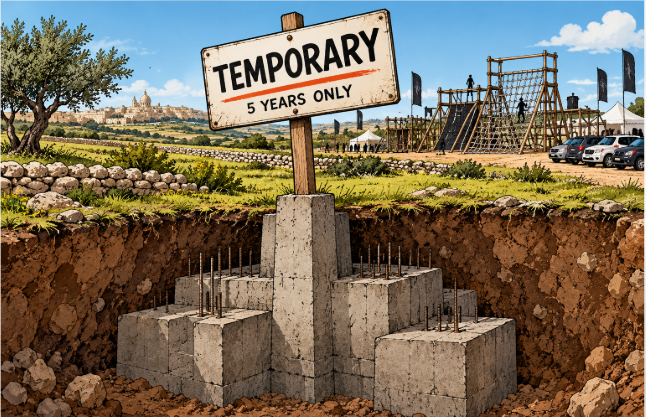
There is something distinctly Maltese about having to debate whether a development that can remain in place for five years should be considered temporary.
The Planning Authority’s proposed framework for outdoor sporting facilities, including obstacle courses, trail runs and endurance events on land outside development zones (ODZ), is intended to address a gap in existing policy. Nine environmental and heritage organisations have formally objected, warning that it could weaken countryside protection by allowing substantial commercial facilities on agricultural and natural land. The public consultation closes today, 14 October.
The question deserves a serious answer, not another round of automatic applause for development or automatic hostility towards business.
Outdoor sport is a legitimate activity. Obstacle courses, trail running and other recreational facilities can promote health, encourage tourism and create commercial opportunities. There is no compelling reason why every private initiative should be treated as an environmental threat. Nor should Malta’s planning system become so inflexible that it prevents sensible, low-impact uses of land.
But the countryside is not an empty canvas waiting for the next commercially attractive idea.
The proposed framework allows favourable consideration for low-impact, reversible facilities for a single, non-renewable period of five years. It envisages removable structures, risk assessments, clearances from relevant authorities and a legally binding obligation to restore the site afterwards. These are meaningful safeguards on paper. The question is whether they will work in practice.
Five years is a substantial period in which to alter the use of agricultural land, introduce commercial activity and affect the surrounding environment. Even if every structure can technically be dismantled, the consequences of traffic, noise, lighting and intensive use do not disappear simply because a permit expires.
The Authority must therefore explain how restoration will be secured, who will monitor compliance and what happens if an operator refuses to dismantle a facility. A legal obligation is only as credible as the willingness to enforce it.
There is also a legitimate question about transparency. MaltaToday reported that a proposal for an obstacle course at Ta’ Qali was discussed at a Planning Authority hearing in 2023, when the developers’ architect referred to discussions with public bodies about a forthcoming policy. The application was later withdrawn. This does not, on its own, establish improper influence. But when a policy potentially affecting protected land emerges after discussions involving prospective developers, the public is entitled to a clear account of how it was developed and whose representations were considered.
There is a wider principle here that ought to appeal to anyone who believes in both private enterprise and the rule of law.
Businesses that obtain the necessary permissions, respect environmental conditions and invest in compliance should not be disadvantaged against competitors who benefit from ambiguity, weak enforcement or retrospective concessions. Regulation that exists only on paper is not merely ineffective. It distorts competition by rewarding those prepared to take risks at everyone else’s expense.
Equally, a planning system that prohibits everything offers neither sensible development nor credible environmental protection. The answer is clear rules, proportionate decisions and consistent enforcement.
The Government and the Planning Authority should explain why this framework is necessary, demonstrate how its safeguards will work and show how temporary permissions will be prevented from becoming a back door to permanent commercial use. The rules must apply consistently, regardless of the applicant’s connections or commercial clout.
Malta cannot manufacture more countryside. What remains must be managed with care, not treated as an inexhaustible reserve of land waiting for its next permitted use.
A temporary permission may be a reasonable compromise. But it must not become a permanent excuse.
Five years is a deadline. It is not a guarantee of good planning.
Sources
1. MaltaToday – Nine NGOs oppose proposed policy for obstacle racecourses in protected countryside
2. The Malta Independent – NGOs warn proposed obstacle course policy could undermine ODZ protection
3. Times of Malta – PA publishes proposals for temporary outdoor sporting events and facilities
4. MaltaToday – Developers discussed outdoor sports policy three years before being drafted