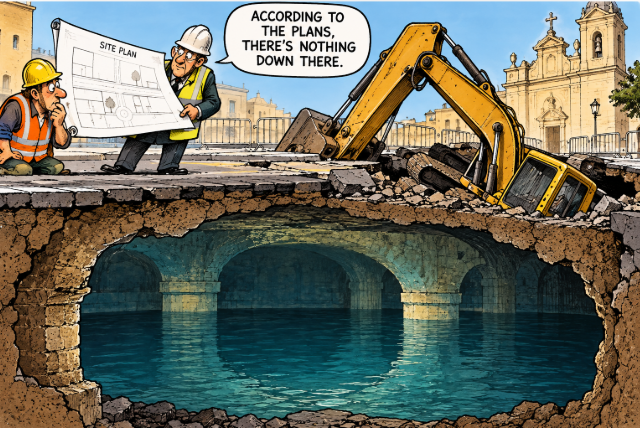
You do not need to be a civil engineer to understand that excavating above an underground cistern with heavy machinery could end badly. Yet in Tarxien, the ground gave way beneath an excavator, exposing a substantial, water-filled cavity beside the parish church.
Fortunately, nobody was injured. But a post-mortem investigation, however thorough, cannot undo what happened. The critical question is why the necessary investigation of the ground did not happen before the excavation began.
An underground cistern does not materialise overnight. Its presence beneath an established road suggests a structure that has been there for a considerable time. In an old village centre, the possibility of historic underground structures is hardly an exotic engineering consideration. Establishing what lies beneath the surface should be a basic part of planning the works, not a discovery made after the ground collapses.
If the cistern was known about, why was the excavation allowed to proceed as it did? If it was not identified beforehand, why were the preliminary surveys insufficient to establish what lay beneath the road? Either way, the issue is not simply how the collapse happened, but whether it should have been foreseeable and preventable.
Infrastructure projects should not be judged solely by whether they eventually deliver a refurbished square, a smoother road or improved public spaces. They must also be judged by the competence of their planning and execution. A project can have a perfectly legitimate purpose and still be badly managed.
Tarxien’s residents and businesses have already endured prolonged disruption. Local businesses have complained about the impact on their trade. The collapse has added another unwelcome development to a project that was already affecting daily life in the village.
Nor should we rush to blame the individual operating the excavator. The operator may be the person visible in the footage, but responsibility extends beyond whoever happens to be sitting in the cab. Site surveys, engineering decisions, excavation methods and supervision all matter. Accountability must follow the evidence, not the most convenient target.
Infrastructure Malta, the Building and Construction Authority and the Occupational Health and Safety Authority must establish what went wrong. But the public also deserves to know what checks were carried out before work began, what was known about the underground structure and whether the excavation method was appropriate in the circumstances.
An investigation after the event is necessary to establish responsibility and prevent a recurrence. It cannot replace the due diligence that should have come first. We do not yet know whether the collapse resulted from inadequate surveys, ignored information or an unsuitable excavation method. Those facts must be established.
But the principle is simple: the time to find out what lies beneath a road is before sending an excavator into it, not after the ground gives way.
UPDATE | 1800hrs
New reporting raises further questions about what was known about the underground cistern before the Tarxien road collapsed.
When we wrote that the time to investigate what lies beneath a road is before sending an excavator into it, we did not yet have the benefit of the latest reporting from Tarxien.
That reporting makes the questions more pointed.
According to Times of Malta, long-standing residents say the underground cistern was well known locally, having been used for decades to collect water. More significantly, the newspaper reports that Infrastructure Malta’s own planning documentation, submitted to the Planning Authority, marked an existing well close to the site of the collapse.
These details do not, on their own, prove that the project team knew the full extent of the cistern or understood the risks posed by the excavation. But they make it harder to treat the incident simply as an unexpected encounter with unknown ground conditions.
If a well was marked on the project documentation, what did the engineers establish about the surrounding underground structure? Were the implications assessed before excavation began? And were the people carrying out the works properly informed about the conditions they might encounter?
These are not technical niceties. They go to the heart of competent project planning. A mark on a drawing is useful only if it leads to the necessary investigation and appropriate precautions on site.
Infrastructure Malta’s reported position that the cistern was discovered during the works also deserves clarification in light of the residents’ accounts and the planning documentation. The distinction between knowing that a well exists and understanding the extent and condition of an underground reservoir matters. So does the distinction between what local residents knew and what the professionals responsible for the project established.
The authorities must now determine what information was available before work began, what investigations were undertaken and whether the excavation was planned accordingly. But the lesson is already clear: an investigation after a collapse cannot substitute for the due diligence that should precede it.
The question is no longer simply what lay beneath the road. It is what those responsible knew or should have known before they started digging.
Sources
Times of Malta – Watch: The moment a Tarxien road collapsed under the weight of an excavator
MaltaToday – ‘I warned them two months ago’: Tarxien shop owner speaks out after road collapse
MaltaToday – Massive gaping hole in Tarxien swallows excavator after road collapse near square
MaltaDaily – No Injuries in Tarxien Ground Collapse, Probe Underway