
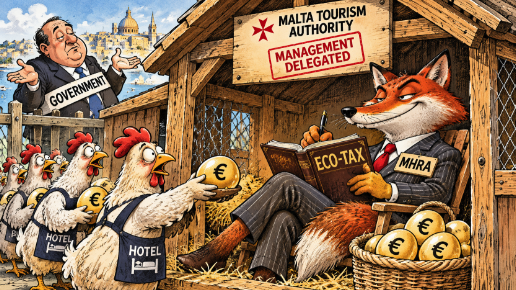
You could not make this up. The tourism eco-contribution is charged to visitors staying in hotels and other accommodation establishments. It is collected by those establishments. And who has been entrusted with an important role in administering the system? The Malta Hotels and Restaurants Association — the very organisation representing the interests of the businesses subject to the levy.
If this sounds like putting the fox in charge of the henhouse, it is because the arrangement raises precisely that sort of question.
Let us be clear about what has happened. The Malta Tourism Authority remains the competent public authority. But operational functions relating to the eco-contribution have been delegated to MHRA under an agreement signed in April. These include onboarding accommodation providers, operational coordination, reconciliation, reporting, collection, remittance and related implementation matters.
In other words, a private-sector lobby group representing the industry affected by the tax has been given a substantial role in administering it.
The Government apparently sees no problem. Tourism Minister Jo Etienne Abela has dismissed concerns about a conflict of interest. MHRA’s president has also defended the arrangement, arguing that the staff involved operate independently of the association’s council. We are also told that the money goes directly to the Malta Tourism Authority.
Fine. But that does not answer the fundamental question: why should an industry association be put in this position in the first place?
There is nothing wrong with government using private-sector expertise. Indeed, there are many areas where private initiative can deliver services more efficiently than an overburdened bureaucracy. But outsourcing a service is not the same as handing an industry representative body a role in administering a statutory levy imposed on the very businesses it represents.
The distinction is not academic. MHRA exists to represent the interests of hotels and restaurants. That is its legitimate purpose. It lobbies government, negotiates on behalf of its members and seeks to influence policy affecting the hospitality industry. There is nothing improper about that. It is what trade associations are supposed to do.
But that is precisely why the arrangement is so difficult to defend. An organisation whose job is to represent the interests of the sector should not also be placed in a position where it has an operational role in administering a tax affecting that sector — at least not without exceptionally clear safeguards, independent oversight and full transparency.
And transparency is precisely what is missing.
The agreement has not been published. Its financial terms have not been disclosed. MHRA’s chief executive has indicated that remuneration is linked to measurable improvements in collection revenues, but the formula remains undisclosed. Accommodation operators have also raised concerns about the handling of commercially sensitive booking and occupancy information.
None of this proves that the arrangement is corrupt, that the data have been misused or that public money has been mishandled. Those would be serious allegations, and there is no basis for making them. But the absence of proven wrongdoing is not a substitute for good governance.
The Government should be asking itself why it thought this arrangement was appropriate, how potential conflicts were assessed, who controls access to commercially sensitive information, how the association is remunerated and who independently verifies its performance.
Instead, we are expected to accept ministerial assurances.
That is not good enough. A statutory tax is not an industry subscription scheme. It is public revenue, imposed under the authority of the State. Its administration must be demonstrably impartial, accountable and beyond reasonable suspicion.
Imagine the reaction if the association representing employers were given an operational role in administering employment-related penalties, or if a major industry lobby were entrusted with administering the tax obligations of its own members. The Government would rightly be asked to explain the obvious conflict of interest.
Why should tourism be different?
The issue becomes even more pressing as the Government prepares to increase the eco-contribution. Visitors are being asked to pay more, accommodation providers are expected to collect it, and the public is entitled to know exactly who is administering the system and under what terms.
The Nationalist Party has now called for the agreement to be published. That is a perfectly reasonable demand. But transparency should not require an Opposition parliamentary statement to become politically inconvenient before government decides to provide it.
Publish the agreement. Disclose the remuneration formula. Identify the contractors and the role they play. Explain the data safeguards. Set out the independent checks and balances.
If the arrangement is as sound as the Government insists, there should be no reason to hide any of this.
The State cannot contract out its responsibility to protect the public interest. It cannot delegate operational functions and then wash its hands of the accountability that comes with them. And it certainly should not confuse the convenience of having an industry association administer a tax with the wisdom of doing so.
The hoteliers’ lobby exists to represent hoteliers. The Government exists to govern in the public interest. Those responsibilities are not interchangeable.
When the people representing the industry being taxed are also given a hand in administering that tax, the Government owes the public a very convincing explanation.
So far, it has offered little more than assurances. That is a poor substitute for accountability.
Sources
Times of Malta – No conflict of interest in MHRA collecting eco-contribution – minister
The Malta Independent – MHRA President strongly denies conflict of interest