
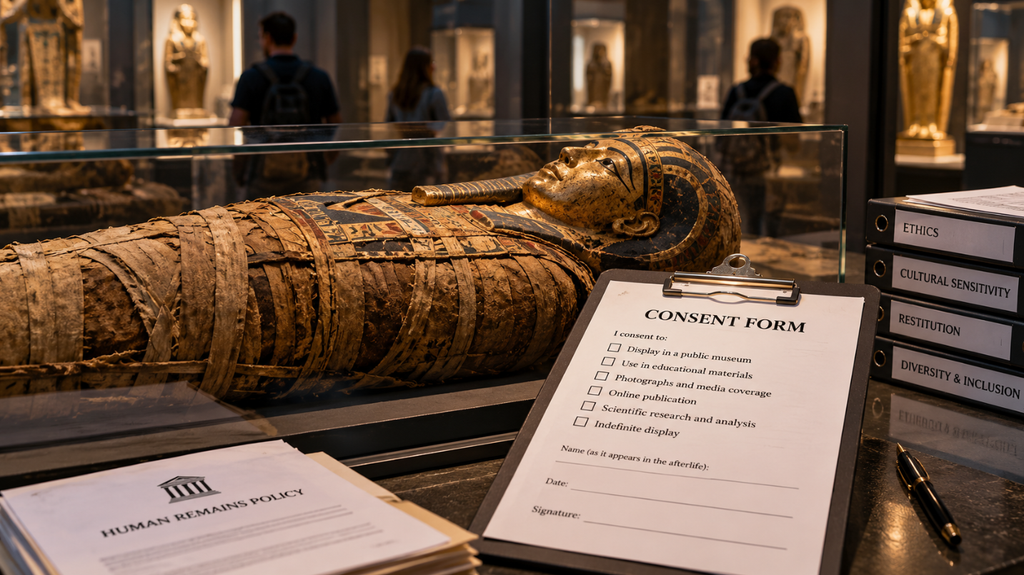
There was a time when museums were accused of hiding the truth. Now they are apparently expected to hide the dead as well.
Museums in Glasgow have removed or concealed certain Egyptian human remains from public display amid concerns about ethics and the absence of documented consent from the deceased. The argument, as reported, is that people who died thousands of years ago should not be exhibited unless there is evidence that they agreed to it.
Quite how one is supposed to obtain informed consent from someone who has been dead for several millennia remains an intriguing administrative challenge. Perhaps the museum should have tried writing to the afterlife. Recorded delivery, naturally. One must have a paper trail.
Imagine the conversation.
“Excuse me, ancient Egyptian citizen. Before we put you in the exhibition, could you just sign this GDPR-compliant consent form, tick the box permitting public viewing, and confirm that you understand the implications of appearing in a twenty-first-century museum?”
No signature? No display. Back into the cupboard you go.
We have reached a curious point in the evolution of modern moral sensibilities when the absence of an answer is treated as though it were an answer in itself. The deceased did not consent, we are told. But they did not refuse either. They were, rather inconveniently, unavailable for comment.
This is not an argument against treating human remains with dignity. Museums should not display people as though they were props in a macabre shop window. The circumstances in which remains were acquired matter. So do the wishes of surviving relatives and communities with genuine cultural connections to them. Collections obtained through exploitation or colonial plunder deserve serious scrutiny.
But none of that establishes that a person who died around the time someone was inventing a wheel should be presumed to have vetoed an exhibition they could never have imagined.
Consent is an important principle. It is not a magic word that resolves every ethical question, regardless of context. It applies most meaningfully when someone has the capacity to make a decision and can understand what is being proposed. Where that is impossible, we must exercise judgement, consider competing interests and explain our reasoning.
Apparently, however, judgement has become unfashionable. It is much easier to invoke an absolute principle, announce that history has failed a contemporary ethical test, and congratulate ourselves for our sensitivity.
The problem with this approach is that the past is not a badly behaved modern citizen who can be summoned before an institutional diversity committee and instructed to update its paperwork.
Ancient Egyptians had their own beliefs about death, burial and the preservation of the body. Their practices were not designed around the assumptions of twenty-first-century Glasgow. We should study those beliefs on their own terms, not pretend that the dead were merely waiting for us to arrive with a revised ethical framework and a clipboard.
And what happens when we apply this principle consistently? Should every ancient skeleton disappear from public view? What about bog bodies, medieval remains, anatomical collections and archaeological discoveries that have transformed our understanding of human history? Must every museum conceal its evidence until somebody produces a signed permission slip from the grave?
Imagine Heritage Malta having to remove Malta’s famous prehistoric “Fat Lady” figurines because nobody can produce a model release signed by the woman who supposedly sat for the sculptor.
No consent form. No documented permission. No proof that she agreed to have her body immortalised in stone. Out goes the figurine. Down comes the display label. Perhaps we should also redact every reference in the history books, just to be safe.
Absurd? Of course it is. These are prehistoric artefacts, not contemporary photographs taken without permission. We do not even know whether the figures depict individual women, idealised bodies, fertility symbols or something else entirely.
And that is precisely the point. Ethical responsibility requires historical understanding and sound judgement, not the mechanical imposition of modern paperwork on people who lived thousands of years ago.
There is a serious argument for displaying human remains responsibly. They tell us about disease, diet, physical labour, social inequality and the realities of human existence. They turn history from a collection of dates and dynasties into something tangible. A well-curated exhibition can explain burial practices, acknowledge the troubling history of archaeological collecting and confront visitors with the humanity of people separated from them by centuries or millennia.
Concealing those remains does not automatically correct historical injustice. Nor does it educate the public about the past. Sometimes it simply removes the uncomfortable object while leaving the uncomfortable questions unanswered.
Of course, a museum may have sound reasons to withdraw particular remains from display. New evidence about their acquisition, a legitimate request for repatriation or the wishes of an identifiable community may justify doing so. The decision should be based on evidence and careful ethical reasoning.
But if the principal argument is that a mummy cannot be exhibited because nobody can produce a consent form signed thousands of years ago, we have wandered beyond sensitivity and into absurdity.
The modern appetite for moral reassurance is understandable. Nobody wants to be accused of insensitivity, and institutions are understandably cautious about appearing disrespectful. Yet a society that treats every possible offence as a reason to conceal something will eventually find itself with very little left to examine.
History is not obliged to satisfy our contemporary sensibilities. Our responsibility is to understand it, scrutinise it and acknowledge its injustices without pretending that concealment is the same as correction.
The dead cannot consent to everything we do with their remains. That places a responsibility on the living to exercise judgement, not to abandon it.
Respect for the dead should guide how we present history. It should not require us to seek a signature from the grave before allowing the living to learn from it.
Sources
STV News – Why have Egyptian mummies at Glasgow’s Kelvingrove Museum been removed from display?
The Scotsman – Talk of consent from mummies is bizarre — but they still shouldn’t be on display
International Council of Museums (ICOM) – ICOM Code of Ethics for Museums
University of Glasgow – The Hunterian Museum