
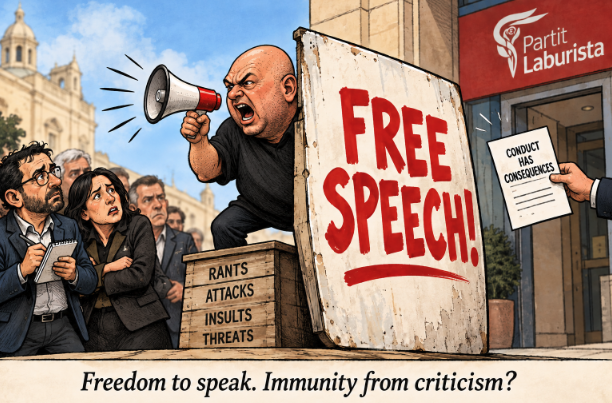
There is a peculiar performance in public life that deserves far less indulgence than it receives: the transformation of the habitual attacker into the aggrieved victim the moment someone pushes back.
Neville Gafà is now claiming that a formal warning from the Labour Party is intended to “intimidate and silence” him. The party has warned that he could lose access to its headquarters and facilities unless he substantially moderates the tone of his public interventions.
The distinction matters. Nobody has announced a ban on his writing or withdrawn his right to express an opinion. The dispute concerns his conduct and his access to party premises.
Yet the language of censorship is being deployed as though a fundamental democratic liberty were under attack.
Freedom of expression is not a privilege granted by political parties. It is a cornerstone of democracy, particularly when it protects people who challenge those in power. But it is not a magic phrase that renders every public intervention beyond criticism, nor does it oblige others to provide a platform, facilities or institutional support to someone whose behaviour they find unacceptable.
Gafà’s public record makes the present complaint particularly difficult to consider in isolation.
In September 2024, Times of Malta reported that Gafà had addressed blogger and author Mark Camilleri in a post referring to where Camilleri lived and suggesting that he would visit him for a chat. PEN Malta expressed concern about what it considered a threat against a writer. The episode raised an obvious question: why should language that can be presented as political bravado by its author be dismissed as harmless when its target has reason to take it seriously?
Then, in June this year, Gafà celebrated the departure of former Office of the Prime Minister official Aaron Zahra with a scathing Facebook post. Zahra subsequently described the insults, attacks and threats directed at him and his family amid the controversy. Gafà’s post was part of the public dispute surrounding Zahra’s departure, although responsibility for individual comments and threats should not be assumed without evidence.
More recently, following Yorgen Fenech’s acquittal, Gafà posted photographs of Daphne Caruana Galizia’s sister and the journalist’s children, accompanied by remarks reported in the press. The conduct prompted renewed criticism of the way Caruana Galizia and her family are treated in political discourse.
These are not trivial matters of tone or disagreements over policy. They raise questions about the line between robust political criticism and the public humiliation of individuals. Political commentary should be capable of being fierce, uncomfortable and even offensive. But personal degradation does not become courageous dissent merely because it is published on Facebook.
This is not an argument for protecting public figures from scrutiny. Quite the opposite. Politicians, journalists, activists and party officials must expect criticism, including criticism they consider unfair. The same principle applies to Gafà. He has every right to challenge the Labour leadership, question its decisions and defend his own position. Others have an equal right to examine his conduct and criticise it without being accused of conspiring to silence him.
Nor should Labour receive a free pass. The party must be transparent about the standards it expects, the authority under which the warning was issued and the procedures available to challenge it. If Gafà’s claim that the warning was improperly issued has substance, it should be examined on its merits. Political organisations cannot credibly preach accountability while treating their own internal rules as optional.
But a procedural dispute is not proof of censorship. And the possibility that a party has acted improperly does not erase the public record of the person challenging it.
There is a difference between being denied the right to speak and being told that one’s conduct has consequences. Confusing the two cheapens the very freedom being invoked. It also insults those who face genuine censorship, intimidation or retaliation for exposing wrongdoing.
Nobody is obliged to admire Gafà’s opinions. Nobody is obliged to host him, endorse him or provide him with facilities. What matters is that any restrictions are properly applied and open to scrutiny.
The right to speak is fundamental. The right to abuse without consequence is not.
And those who make a habit of dishing it out should not be surprised when the public stops confusing aggression with courage – and accountability with persecution.
SOURCES
- Times of Malta — Labour warns Neville Gafà: Moderate your tone or lose access to party HQ
- Times of Malta — Neville Gafa ‘threatens’ Mark Camilleri: PEN Malta sounds warning
- Times of Malta — Ex-OPM aide hits back at ‘vicious’ attacks by PL insiders following resignation
- Times of Malta — ‘Corrupt’ Attorney General needs to go, PN says