
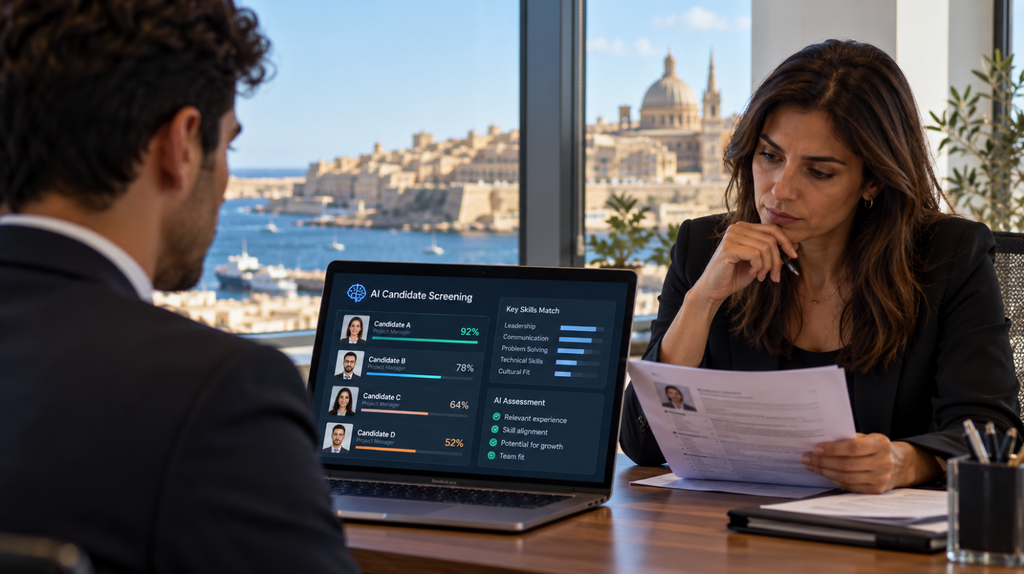
Imagine being rejected for a job, passed over for promotion or dismissed, only to discover that an algorithm helped shape the decision. You ask why. The answer is that a computer system assessed you as unsuitable.
And that is supposed to settle the matter?
Malta is enthusiastically embracing artificial intelligence. Businesses are being encouraged to automate, innovate and invest in digital tools. It is an understandable ambition. But figures published by MaltaToday today raise a question that deserves rather more attention: how far should we allow technology to influence decisions affecting people’s livelihoods?
According to the latest Eurobarometer survey, 15% of Maltese SMEs and mid-cap companies use or plan to use AI in human resources decisions involving recruitment, promotion or dismissal. The EU average is 9%. The figure does not mean that machines are independently hiring and firing people. Human oversight remains the norm, with most businesses using AI to make recommendations rather than take final decisions. Nevertheless, Malta is among the highest adopters in this category.
The distinction between making a decision and influencing one, however, is not always as reassuring as it sounds.
An algorithm does not need the final say to exert considerable influence. A system that ranks applicants, screens CVs or assesses performance can shape the choices presented to a manager. Once a candidate has been labelled unsuitable by software, how many managers will question the reasoning behind that assessment? How many will simply accept the recommendation?
There is nothing inherently wrong with using technology to improve recruitment and management. Properly designed systems can process applications more efficiently, identify relevant skills and help reduce arbitrary human decisions. They can also free managers to concentrate on the human aspects of their responsibilities.
But technology is not synonymous with objectivity.
AI systems learn from data. If that data reflects historical preferences, institutional habits or existing inequalities, the technology can reproduce them at scale. A system may appear neutral while quietly favouring certain profiles, career histories or patterns of behaviour. The danger is not necessarily a machine making an obviously discriminatory decision. It is a flawed recommendation acquiring the authority of scientific objectivity simply because it came from a computer.
There is also a wider issue beyond recruitment. A new Eurofound report, published this week, examines the use of algorithms to allocate tasks, determine working hours and monitor employee performance. Drawing on European workplace data, it finds that algorithmic management is associated with higher job demands and greater job strain. Performance monitoring is particularly associated with poorer wellbeing outcomes, including exhaustion and work–family conflict.
These findings do not mean that every digital management tool is harmful. They do, however, challenge the assumption that greater automation automatically produces better working conditions.
The European Union has recognised the risks. Under the AI Act, certain systems used in recruitment, worker management and employment decisions are classified as high-risk. The relevant obligations are scheduled to apply from December 2027, following the revised implementation timetable. They include requirements concerning risk assessment, data quality, traceability and human oversight.
Malta should not wait until then to take the issue seriously.
Employers need clear guidance on responsible use. Candidates and employees should know when AI materially influences decisions affecting them. They should be able to understand the basis of an assessment and challenge an outcome. Above all, there must be a real person prepared to take responsibility for the decision.
This need not become another exercise in bureaucratic box-ticking. Smaller businesses should be able to benefit from technology without having to navigate an unnecessarily complicated compliance regime. But the convenience of automation cannot become an excuse for avoiding responsibility.
Malta wants to become an AI-friendly country. Fine. But being friendly to technology should not mean being indifferent to the people affected by it.
An algorithm can rank candidates, identify patterns and make recommendations. It can help a business become more productive and competitive. But when someone’s livelihood is at stake, responsibility must remain firmly human.
A computer can make a recommendation. It cannot be allowed to become an excuse.
Sources
1. MaltaToday – Maltese firms use AI in hiring, firing and promotion decisions.
2. Eurofound – Algorithmic management in European workplaces.
3. European Commission – AI Act – regulatory framework and implementation.
4. European Union – Regulation (EU) 2024/1689 – Artificial Intelligence Act.
5. European Commission – Eurobarometer survey highlights growing use of AI in European companies.