
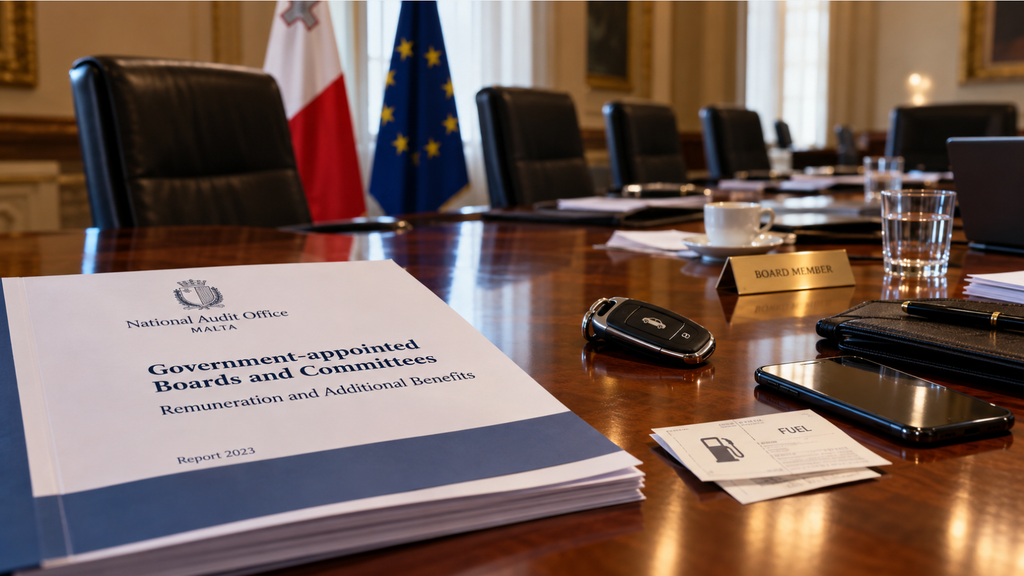
The National Audit Office has found that more than €580,000 in additional allowances and benefits were paid to members of government-appointed boards despite not being provided for under the applicable remuneration framework. It has also identified cases in which board members received fixed annual payments despite their boards holding no formal meetings during 2023.
The findings deserve more than a shrug and another promise that procedures have since been improved.
The report covers 462 government-appointed bodies across 19 ministries. In 2023, government spent approximately €9.05 million remunerating members of 361 categorised boards and committees. The additional benefits included car and fuel allowances, health insurance, communications allowances and mobile expenses. Incomplete information supplied by ministries means the €580,000 figure could be higher.
Let us be clear about what this does not mean. Not every person appointed to a public board is there as a political favour. Not every board member who receives remuneration has done nothing. Serious public bodies need expertise, and much of their work may take place outside formal meetings.
But that is precisely why clear rules matter.
Public appointments should be made on transparent criteria. Responsibilities should be defined. Remuneration should be proportionate to the work involved and authorised under a framework that can be independently checked. When benefits are paid outside that framework, or records are too incomplete to establish whether payments were justified, the burden is on the authorities to explain what happened.
The NAO has called for ministries to ensure that remuneration is supported by verifiable records and that payments are not made in years when boards and committees do not convene. It has also urged tighter controls over additional benefits.
The government says it has already revised the framework governing appointments and remuneration. That is welcome. But revising a manual is the beginning of accountability, not its conclusion.
What happened to the money already paid? Were the payments lawful under any other approval or arrangement? Have any sums been recovered? Which ministries failed to supply complete information? And what assurance can the public have that the new rules are being followed?
These are not unreasonable questions. They are the minimum expected when public money is involved.
There is a danger in treating every governance failure as evidence of corruption. The NAO’s findings do not establish that every recipient acted improperly, and the report does not identify all the individuals or boards involved in the cases of payment without meetings. We should not invent conclusions the evidence does not support.
But neither should we ignore the conditions that allow public confidence to erode: opaque arrangements, incomplete records, weak oversight and benefits that cannot be adequately justified.
Political parties are entitled to appoint people they trust, provided those appointments comply with the law and the people selected are suitable for the roles. What they are not entitled to do is treat public institutions as extensions of their own organisations, where the rules are flexible and accountability is somebody else’s problem.
A public board is not a private club. Its members are entrusted with responsibilities that exist for the benefit of citizens, not the convenience of those who appoint them.
With Budget 2027 approaching, ministers will speak about investment, benefits, tax measures and the responsible management of public finances. They should also explain how they intend to ensure that every euro spent through the machinery of government is properly authorised, justified and accounted for.
Fiscal responsibility begins not with what government promises to spend, but with its willingness to account for what it has already spent.
Sources