
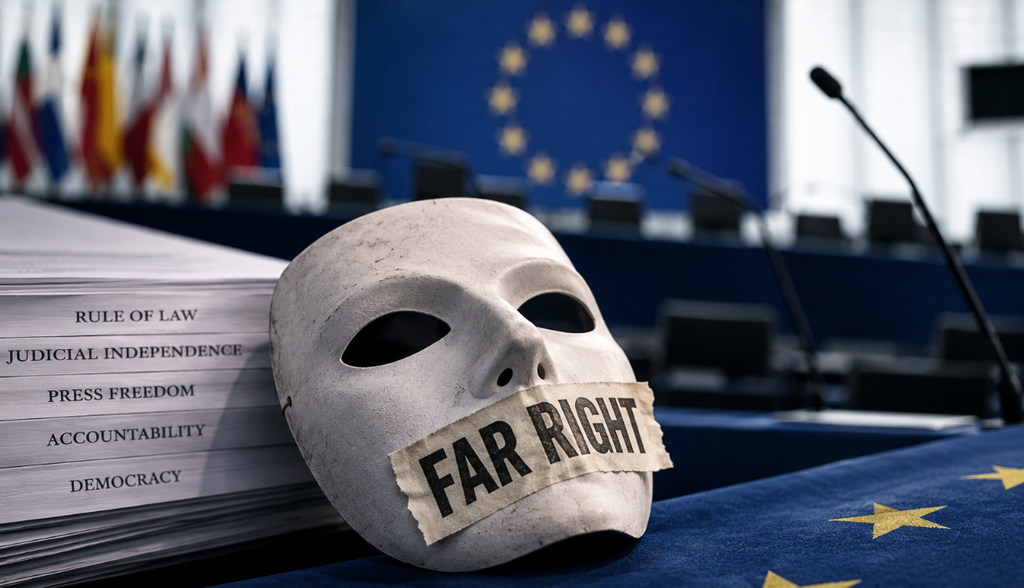
There is something deeply unsatisfactory about the way the term far right is increasingly deployed in political debate: not always to describe a clearly identifiable ideology, but to discredit those asking uncomfortable questions.
The latest debate on Malta’s rule of law in the European Parliament offered another example. Swedish Social Democrat MEP Evin Incir accused the European People’s Party and the far right of exploiting Daphne Caruana Galizia’s murder for political gain. She also pointed to progress Malta had made in protecting journalists and securing convictions in connection with the assassination.
These are arguments that deserve to be examined on their merits. But so do the arguments of those who remain concerned about Malta’s institutions, the independence of its judiciary and the continuing questions surrounding accountability at the highest levels of public life.
Progress and scrutiny are not mutually exclusive. Convictions in Daphne’s murder case were important. They do not, in themselves, settle every question about the rule of law, nor do they make criticism of the government illegitimate. A democracy that accepts praise for its achievements must also tolerate scrutiny of its failures.
The context has now acquired another dimension. The Maltese Herald has reported that Incir is in a relationship with Maltese Labour MEP Daniel Attard, a prominent defender of former prime minister Joseph Muscat and a frequent critic of journalists and institutions that have challenged Labour’s political establishment.
If that report is accurate, it is a legitimate matter of public interest to ask whether the connection is relevant to the political positions being taken. It does not prove that Incir’s arguments were influenced by her relationship, and it would be wrong to pretend otherwise. But neither should questions about political proximity be dismissed simply because they are uncomfortable.
The test must be consistent. If political connections are relevant when assessing the judgement and independence of one public figure, they cannot become irrelevant when the person concerned belongs to our preferred political camp.
More importantly, the substance of the European Parliament debate should not be obscured by arguments about who is friends with whom, who is dating whom, or which party can attach the most damaging label to its opponents. The real questions remain straightforward: Are Malta’s institutions sufficiently independent? Are allegations of wrongdoing investigated impartially? Can journalists and government critics do their work without intimidation? Are those who wield political power held to the same standards as everyone else?
These questions cannot be answered by calling critics far right. Nor can they be answered by accusing every Labour politician of authoritarianism. Both are shortcuts that substitute political branding for serious argument.
There is also an irony in invoking the far right as a warning against political opponents while appearing unwilling to engage fully with concerns about democratic accountability at home. Defending the rule of law is not the property of the EPP, the Socialists or any other political family. It is a standard that should bind them all.
Daphne Caruana Galizia’s murder must never become a partisan instrument. But neither should her name be invoked to suggest that continued scrutiny is somehow disrespectful to Malta or an attack on its people.
The country is not its government. Criticism of those in power is not hostility towards Malta. And the demand for accountability is not extremism.
If European politicians want to be taken seriously when they defend democracy, they must do more than condemn the political opportunism of their opponents. They must demonstrate that the same principles apply to their allies, their colleagues and, where relevant, themselves.
Otherwise, the accusation of far right risks becoming precisely what it should never be: a political shield against legitimate questions.
Sources
1. The Maltese Herald – reported relationship between Evin Incir and Daniel Attard
2. Times of Malta – Swedish MEP criticises EPP over Malta rule-of-law debate
3. The Malta Independent – Maltese MEPs clash over Malta’s rule of law
4. MaltaToday – MEPs trade arguments during the European Parliament debate