
There is a difference between informing the public and alarming it. Public institutions should understand that difference, particularly when communicating about an emergency involving the country’s principal public hospital.
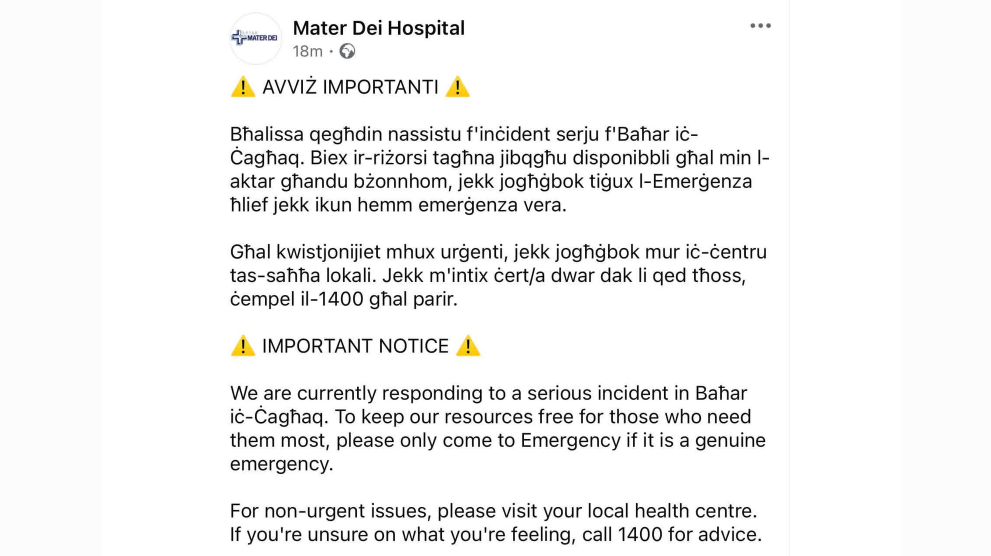
On Sunday, Mater Dei Hospital published an urgent notice announcing that it was responding to a “serious incident” in Baħar iċ-Ċagħaq. The public was asked to attend the Emergency Department only in cases of genuine emergency, while anyone with non-urgent medical concerns was directed towards their local health centre or advised to call 1400.
The wording was striking. It spoke of keeping resources available for those who needed them most and gave the impression that the hospital was dealing with an exceptional situation requiring the public’s cooperation.
The incident was indeed tragic. A boat had struck the reef at Is-Sikka s-Safra, leaving three people unconscious when rescuers reached them. One man subsequently died, while another man and a 14-year-old boy were reported to be in critical condition. Our thoughts should be with the families involved, and recognition is due to the emergency services and medical teams who responded.
But the seriousness of the accident does not mean that the hospital’s public communication should be beyond scrutiny.
What exactly was the public supposed to understand from the announcement? Was the Emergency Department temporarily overwhelmed? Were specific resources being diverted to deal with the incoming casualties? Was the public being asked to avoid attending because of a temporary operational constraint, or was this simply a precautionary request?
The notice did not say.
Instead, it used the language of a major emergency without providing even the most basic context. There was no indication of the scale of the incident, the nature of the operational pressure or why the public needed to be alerted in such emphatic terms.
Of course, hospitals do not need to disclose confidential medical information or provide a running commentary while emergency teams are dealing with a developing incident. Nor should they be expected to compromise an operation to satisfy public curiosity.
But there is a considerable difference between protecting sensitive information and communicating without sufficient clarity.
A public notice should tell people what they need to know, what action they are expected to take and, where possible, why that action is necessary. If the Emergency Department is under exceptional pressure, say so. If resources are being diverted to deal with a major incident, explain that clearly.
The public is perfectly capable of understanding the difference.
There is also a wider issue. Social media has become the preferred communication channel for public institutions. It is immediate and reaches large audiences, but immediacy should not come at the expense of precision. Flashing warning symbols, capitalised headings and dramatic language may attract attention. They do not necessarily provide understanding.
We should also be careful not to normalise the idea that hospital resources are available only for those who can somehow establish that their condition is sufficiently serious. People experiencing symptoms may not know whether they are facing a genuine emergency. That is precisely why clear guidance and accessible medical advice matter.
Mater Dei was right to remind the public that Emergency Departments should not be used for non-urgent complaints. That message is important in a health system under pressure. But it should be communicated consistently, rather than appearing as an exceptional warning whenever a serious incident occurs.
Public confidence depends on institutions being both competent and credible. That credibility is built not only through the services they provide, but also through the way they communicate with the people they serve.
When a national hospital issues an urgent warning, people should understand what is happening and what they are being asked to do. They should not be left wondering whether the country is facing a hospital emergency or whether a particular incident requires a temporary adjustment in the use of resources.
In public communication, clarity is not a luxury. It is part of the service.
The public deserves to be informed, not simply alerted.
Sources
Times of Malta – One dead, two critical after boat collides with reef off Baħar iċ-Ċagħaq
MaltaToday – Boat strikes reef, leaving one dead and two, including 14-year-old boy, in critical state
The Malta Independent – One dead, two critical after boat crashes into reef near Baħar iċ-Ċagħaq