
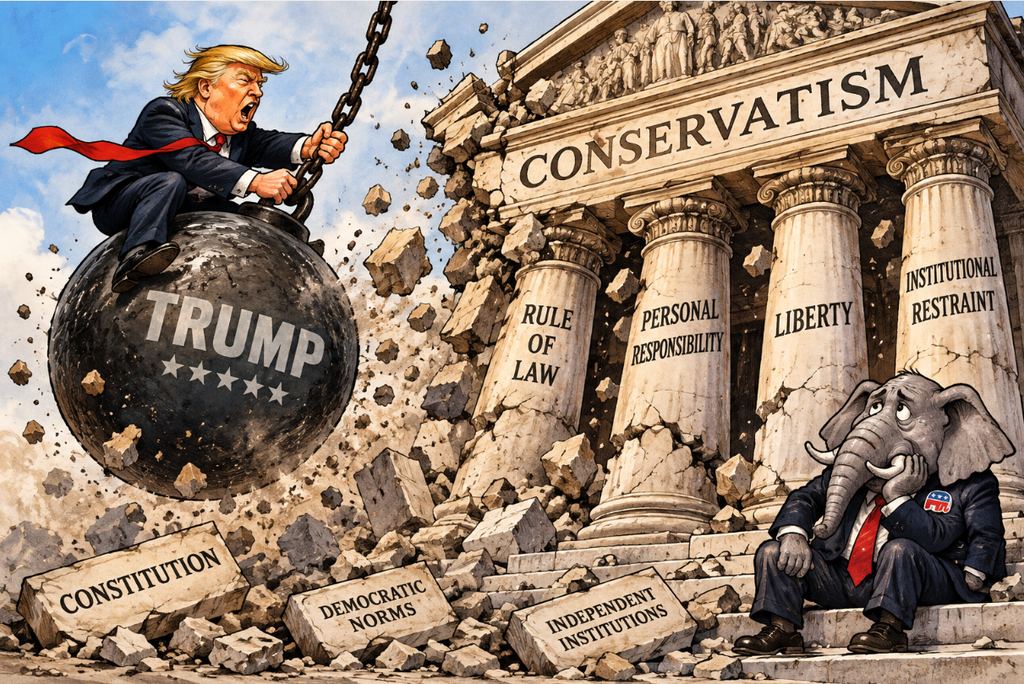
Donald Trump has done incalculable damage to moderate right-wing politics. By turning conservatism into a vehicle for personal grievance, political intimidation and contempt for democratic conventions, he has betrayed many of the principles the traditional right once claimed to defend.
“What’s wrong with you? Are you a sick person? I actually think there’s something wrong with you.”
That was Donald Trump addressing Andrew Feinberg, a journalist from The Independent, during an exchange in the Oval Office on 20 October. Feinberg was attempting to question the US President. Trump’s response was to interrupt him, question his health and suggest that something was wrong with him. The hostility did not end there: Vice-President JD Vance subsequently joined in the public disparagement of the journalist.
This is not merely a question of manners. Nor is it simply another episode in the never-ending spectacle of Trump’s presidency. It illustrates a deeper degradation of political culture: the idea that those who question the powerful are not citizens exercising a democratic right, but enemies who must be humiliated, threatened or discredited.
And for those of us who believe in a moderate, democratic and intellectually serious right, the damage is immense.
Conservatism has a proud intellectual tradition. It values personal responsibility, the rule of law, institutional continuity, limited government, enterprise, individual liberty and the recognition that power must be restrained. It understands that institutions matter precisely because no individual, however popular or powerful, should stand above them.
Trump’s politics repeatedly invert those principles. Loyalty to the man takes precedence over loyalty to institutions. Personal grievance becomes political doctrine. Criticism is treated as betrayal. The press is an enemy, judges are legitimate only when they deliver favourable outcomes, and political opponents are routinely portrayed not merely as wrong but as wicked, stupid or un-American.
This is not strength. It is the politics of insecurity dressed up as strength.
The consequences extend well beyond the United States. Trump has given opponents of conservatism an extraordinarily convenient caricature of the entire right: angry, intolerant, conspiratorial and contemptuous of democratic restraints. Every insult becomes another exhibit; every attack on an independent institution another opportunity to portray conservative politics as inherently authoritarian.
Moderate conservatives are left with an unenviable choice. They can defend behaviour they would once have condemned, remain silent to avoid alienating their own political camp, or speak out and risk being denounced as traitors by people who have confused a political movement with one man.
The irony is that Trump’s self-proclaimed defenders of traditional values often display remarkably little respect for the traditions that make constitutional democracy possible. Decency is dismissed as weakness. Restraint is mocked as cowardice. Expertise is ridiculed, compromise is branded surrender, and the most abrasive voice in the room is mistaken for the most courageous.
There is nothing inherently conservative about any of this.
Of course, the traditional right has its own failures and cannot escape responsibility for the conditions that enabled Trump’s rise. Economic insecurity, distrust of political elites, uncontrolled migration and the sense that established parties had stopped listening to ordinary people were not imaginary grievances. They deserved serious answers. But exploiting those concerns through resentment and personal domination is not the same as resolving them.
Trump understood the anger. He turned it into a political asset. Whether he has strengthened the conservative cause is another question entirely.
A serious conservative movement should be capable of defending secure borders without dehumanising migrants, promoting law and order without undermining judicial independence, supporting national sovereignty without treating international cooperation as treason, and challenging journalists without attempting to intimidate them.
Above all, it should understand that the character of a leader matters. Not because politicians must be saints, but because a person who cannot tolerate scrutiny is unlikely to respect the limits on their own power.
The right does not need to imitate the left, apologise for its principles or abandon legitimate conservative concerns. It needs to recover its confidence in those principles and rediscover the courage to apply them to its own side.
Trump may continue to command the loyalty of millions. But popularity is not proof of wisdom, and electoral victory is not a licence to degrade public life.
The tragedy is that a political movement with a rich tradition of responsibility, liberty and institutional restraint has allowed itself to be overshadowed by a man who treats public office as an extension of his own ego.
The damage is not simply that Trump has made conservatism less attractive. It is that he has made it harder to explain what conservatism is supposed to stand for.
And until the moderate right is prepared to say, clearly and without qualification, that this is not what we believe in, Trump’s greatest political victory may be the damage he leaves behind in his own camp.
Sources
AL.com – Trump snarls, shushes and snaps at reporters, 20 October 2026
CNN – Transcript of the 20 October 2026 Oval Office exchange
Carnegie Endowment – The Effects of US Democratic Backsliding on US Power