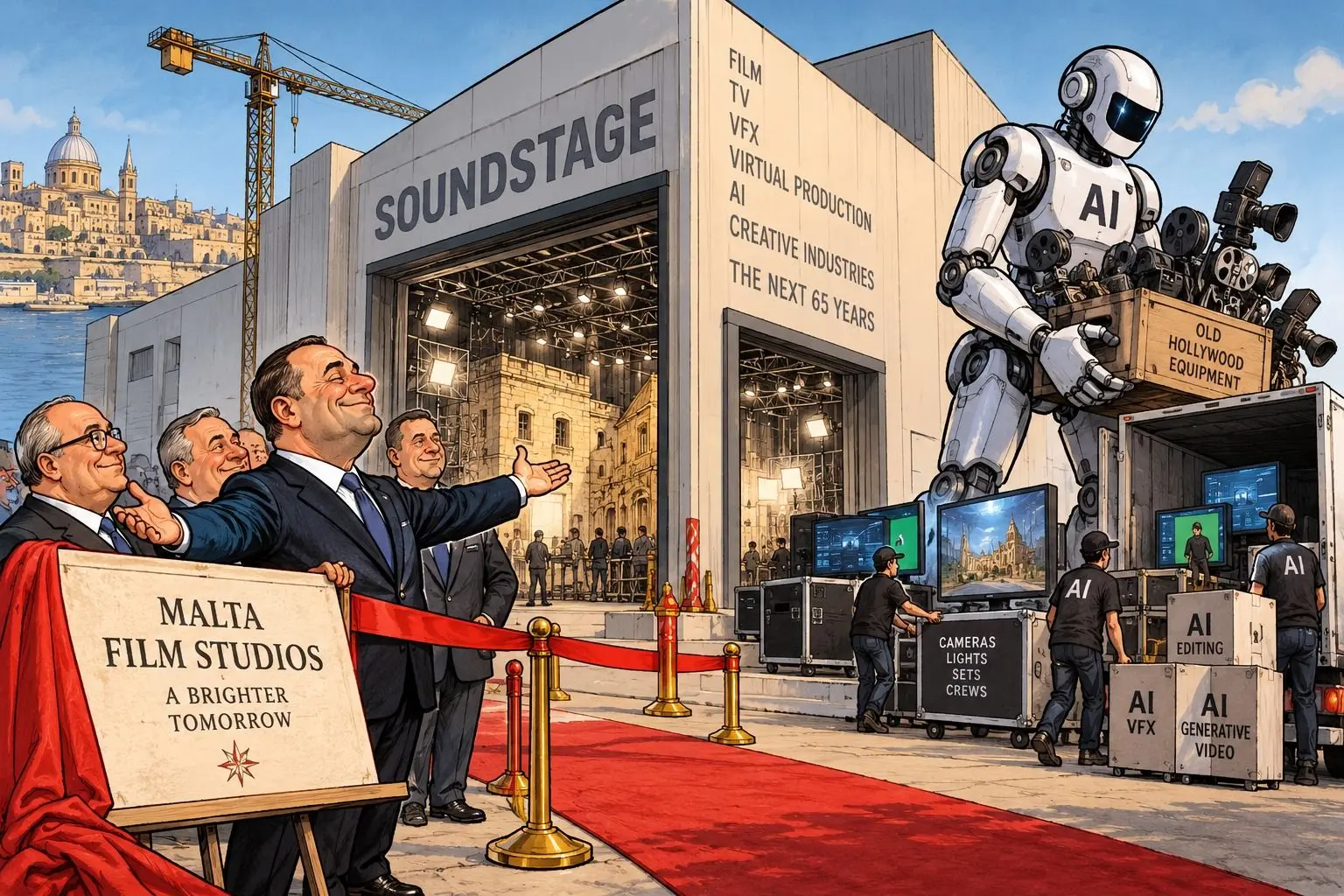
There is something slightly odd about building a film studio for the next 65 years at precisely the moment when we are no longer quite sure what a film studio is.
The Malta Film Commission has put out a tender for the redevelopment of the Malta Film Studios in Kalkara. It is a serious proposition: some 92,400 square metres, a deep-water tank, a proposed “Land-Sea Super Stage”, production facilities and all the infrastructure that goes with them. And, to be fair, there is much to welcome here.
The project is being offered as a private concession rather than another government-funded construction project. The private operator is expected to finance, build and operate the facility. If private investors are prepared to put their own money behind the proposition, that is a considerably more sensible starting point than the State simply writing another cheque.
But there is a rather obvious question which seems to have been lost somewhere between the tender documents and the inevitable photographs of politicians standing beside artists’ impressions.
Are we building tomorrow’s film studio… or yesterday’s? Because the film industry is changing. And it is changing fast.
Artificial intelligence is already eating its way through the production process. Visual effects are becoming increasingly sophisticated. Virtual production is changing the relationship between the physical and digital worlds. Real-time engines, digital doubles, volumetric capture, synthetic environments and AI-assisted workflows are making it possible to create things which, not very long ago, required enormous physical resources.
None of this means that soundstages are going to disappear. They won’t.
Actors will still need to stand somewhere. Directors will still need controlled environments. Some productions will still need enormous sets, water tanks and the sort of physical infrastructure that Malta can do particularly well.
But that is precisely the point. Some will.
The danger is not that Malta builds a studio nobody uses. The private sector would probably not finance that. The more subtle danger is that we build a very good facility for the industry as it exists today, only to discover 10 or 15 years from now that the most interesting part of the industry has moved somewhere else.
And that is a rather more difficult problem to fix.
A building has a nasty habit of becoming obsolete more slowly than technology does. The tender is for a 65-year concession. 65 years!
Think about what the world looked like 65 years ago. Malta was still a British colony. There was no internet, no digital cinema, no computer-generated imagery, no streaming and certainly no generative AI. The idea that we could have predicted today’s film industry from the technology of 1961 would have been laughable.
So how confident are we that today’s assumptions will still make sense in 2091? This is not an argument against the project. Quite the opposite. It is an argument for making it much more ambitious.
If Malta is going to build new film infrastructure, why limit our imagination to film? Why not build for content production?
Film and television, certainly. But also virtual production, animation, gaming, immersive entertainment, volumetric capture, digital environments and whatever comes next.
Malta already has pieces of that ecosystem. What it lacks is the ambition to stop thinking of them as separate industries. That is where the real opportunity lies.
The State’s role should not be to guess what the next successful film will look like. Nor should it be to build monuments to the last successful one.
Its role is to create the conditions in which private enterprise, technology and creative talent can adapt as the market changes.
And here, interestingly, the private-concession model may be the best part of the whole proposition. Let the investor carry the commercial risk. Let the operator work out what producers will actually pay for. Let competition and technology determine how the facility evolves.
But public land is still being committed for 65 years.
So the public has every right to ask whether the people designing this project are thinking in terms of a building or an ecosystem.
Because concrete lasts. Business models don’t… and technology certainly doesn’t.
Malta has spent years trying to establish itself as a place where other people’s films get made.
Perhaps the next step is to stop asking what the film industry needs from Malta today – and start asking what the creative industries of tomorrow will need Malta to become.
Otherwise, we may find ourselves with a magnificent new film studio… and a very old idea of what it is for.