
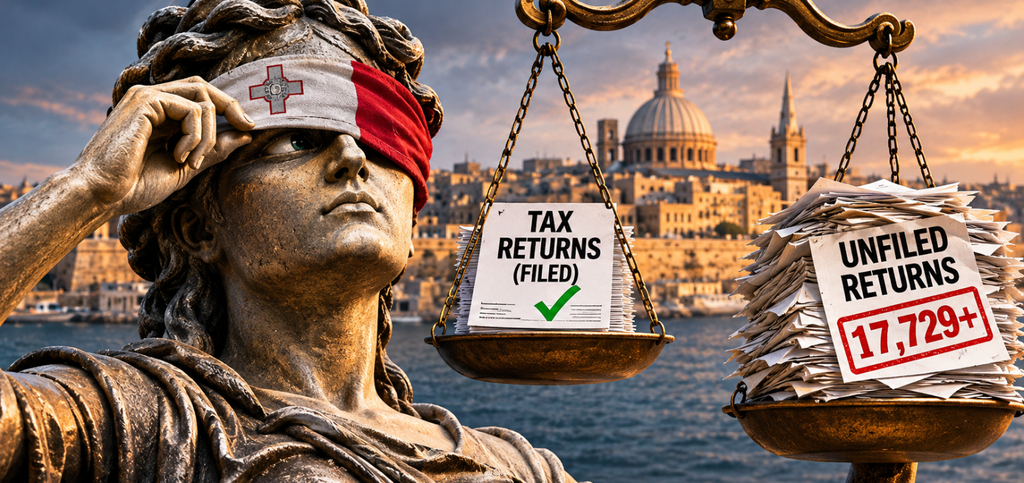
There is something fundamentally unfair about a tax system in which the compliant taxpayer is easy to find, but the persistent non-filer can remain in the system’s blind spot for years.
A performance audit published by the National Audit Office this week makes for uncomfortable reading. According to the report, fewer than half of Malta’s corporate income tax returns were filed on time in 2025. Of the 44,243 returns issued to companies, just under 48% were submitted by the deadline. By July this year, 17,729 remained unfiled.
Personal income tax compliance was better, but still below international benchmarks. More than 11% of returns issued to individuals in 2025 remained outstanding.
These are not isolated administrative oversights. The Auditor General identified 260,124 outstanding personal income tax returns and 74,741 corporate returns covering the period between 1999 and 2025. Thousands of individuals and companies have accumulated five or more outstanding returns.
To put this into perspective, income tax generated approximately €3.4 billion in 2025, accounting for 51% of government tax revenue.
The problem is not simply that returns are missing. It is that the administration appears to have struggled for years to establish an effective mechanism for ensuring that taxpayers fulfil one of their most basic legal obligations.
The NAO identified outdated taxpayer records, fragmented databases, insufficient resources and weaknesses in the existing penalty system. In some circumstances, penalties only become payable once an outstanding return is submitted or an assessment is issued. In other words, the longer a taxpayer remains non-compliant, the longer the consequences can be deferred.
This is hardly an effective deterrent.
To be fair, the report does acknowledge improvements. Personal filing rates have increased since 2023, and the Malta Tax and Customs Administration is undergoing a significant digital and organisational transformation. Some companies have also encountered difficulties securing auditors to prepare their financial statements, which are required for corporate tax returns.
Nor should every outstanding return be treated as evidence of tax evasion. A missing declaration does not automatically mean that tax is owed, let alone that fraud has taken place.
But none of this changes the underlying principle.
A functioning tax system depends on voluntary compliance, supported by credible enforcement. People and businesses must know that the rules apply equally, that obligations are taken seriously and that those who deliberately disregard them cannot simply wait for the problem to disappear.
There is also a question of fairness towards those who do comply. Employees have tax deducted directly from their salaries. Responsible businesses meet their reporting obligations, maintain their accounts and pay what is due. They have every right to expect that competitors and other taxpayers are held to the same standards.
This is not an argument for an indiscriminate crackdown. Enforcement must be proportionate, transparent and based on reliable information. Indeed, the NAO also highlighted the need for better quality assurance in tax audits, noting that a significant proportion of formal objections resulted in revised assessments. The authority must be capable of getting things right as well as enforcing the law.
But a state that struggles to enforce its own rules eventually undermines the credibility of those rules.
We hear much about fiscal responsibility, economic sustainability and the need to ensure that public expenditure remains affordable. These are important considerations, particularly in a country where government has become increasingly involved in subsidising everyday costs.
Yet fiscal responsibility is not only about controlling expenditure or finding new sources of revenue. It is also about ensuring that existing obligations are properly discharged.
The government cannot continually look towards compliant taxpayers to finance its ambitions while allowing a substantial backlog of unfiled returns to accumulate.
Taxation is a civic obligation. It is also a social contract. Citizens contribute because they expect the system to operate fairly, and because they understand that public services must be financed collectively.
That contract becomes harder to defend when compliance appears optional.
Before asking who else should pay more, perhaps the state should demonstrate that it is capable of ensuring that everyone already obliged to pay, or at least to declare their income, plays by the same rules.
A fair tax system does not begin with how much the state takes. It begins with whether the rules apply equally to everyone.
Sources