
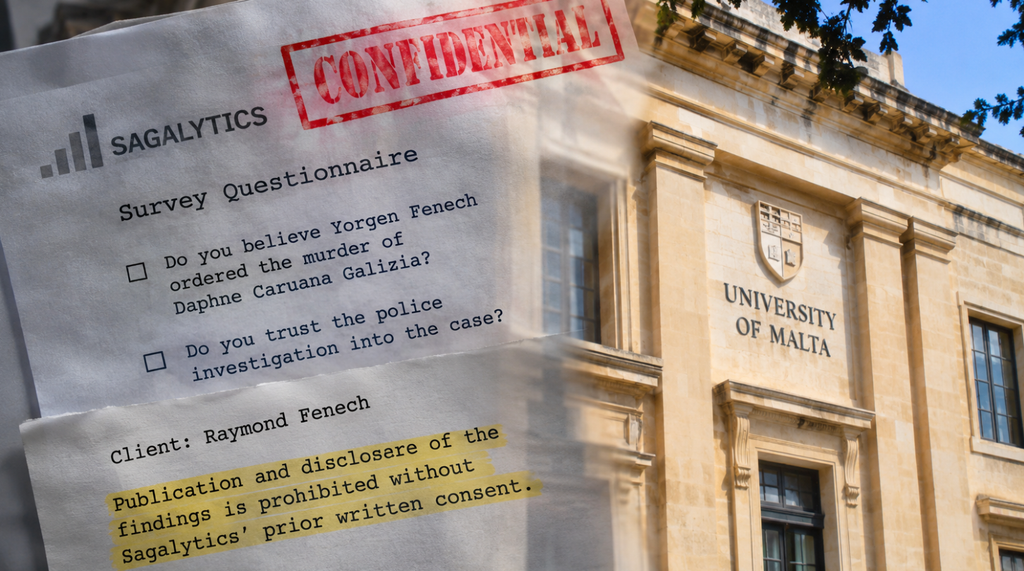
There are moments when an institution’s explanation raises almost as many questions as the incident it is supposed to resolve. The University of Malta’s decision to dismiss the ethics complaint concerning Professor Vince Marmarà is one of them.
The controversy centres on surveys commissioned by businessman Raymond Fenech, uncle of Yorgen Fenech, and conducted by Sagalytics, the polling company of which Marmarà is sole director and shareholder.
Three surveys were commissioned, in 2021, 2023 and June 2026. The last was conducted weeks before Yorgen Fenech’s trial for complicity in the assassination of Daphne Caruana Galizia, after the list of prospective jurors had been published.
The questionnaire was hardly an innocuous exercise in consumer preferences. Respondents were asked whether they believed Fenech had ordered the murder, whether they trusted the police investigation, what they thought of Daphne Caruana Galizia and whether they considered themselves sufficiently objective to decide Fenech’s case.
The contractual arrangements raise further questions. Pollsters were instructed to introduce themselves as representatives of a Malta-based polling company working for an independent client. Neither the identity of Sagalytics nor that of the person commissioning the research was to be disclosed. A separate confidentiality clause prohibited publication or disclosure of the findings without Sagalytics’ prior written consent.
There may be legitimate reasons for protecting the confidentiality of commissioned research. But when the subject is a pending murder trial, the questions concern public confidence in the courts and the identity of the client is deliberately concealed, the need for transparency becomes considerably more pressing.
The survey was brought to the attention of the trial judge. She rebuked the defence for failing to disclose that the exercise had taken place, found no grounds for criminal action and instructed that its findings were not to be used. Marmarà denied targeting prospective jurors, maintaining that the sample was randomly selected. The defence has also said that none of the jurors admitted participating in the survey.
These qualifications matter. There has been no finding that the jury was manipulated, that the survey was illegal or that the eventual verdict was influenced by it. The acquittal must be respected, subject to the appeal lodged by the Attorney General.
But the University controversy is a separate matter.
The complaint against Marmarà was dismissed by retired judge Geoffrey Valenzia on the basis that the research had been undertaken by Sagalytics, a separate legal entity, rather than by Marmarà personally. The decision also concluded that university ethics clearance applied to academic research, not private commercial work.
That reasoning raises a fundamental question about the relationship between corporate identity and individual professional responsibility.
Of course a limited liability company has a separate legal personality. That principle exists for good reason. But Marmarà is not merely an employee of a company whose ownership and management are beyond his control. He is its sole director and shareholder. The company acts through people, and in this case the person at its centre is the very academic whose conduct prompted the complaint.
The question is not whether every commercial activity undertaken by a university lecturer should require prior approval. That would be absurd. Academics must be free to engage in private enterprise and professional work outside their university appointments.
The question is whether an academic’s professional and ethical obligations simply stop applying when the work is undertaken through a company he wholly owns and controls.
Matthew Caruana Galizia has challenged precisely this distinction, arguing that the corporate veil cannot provide cover for ethical violations. His intervention deserves consideration as a question of principle, irrespective of the language used in the public exchange.
The University’s decision may have resolved the narrow question of whether its research ethics approval was required. It has not necessarily resolved the wider question of whether the conduct was compatible with the standards expected of members of its academic community.
Nor can the matter be divorced from the wider public-interest context. The Shift has separately reported that Marmarà and Sagalytics featured in 12 government direct orders worth €145,300 during the first ten months of 2026. Those awards do not establish wrongdoing, and their procurement routes and deliverables must be assessed individually. But they make transparency and public accountability all the more important.
A university is not simply a collection of lecture theatres and academic titles. It is an institution that claims to uphold standards of intellectual honesty, professional integrity and ethical conduct. Its credibility depends not only on what it teaches, but on the consistency with which it applies those principles.
A legal distinction may settle a question of corporate identity. It cannot, on its own, settle every question of professional ethics.
And when an institution is asked to examine the conduct of one of its own, the public is entitled to expect more than a technical explanation. It is entitled to understand the principles being applied, the limits of the institution’s jurisdiction and why those limits are considered sufficient.
The University should publish a fuller explanation of the ethical framework it applied and clarify whether its code of conduct can ever extend to an academic’s private professional activities when those activities raise questions about the University’s reputation.
The issue is not whether academics should be allowed to do business. It is whether professional responsibility can be separated from personal conduct simply by putting a company between the two.
That is a question the University should be prepared to answer.
Sources
Times of Malta – Matthew Caruana Galizia slams ‘brain-dead’ ruling on Marmarà ethics case
Times of Malta – Momentum says questions remain about Yorgen Fenech trial survey
Times of Malta – University dismisses ethics complaint against Marmarà over Yorgen Fenech survey
Times of Malta – Momentum publishes survey Ray Fenech commissioned to ask about Daphne and Yorgen
MaltaToday – The 22 questions asked in survey commissioned by Yorgen Fenech’s uncle
The Shift News – €145,300, 12 direct orders for Marmara despite repeated polling misses
Times of Malta – Survey held on eve of Yorgen Fenech trial was questioned by judge