There is something uncomfortable about €400 million becoming the new normal.
Finance Minister Clyde Caruana says Malta will continue subsidising energy prices, with the bill expected to hit around €400 million this year and again next year. Over the past five years, the government says it has spent €1.35 billion on energy subsidies.
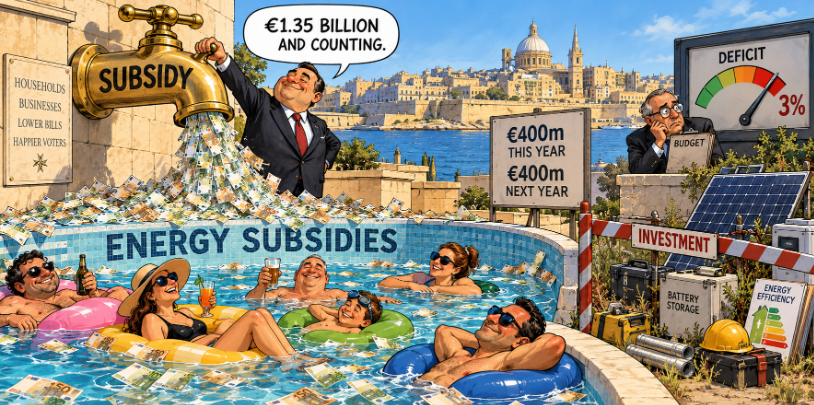
The original justification was understandable. When energy prices exploded, protecting households and businesses from a sudden shock made sense.
But emergency measures have a habit of becoming permanent.
At some point, we have to ask a rather simple question: what exactly are we buying with all this money?
Cheaper energy today, certainly. But are we buying greater energy security tomorrow?
The European Commission has warned that fossil-fuel subsidies can discourage investment in renewables, energy efficiency and electrification, while creating fiscal risks. The Malta Chamber has gone further, arguing that a modest increase in fuel prices in 2022 could have saved around €100 million — money that could instead have gone into solar and energy infrastructure.
That is the uncomfortable trade-off.
Every euro spent keeping consumption artificially cheap is a euro that cannot be spent making us less dependent on expensive energy in the first place.
This does not mean abandoning people to the market. It means being more intelligent about who we subsidise and why.
Help those who genuinely need help. Protect vulnerable households. Support businesses where competitiveness is genuinely at stake.
But stop pretending that a universal subsidy is an energy policy.
Malta cannot permanently make energy cheaper by sending the bill to taxpayers. The world does not become cheaper because government absorbs the difference.
And there is another problem. Once people get used to a subsidy, removing it becomes politically toxic. What begins as emergency relief quietly becomes an entitlement. Eventually, every government finds itself defending yesterday’s temporary measure as though it were a constitutional right.
That is how fiscal policy gets trapped.
Government is also planning to invest €75 million in Enemalta’s distribution network. Good. But when we are spending roughly €400 million a year subsidising energy, we should be asking whether enough of that money is being redirected towards the things that could eventually make subsidies unnecessary: renewables, storage, efficiency and a stronger grid.
The subsidy State cannot last forever.
The question is not whether Malta should have protected people from an extraordinary energy shock. It should have.
The question is whether, €1.35 billion later, we have made ourselves less vulnerable to the next one.
Because if we haven’t, then we haven’t solved the problem.
We’ve simply paid the bill.