
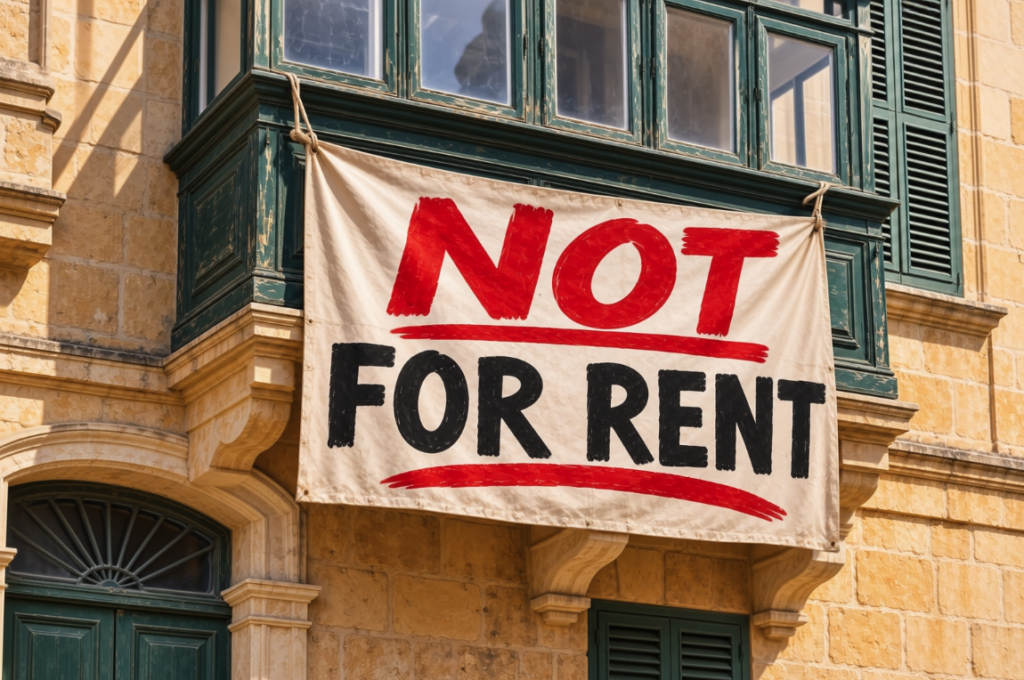
The State has just been ordered to pay €135,067 to a property owner because legislation designed to protect tenants had imposed a disproportionate burden on his property rights. The money will not come from the politicians who designed the system, nor from those who kept it in place for decades. It will come from the public purse.
That is the most revealing part of this judgment.
The case concerns a commercial property at 29, Timber Wharf, Marsa, which had been subject to a protected lease since 1952. When proceedings were instituted in 2021, the annual rent was approximately €135. A court-appointed expert valued the property at €300,000 and estimated that it could command an annual market rent of €15,000.
Let that sink in. A property worth €300,000 was generating €135 a year.
The First Hall of the Civil Court, exercising its constitutional jurisdiction, found that the restrictions imposed by Malta’s rent legislation had prevented the owner from obtaining a reasonable return while severely limiting his ability to terminate the tenancy. It awarded €134,567.32 in pecuniary damages and a further €500 in non-pecuniary damages. The State Advocate was ordered to pay.
The court did not find a breach of the Constitution’s property-rights provision, but it did find a violation of Article 1 of Protocol No. 1 of the European Convention on Human Rights, which protects the peaceful enjoyment of possessions.
There is an important distinction here. The tenant was not ordered to pay compensation. Nor should the tenant be portrayed as the villain. The tenant was living under a legal arrangement created and maintained by the State. The responsibility for the violation lies with the legislation and the government that imposed it.
And that is precisely the problem.
For decades, successive governments pursued a form of social policy in which the cost of protecting tenants was effectively transferred to individual property owners. Rather than funding adequate social housing through public resources, the State used private property as an instrument of social policy, forcing owners to subsidise arrangements over which they had little control.
It was politically convenient. The beneficiaries could be told that their homes were protected, while the financial burden was quietly imposed on someone else. The politicians could claim credit for social protection without having to account honestly for its cost.
Except that the cost never disappeared. It accumulated. And now the taxpayer is picking up the bill.
This is not an argument against protecting vulnerable tenants. A civilised society should protect people who genuinely need housing assistance, particularly the elderly and those on limited incomes. Sudden eviction or unaffordable rent increases can have devastating consequences.
But social protection must be designed honestly. If society decides that a tenant should pay below-market rent, the difference should be funded transparently through a properly designed public scheme, not extracted indefinitely from an individual property owner. The cost of a social policy should be borne collectively, not imposed arbitrarily on whoever happens to own the property.
Nor is this an isolated case. Malta has seen a succession of judgments finding that aspects of its old protected-rent regime violated property rights. Compensation awards have been made in cases involving residential properties, commercial premises and even properties occupied by political organisations. The State has repeatedly been reminded that a legitimate social objective does not give government unlimited authority to disregard fundamental rights.
The 2021 reforms attempted to address some of these injustices. But they cannot undo decades of damage, and they do not erase the public liability already created.
The question is not whether tenants deserve protection. They do. The question is why successive governments believed that protecting one person’s interests justified taking another person’s property rights for granted.
A government that wants to pursue social justice should have the courage to pay for it through the public purse and explain the cost to taxpayers. It should not disguise the expense by making private citizens carry the burden until a court eventually intervenes.
Social justice is not achieved by making someone else pay for it without consent. And when the courts finally send the bill, it is the taxpayer who discovers just how expensive political convenience can be.
Sources
MaltaToday — Landlord awarded €135,067 after court finds protected rent breached property rights, 13 November 2026
European Court of Human Rights — Grech and Others v Malta
Council of Europe — Execution of judgments concerning Maltese rent legislation
MaltaToday — Constitutional Court increases compensation to owners of Senglea Labour Party club to €209,859