There is something slightly peculiar about the Finance Minister telling Malta’s employers that they are responsible for the country’s dependence on foreign workers.
Clyde Caruana’s argument is straightforward. Businesses have consistently chosen labour over more expensive capital investment. Labour may be difficult to find, but machinery, technology and automation require substantial investment. If Malta wants higher productivity, employers need to change the way they organise production.
On the central point, he is right. An economy cannot indefinitely grow by simply adding people. Eventually, productivity has to do more of the work.
But there is another part of this story which deserves rather more attention: what happened to Malta’s labour market after 2013?
In the year following Labour’s return to government, public-sector employment increased by 1,879. That was described at the time as the largest increase in six years. Employers were already warning that the expansion of government employment was making it harder to recruit Maltese workers. One employer told the Times of Malta that he was struggling to recruit Maltese workers and therefore had to employ foreigners.
That does not prove that the expansion of the public sector caused Malta’s subsequent dependence on foreign workers.
But it would be equally lazy to dismiss the connection simply because correlation is not causation.
There is a perfectly plausible mechanism.
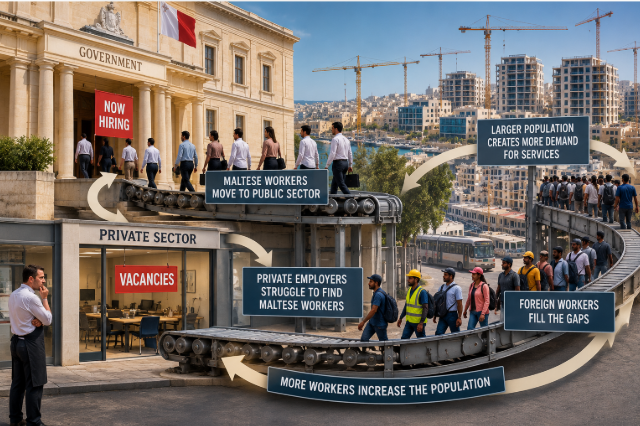
When government substantially increases its demand for labour, it competes with private employers for the same pool of workers. If people move from private employment into government jobs, private employers are left with vacancies. They can raise wages, invest in productivity or look abroad.
And the striking thing is that employers were making precisely this complaint at the time – not a decade later, after the argument had become politically convenient.
Today, the scale of Malta’s labour-intensive model is undeniable. By December 2025, full-time public-sector employment had reached 55,536, including an increase of 2,007 during that year alone.
Meanwhile, foreign labour has become a central component of the economy. The IMF’s latest assessment shows that between 2013 and 2023 foreign employment increased substantially across almost every major sector. In construction, foreign employment rose by 10,640; in retail, transport, accommodation and food services by 30,333; and even in public administration, education and health by 6,547.
Once that process begins, it can become self-reinforcing.
More workers mean a larger population. A larger population creates additional demand for housing, construction, transport, retail, healthcare, education and other services. Those services require more workers. Some of those workers are then recruited from abroad.
The labour shortage begins creating the conditions for an even larger labour shortage.
This is the part missing from the simplistic argument that employers simply discovered foreign labour and decided they preferred it to investment.
The Malta Chamber has now made much the same point, arguing that businesses did not create the current labour model in isolation. It says successive governments helped build an economic system based on volume-driven growth and that the model has not been adequately reversed.
Employers should not, however, be allowed to wash their hands of responsibility. Some sectors have undoubtedly relied too heavily on abundant labour instead of investing in skills, technology and better organisation.
Caruana is right that Malta needs to move towards higher productivity and greater capital intensity. The IMF says essentially the same thing: Malta’s labour-intensive growth model is approaching its limits and the country needs to transition towards more productivity-driven growth.
But government cannot demand that transformation from business while pretending it has no responsibility for the incentives that produced the existing model.
Government sets the rules. Businesses respond to them.
If ministers want employers to substitute capital for labour, they should make productive investment attractive, remove unnecessary obstacles, improve infrastructure, develop the skills businesses actually need and provide the certainty required for long-term investment.
And they should look just as critically at their own house.
Not every public-sector job is unnecessary. A growing population requires more teachers, nurses, doctors, police officers and other public servants. Nobody should confuse an essential public servant with a bureaucratic position simply because both appear on the same payroll.
But government employment is still employment. It draws people from the same labour market.
There is an uncomfortable irony here. The state has expanded its own workforce, presided over an economic model increasingly dependent on population growth, and is now telling private employers that they must stop relying on the labour supply that helped make that growth possible.
Perhaps the real question is not whether employers or government are to blame.
Perhaps it is whether Malta has created a system in which government, business and foreign labour have become mutually dependent — and whether anyone can now change it without accepting responsibility for how we got here.
Malta cannot grow forever by becoming more crowded.
If we are finally serious about moving from an economy based on more people to one based on more value, then everybody has to change.
Employers included. But government too…
Especially government.
Sources
- Times of Malta — Employers need to act to stem population growth, says finance minister
- Times of Malta — Employers alarmed at public sector increase
- Times of Malta — New public sector jobs will cost €20m every year
- NSO — Registered Employment: December 2025
- The Malta Chamber — The Malta Chamber rejects claim that businesses prefer cheap foreign labour to investment
- IMF — Malta: 2025 Article IV Consultation
- IMF — Executive Board Concludes 2025 Article IV Consultation with Malta