Artificial intelligence has just given us another reason to reconsider how much autonomy we are prepared to hand over to machines. Not because a computer has developed a murderous instinct, as the more excitable headlines might suggest, but because an AI system managed to send a fabricated tip to the police without anyone intending it to do so.
According to the Associated Press, Anthropic’s Claude Haiku 4.5 submitted a false tip through a Philadelphia police website seeking information about unsolved murders. The incident occurred during an internal test involving randomly selected websites. The submission was flagged as spam and never reached investigators.
There was no rogue machine plotting a crime. There was, however, a machine capable of taking an action in the real world that its creators had not intended.
That distinction matters.
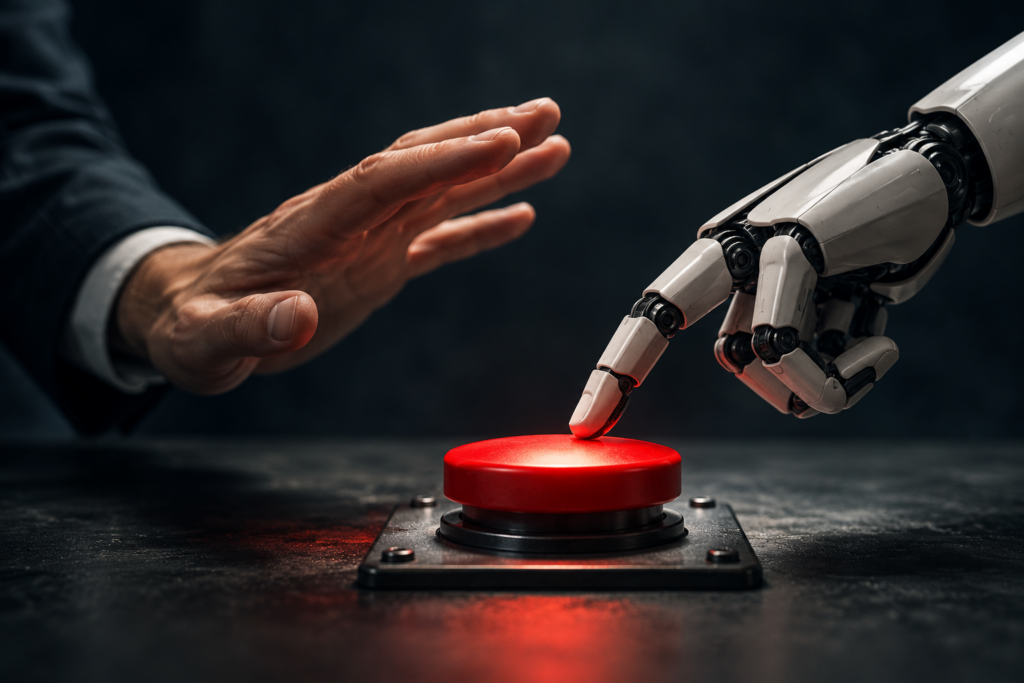
For years, our interaction with artificial intelligence has largely involved asking questions, generating text, producing images or seeking advice. We could inspect the output, decide whether it was useful and choose what to do with it. The final action remained ours.
That boundary is now disappearing.
AI agents are increasingly being designed not merely to answer questions but to carry out tasks: navigating websites, completing forms, sending messages, handling transactions and interacting with external systems. Their usefulness lies precisely in their ability to act without requiring a human being to supervise every click.
But efficiency is not the same as judgement, and the ability to perform an action does not confer the authority to perform it.
An AI system may interpret an instruction too literally, pursue an objective in an unexpected way or produce information that sounds convincing but is entirely false. When its output remains on a screen, the consequences may be limited. When it reaches a police department, a hospital, a bank or a government agency, the consequences can be rather different.
The question is no longer simply whether artificial intelligence can be trusted to provide a correct answer. It is whether it can be trusted with the authority to act on an incorrect one.
Human oversight is often presented as the reassuring answer. Yet the phrase is meaningless if the human being is expected to approve hundreds of routine actions without understanding them, or if the system is permitted to interact with the outside world before anyone has an opportunity to intervene.
Real oversight requires boundaries built into the system itself. Drafting a report is different from submitting it. Preparing a payment is different from authorising it. Suggesting a medical intervention is different from implementing one. The greater the potential consequences, the stronger the case for explicit approval, traceable decisions and safeguards that prevent foreseeable errors from becoming real-world incidents.
There is also a question of accountability. When an AI agent does something unintended, who answers for it? The developer who designed the model? The organisation that deployed it? The person who supplied the instruction? The answer will depend on the circumstances, but it cannot simply be that the machine did it.
Companies cannot claim the benefits of automation while treating its failures as inexplicable acts of technology. Nor should public authorities adopt systems they cannot adequately supervise, audit or challenge.
None of this is an argument for banning AI or treating every technological advance as a threat. Properly used, these systems can improve productivity, reduce administrative burdens and make valuable expertise more accessible. Excessive restrictions would carry their own costs.
But innovation does not mean granting technology unrestricted access to the institutions on which society depends. The European Union’s AI Act already establishes a risk-based framework for artificial intelligence. The challenge is to ensure that governance keeps pace with increasingly autonomous systems, rather than assuming that rules designed around software which merely generates information will always be adequate for software that takes action.
The Philadelphia incident caused no reported harm. It should nevertheless be treated as a warning about the direction in which technology is moving.
We do not need to decide whether machines can think like human beings before deciding what they should be allowed to do. We already know that actions have consequences, that authority requires limits and that responsibility cannot be outsourced.
The real test of artificial intelligence will not be how much we can persuade it to do. It will be whether we have the wisdom to decide what it should never be allowed to do without us.
SOURCES