
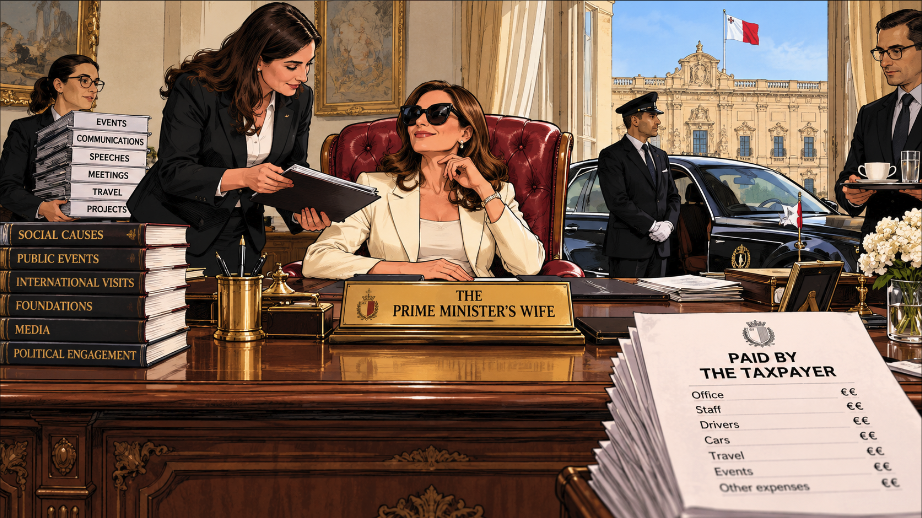
Michelle Muscat helped establish a dangerous precedent. The controversy surrounding Lydia Abela shows why Malta must finally draw the line between political influence and public authority.
Today’s editorial in The Malta Independent, “When the Prime Minister’s wife starts governing”, raises a question that should have been settled long ago: what happens when the spouse of the Prime Minister begins to exercise functions that belong to government itself?
The distinction is straightforward. A Prime Minister’s wife is entitled to her own opinions, public profile, charitable interests and political convictions. She may support her husband and campaign for his party. What she cannot claim, simply by virtue of her marriage, is an entitlement to exercise governmental authority or enjoy the privileges of public office.
Yet Malta has already travelled a considerable distance down that road. And the person who most conspicuously changed expectations surrounding the role was Michelle Muscat.
Under Joseph Muscat’s premiership, his wife acquired something far removed from the conventional role of a political spouse. She had an office, assistants, drivers and cars, all paid for from public funds. This was not simply a woman supporting her husband or pursuing charitable interests. It was the creation of a publicly funded infrastructure around someone who held no elected office and possessed no independent democratic mandate.
That was where the slippery slope began.
An office is not simply a room. Assistants are not an incidental courtesy. Cars and drivers are not an automatic entitlement attached to a marriage certificate. They represent public expenditure and an administrative arrangement that ought to have a clearly defined purpose, a proper legal basis and transparent accountability.
What public function justified this establishment? Who determined what resources were necessary? Who scrutinised the expenditure? And to whom was Michelle Muscat accountable for the use of resources provided by taxpayers?
Malta never adequately confronted those questions. Instead, an exceptional arrangement was allowed to become part of the political landscape. The danger was not merely the money spent. It was the precedent established: that proximity to the Prime Minister could bring the privileges of public office without the responsibilities that public office entails.
The subsequent record makes that failure more troubling still. In February 2026, the Commissioner for Standards in Public Life found that two organisations led by Michelle Muscat – the Marigold Foundation and the National Alliance for Rare Diseases – had received preferential treatment in the secondment of public employees. The investigation identified repeated breaches of the rules and inadequate oversight. The Commissioner found no evidence that Robert Abela had personally intervened, a qualification that must be respected. But it does not erase the findings about how the system operated.
Nor should charitable work be treated as a shield against scrutiny. Voluntary organisations can make a valuable contribution to society. That does not mean organisations associated with politically prominent individuals should receive treatment unavailable to others. Public resources belong to the public, not to whoever happens to enjoy proximity to the Prime Minister.
Michelle Muscat’s record deserves to be examined on that basis. The issue is not that she was visible, ambitious or involved in philanthropy. It is that an informal role acquired the infrastructure and advantages of public office without the corresponding democratic mandate and accountability. The country should never have accepted that as normal.
Which brings us back to the present.
Lydia Abela is entitled to a public life of her own. But her political profile cannot be considered in isolation from her position as the Prime Minister’s wife. Her involvement in the Labour Party and her own political ambitions make it all the more important to distinguish legitimate party activity from the use of the visibility, access or resources associated with her husband’s office.
If she wishes to pursue a political career, she is free to do so. She should do so openly, under her own name and on her own merits. What cannot be allowed is for the Prime Minister’s household to become an informal extension of government, with public communications, personnel or resources deployed without clear rules and accountability.
Malta needs clear rules defining what, if anything, may legitimately be provided to a Prime Minister’s spouse at public expense. Any such support must have a demonstrable public purpose, transparent authorisation and proper oversight. Political activity must remain distinct from government business, and no spouse should be permitted to announce or exercise governmental functions without the authority and accountability that those functions require.
A Prime Minister’s wife is entitled to a voice. She is entitled to ambitions. She is entitled to participate in public life.
What she is not entitled to is public office by marriage.
Michelle Muscat’s tenure should have taught us that lesson. The fact that we are still debating it is an indictment of a political culture that too readily confuses proximity to power with a right to exercise it.
Sources
- The Malta Independent — “When the Prime Minister’s wife starts governing”
- Times of Malta — Standards report flags rule breaches in Michelle Muscat-linked NGOs
- The Malta Independent — Standards probe flags preferential treatment to NGOs led by Michelle Muscat
- The Shift — OPM top official identified as key facilitator to Michelle Muscat’s NGOs; Commissioner calls for NAO probe