
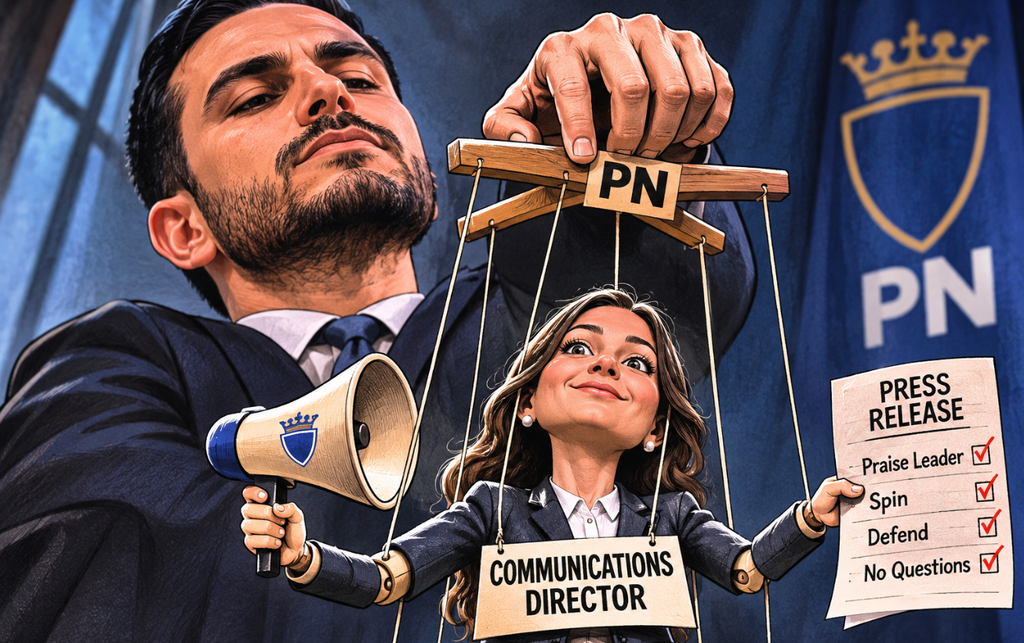
There are appointments that tell you considerably more about the people making them than about the people being appointed. The Nationalist Party’s latest choice for Director of Communications is one such appointment.
Chayenne Riolo has been appointed to replace Nathaniel Attard, who was removed from the post in October after just over two years in the role. The PN has offered little by way of explanation for Attard’s departure, other than describing organisational changes as part of a process of reform.
Riolo, meanwhile, is a nursing graduate, a journalist with the party’s television station, and is pursuing a Master’s degree in Public Policy Leadership. She also served as Vice-Chairperson of the European Democrat Students between 2024 and 2026.
Those are the biographical details made public by the party and reported in the press. They may be perfectly respectable achievements. But they do not, in themselves, answer the obvious question: what qualifies someone to take charge of the communications operation of Malta’s main Opposition party?
Let us be clear. This is not a criticism of Riolo personally. She may well prove capable of the job. Nor should anyone be denied an opportunity because of their age or because they are at an earlier stage of their professional career.
But an appointment to one of the most politically sensitive positions in the Opposition cannot be assessed on goodwill, potential or a polished biography. It must be assessed against the demands of the job.
And those demands are considerable.
A Director of Communications is not simply someone who writes press releases, prepares social media posts or coordinates television appearances. The role requires political judgement, strategic thinking, an understanding of the media landscape, crisis management skills and, above all, the confidence to tell the party leadership when it is getting things wrong.
That last requirement is perhaps the most important.
A communications director must be able to challenge the leader. To question a proposed response. To anticipate the consequences of a political decision. To recognise when a message is damaging, when an opportunity is being squandered and when silence is preferable to another ill-advised statement.
In other words, the job requires someone who can think independently, not merely someone who can follow instructions.

Which brings us to the uncomfortable question surrounding this appointment: is the PN looking for a communications strategist, or a dependable subordinate?
Because there is a difference.
If the objective is to surround the party leader with people who are personally loyal, unlikely to challenge him and willing to implement whatever instructions they receive, then perhaps this appointment makes perfect sense. But that is not how a serious political organisation should operate.
The removal of Nathaniel Attard makes the decision even more difficult to understand. Attard had years of experience in journalism and broadcasting, had headed the party’s news operation, edited In-Nazzjon and subsequently managed communications at BirdLife Malta. He had also overseen the PN’s communications operation during the recent general election campaign.
The party has never properly explained why his services were no longer required. Alex Borg described the change as part of a process of reform. Fine. But reform should mean improving an organisation, not simply changing the people occupying its offices.
If the previous director was considered inadequate, what were the shortcomings? What was the professional profile sought for his successor? What criteria were applied? And what particular experience or expertise persuaded the party that this was the right appointment?
These are entirely reasonable questions. The PN is, after all, asking the electorate to trust it with the running of the country. It should not be unreasonable to expect it to demonstrate sound judgement in managing its own affairs.
Alex Borg has spoken repeatedly about renewal, a new generation and a different political culture. But renewal is not a cosmetic exercise. It is not about replacing established figures with younger faces and hoping that the optics will do the rest.
Nor is it about creating an inner circle of people whose principal qualification is that they are considered dependable by the leader.
The Opposition needs people who can challenge the government, but it also needs people who can challenge the Opposition leader when necessary. It needs competence, experience and independent judgement. Above all, it needs a professional operation capable of functioning beyond the personality of whoever happens to occupy the leadership post.
A communications director should be the person who tells the leader that his latest idea is a bad one before it becomes tomorrow’s headline.
If all the leader wants is someone to tell him that every idea is brilliant, he does not need a Director of Communications. He needs a fan club.
The PN does not need to look younger. It needs to look more competent. And if Alex Borg wants to convince the country that his party is ready to govern, he might start by demonstrating that he understands the difference between appointing people who serve the party and appointing people who simply serve him.
Sources