
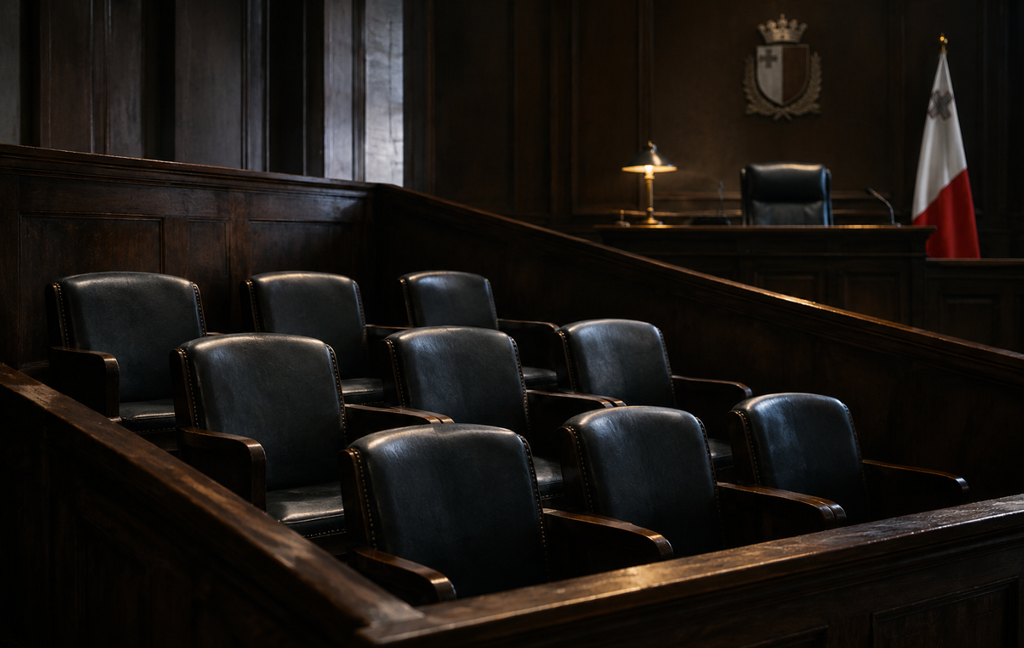
The acquittals of Yorgen Fenech and Lorin Scicluna have exposed something far more troubling than public disagreement with the verdicts. They have exposed the extent to which confidence in Malta’s criminal justice system has deteriorated. And yet, much of the debate continues to revolve around the jury, as though the nine citizens who deliberate at the end of a criminal trial are somehow responsible for everything that went wrong before they entered the courtroom.
That is a convenient distraction.
A jury does not investigate a murder, gather forensic evidence, interview witnesses, build a prosecution or decide which cases are brought before the courts. It is the final link in a chain of institutions whose job is to establish the truth and present a case that can withstand scrutiny. If that chain is defective, the problem does not begin with the jury. It begins much earlier.
Malta’s criminal justice system has been allowed to accumulate serious structural weaknesses for years. The European Commission’s 2026 Rule of Law Report makes for uncomfortable reading. Public perception of judicial independence has fallen from 69% to 47% in just one year. More astonishingly, severe criminal cases at first instance took an average of 3,977 days to conclude in 2024. Almost 11 years. The longest duration in the European Union.
11 years to deliver justice is not an administrative inconvenience. It is a failure of the system.
And who, precisely, is accountable for that failure? Successive governments have had ample opportunity to address the deficiencies in our institutions. We have had commissions, consultations, reform announcements and political speeches about strengthening the rule of law. Yet the public is still confronted with a justice system struggling with delays, questions about institutional independence and a crisis of confidence that no amount of government public relations can disguise.
The controversy surrounding the survey commissioned ahead of the Fenech trial raises another deeply uncomfortable question. How secure are our jury selection procedures against attempts to identify, profile or influence potential jurors? These are not trivial concerns. The integrity of a jury depends not only on the honesty of those selected but also on the credibility of the process through which they are selected. If that process cannot command public confidence, it needs independent scrutiny.
Repubblika’s recently published paper, Justice in the Name of the People, deserves serious consideration precisely because it looks beyond the immediate controversy. It proposes an independent review of the entire criminal justice system, including jury selection, judicial oversight, prosecutorial competence, police independence, evidence preservation and the possibility of alternative court structures.
This is the discussion Malta should be having. Not whether juries are too lenient, whether judges should have more power or whether the latest acquittal somehow proves that the system is working. The question is whether the institutions responsible for delivering justice are equipped, independent and competent enough to do their jobs.
And let us be clear about something else. The presumption of innocence is fundamental. Nobody should be convicted to satisfy public anger, political pressure or a newspaper headline. But neither should the presumption of innocence become a convenient shield against examining why serious criminal cases fail to reach a convincing conclusion. An acquittal may be legally correct. It does not automatically mean that every institution involved performed its duties adequately.
The Government should therefore stop treating the state of the justice system as a matter of institutional housekeeping. It is a fundamental responsibility of government. The Opposition, too, should resist the temptation to turn every controversy into an opportunity for political point-scoring. Both parties have participated in governing this country. Neither has a monopoly on responsibility, nor a credible claim to innocence when it comes to the state of our institutions.
What Malta needs is an independent review with the authority to examine uncomfortable questions, identify failures and recommend meaningful reforms. Not another committee whose report gathers dust, nor another round of political assurances that everything is being addressed.
The jury is not the whole justice system. It is simply where the public gets to see the final result. The real failures, if failures there are, may lie much further up the chain. And it is about time someone was made to answer for them.
Sources
The Malta Independent – Repubblika calls for independent review of entire justice system
Repubblika – Justice in the Name of the People: Full 50-page discussion paper
European Commission – 2026 Rule of Law Report: Malta Country Chapter