
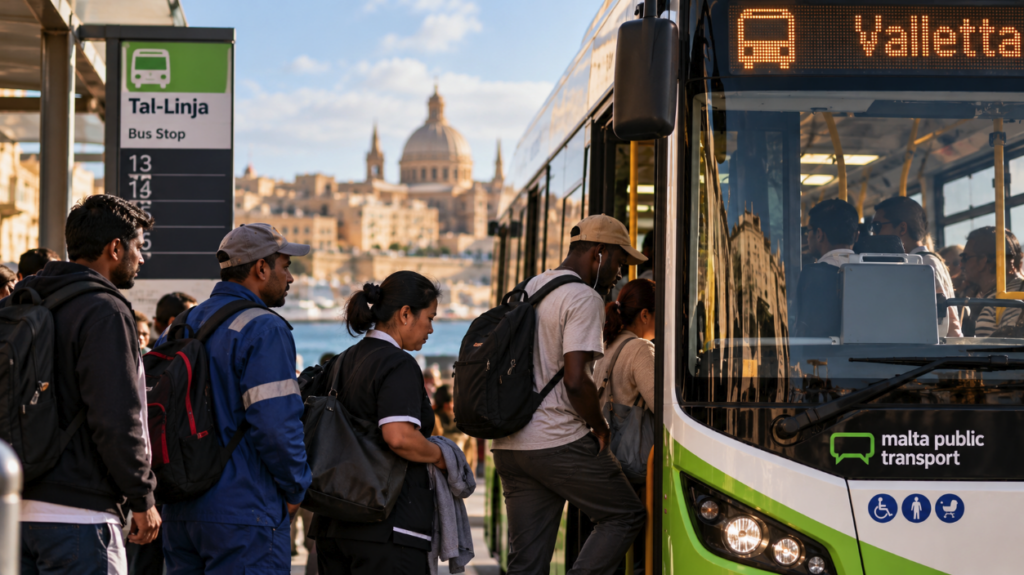
The government may save millions by withdrawing free public transport from most third-country nationals (TCNs). But saving money for the Treasury is not the same as saving money for Malta.
According to Times of Malta, the government intends to end free travel for most TCNs who do not have long-term residency from next year. Those affected could face a monthly Tal-Linja card charge of around €33, while other categories of residents would retain free travel.
The immediate attraction is obvious. The state spends tens of millions of euro subsidising free public transport, and restricting eligibility should reduce that bill. But this is a cost-saving measure whose consequences extend well beyond the government’s accounts.
For a professional earning a comfortable salary, €33 a month may be an inconvenience. For a low-paid employee working shifts in hospitality, cleaning, construction, care or other essential services, it is another recurring expense to be met from an already limited income.
These workers are not simply passing through Malta’s economy without contributing. Many pay income tax and social security contributions, as well as the indirect taxes included in their everyday spending. They provide labour to businesses that Malta relies upon and contribute to the public finances that support the services we all use.
Yet they may now be asked to pay more simply to get to work.
There is, however, a question beneath the arithmetic. Why are TCNs the group being singled out?
The government is entitled to review public expenditure. It is also entitled to establish reasonable eligibility rules for publicly funded benefits. But when a policy removes a benefit from one category of residents while preserving it for others, the distinction deserves an explanation beyond the amount it saves.
Is this simply a decision about the most effective way to manage a transport subsidy? Or is it also a response to a political climate in which restricting benefits for non-EU nationals has become an attractive way of demonstrating that government is taking a tougher line on immigration?
We should not presume the answer. The reported decision, on its own, does not prove that ministers have bowed to anti-immigration pressure. But the question is legitimate, and government should be prepared to answer it. A fiscal measure should be defended by its economic rationale, not by the political convenience of making a particular group pay.
TCNs who work legally in Malta are not merely recipients of public services. Many pay taxes and social security contributions, rent homes, buy goods and services, and help sustain industries that would struggle to operate without them. Their contributions do not automatically entitle them to every benefit on identical terms, but neither should their nationality make them an easy target for savings that would be politically harder to impose elsewhere.
The economic consequences may also extend beyond the individual worker. Employers could face requests for higher wages or transport allowances to offset the additional expense. Some may absorb the cost; others may refuse. In sectors already struggling to recruit and retain staff, the change could influence decisions about whether to remain employed in Malta or seek opportunities elsewhere.
These are risks, not certainties. Their scale should be assessed rather than assumed. But a government serious about economic policy should consider them before celebrating a reduction in expenditure.
There is a further contradiction worth examining. Malta depends on migrant labour to sustain its economy, yet public debate often treats migration primarily as a problem to be contained. A government cannot indefinitely rely on foreign workers to fill essential roles while ignoring the cumulative effect of policies that make their lives and work more expensive.
If the objective is fiscal discipline, publish the expected savings and the assumptions behind them. If it is to encourage sustainable transport, explain how the policy will affect bus use and car journeys. If the distinction between categories of residents is justified on policy grounds, state those grounds clearly.
What is not enough is to announce a saving and assume the argument ends there.
A government may legitimately review a subsidy. It should not need an unpopular target to justify doing so.
Sources
Times of Malta – Buses will no longer be free for TCNs
Government of Malta – Free Public Transport
National Statistics Office – Public Transport