
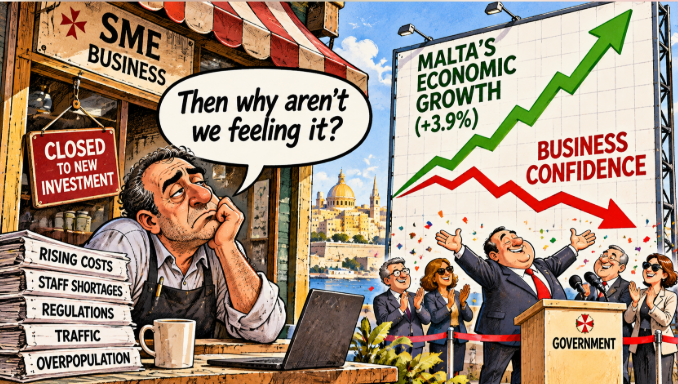
There is something rather uncomfortable about the latest figures from Malta’s small business community. While the Government continues to celebrate economic growth, three out of every four businesses surveyed believe the country is heading in the wrong direction.
The latest SME Barometer, published by the Malta Chamber of SMEs in collaboration with MISCO, puts that figure at 73%, up from 64% in the previous quarter. More worrying still, only 19% of respondents believe the coming twelve months will be a good time to invest. More than half remain undecided.
These are not figures that should be casually dismissed.
To be fair, Malta’s economy is not collapsing. The European Commission forecasts growth of 3.9% this year and 3.5% next year, with unemployment remaining exceptionally low. By conventional macroeconomic indicators, the performance remains strong.
But perhaps that is precisely where our economic debate has become too comfortable. We have become accustomed to measuring success through GDP growth, employment numbers and visitor arrivals, while paying insufficient attention to the quality and sustainability of that growth.
An economy can grow while its foundations become increasingly strained.
The SME survey offers a revealing snapshot of that tension. Employee shortages remain the biggest operational challenge, identified by 38.3% of respondents. Inflation and traffic congestion follow. When asked about the country’s most pressing problems, 35% identified overpopulation, 31.7% cited a lack of good governance and 25.9% pointed to corruption.
These are not isolated complaints about the cost of doing business. They describe an environment in which businesses are increasingly questioning whether the country is managing its development intelligently.
Consider the contradiction. Employers complain that they cannot find enough workers, while simultaneously identifying overpopulation as one of the country’s most pressing national problems. The answer cannot simply be to import more labour whenever demand increases. Nor can it be to impose additional fees on foreign workers while failing to address the structural dependence that successive governments have created.
At some point, we have to confront the uncomfortable question of whether Malta’s economic model is delivering productivity or merely expanding capacity through population growth.
There is a difference.
A higher-value economy requires investment in technology, skills, innovation and better management. It requires businesses to become more productive rather than simply employ more people. It requires public infrastructure that supports economic activity instead of obstructing it, and a regulatory environment that rewards compliance rather than allowing unscrupulous operators to undercut those who play by the rules.
Of course, businesses themselves cannot escape responsibility. Employers must invest, train their workforce, embrace technology and improve productivity. Government cannot be blamed for every commercial difficulty, nor should every business complaint automatically become public policy.
But government has a responsibility to create the conditions in which enterprise can flourish. That means predictable regulation, efficient administration, effective enforcement, sensible planning and institutions that command public confidence.
It also means understanding that uncertainty has an economic cost. When only one in five businesses believes the coming year is a good time to invest, something deserves attention. Investment decisions are not made in a vacuum. They depend on confidence that the rules will remain predictable, infrastructure will be available and the wider economic environment will reward rather than penalise initiative.
The Government may reasonably point out that the survey was conducted before the Budget. The next quarterly results will therefore be particularly interesting. But that is no excuse for ignoring what the present figures are telling us.
We should also be careful not to confuse criticism of the economic model with criticism of economic growth itself. Growth is essential. Private enterprise, investment and job creation are what sustain prosperity. But growth without direction eventually becomes an exercise in managing its own consequences.
More people require more infrastructure. More businesses require more skilled workers. More construction requires better planning. More economic activity requires stronger institutions and more effective regulation.
None of this should be particularly controversial.
Perhaps the real question is not whether Malta’s economy is growing. Clearly, it is. The question is whether we are building an economy capable of sustaining that growth without progressively undermining the quality of life, competitiveness and confidence on which its future depends.
If three-quarters of our SMEs believe the country is heading in the wrong direction, it might be time to stop congratulating ourselves on the growth figures and start asking why.
Because an economy that grows but loses the confidence of those expected to invest in its future is not necessarily failing today.
But it may be storing up tomorrow’s problems.
Sources
MaltaToday – 73% of small businesses say Malta is moving in the wrong direction
The Malta Independent – Only 19% of SMEs expect the next 12 months to be a good time to invest
European Commission – Economic forecast for Malta