
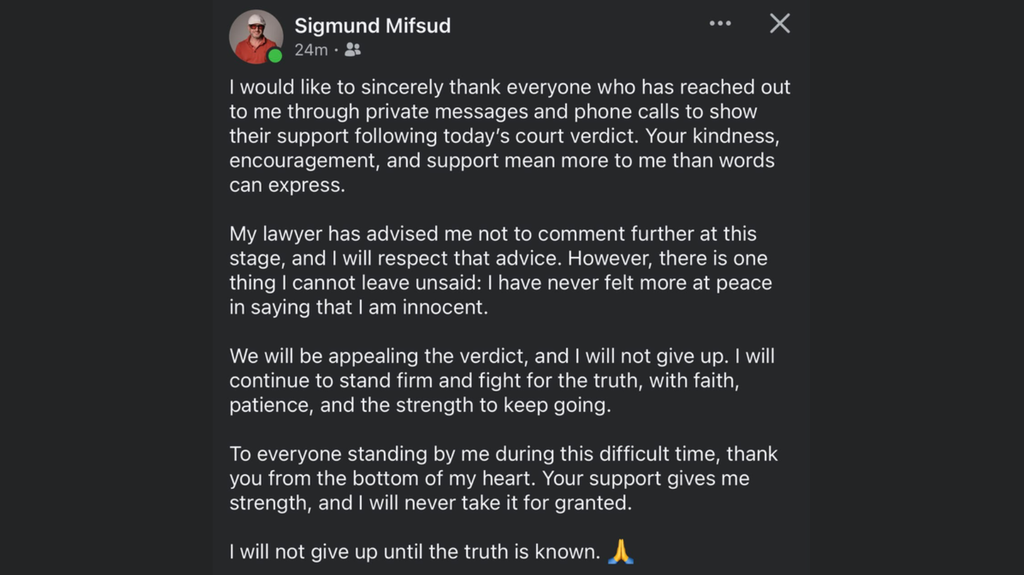
There is something deeply troubling about a chief executive who, after being sentenced to six months’ effective imprisonment for attempting to obstruct justice, emerges to declare that he has never felt more at peace in saying he is innocent.
Sigmund Mifsud is entitled to appeal. He is entitled to defend himself, challenge the judgment and insist that he believes himself innocent. Those rights are fundamental. But the public is equally entitled to examine what the court found, rather than allowing the discussion to be reduced to a contest between his conviction and his personal conviction of his own innocence.
The former chief executive of the Malta Philharmonic Orchestra was found guilty of attempting to obstruct justice in connection with sexual harassment committed by another orchestra employee. He was acquitted of two other charges. The six-month prison sentence is subject to appeal. These are the facts, and they should be stated precisely.
The court’s judgment, however, goes to the heart of what leadership means.
The employee who admitted to sexual harassment was responsible for his own conduct. Mifsud’s responsibility was different. He occupied the position of chief executive, with the authority and duty to safeguard the well-being of the people working under him. The woman had turned to management for help. Instead, the proceedings established a separate criminal responsibility on the part of the man at the top.
The distinction is crucial. One man was responsible for the harassment. The other was convicted of attempting to obstruct justice in the aftermath. These are not interchangeable offences, but neither can the second be dismissed as a mere administrative misjudgement.
Indeed, the abuse of a position of trust can compound the damage caused by the original wrongdoing. An employee who is harassed by a colleague should not then have to confront the possibility that the machinery of management will be mobilised against her for daring to speak up.
The question is not whether Mifsud should have automatically believed every allegation. No responsible manager should dispense with evidence or due process. His duty was to ensure that a complaint was handled properly, that the employee was protected and that the relevant authorities could establish the facts without interference.
An orchestra’s reputation is not a legitimate excuse for obstructing that process. If anything, a publicly supported cultural institution should be held to a higher standard of accountability, not a lower one.
Mifsud has also publicly thanked those who have rallied around him and promised to fight until the truth is known. His supporters are entitled to stand by him. But sympathy for a defendant and acceptance of a court’s findings are not mutually exclusive matters. Nor does the existence of other, perhaps more disturbing, crimes make this one less serious.
If his argument is that rape cases and other offences sometimes go unnoticed while he has been singled out, the answer is straightforward: failures elsewhere do not establish injustice here. The proper response to inadequate prosecutions is to demand that more cases be investigated and prosecuted properly, not to use those failures to deflect attention from a conviction.
There is, admittedly, a legitimate question about sentencing consistency. The employee who admitted to the harassment initially received a suspended prison sentence; on appeal, that was reduced to a conditional discharge and a €500 fine. The apparent contrast with Mifsud’s effective prison term deserves scrutiny. But the two cases involved different offences, different proceedings and different judicial assessments. The comparison cannot, by itself, establish that Mifsud has been treated unfairly.
Nor should the debate end with the sentence. What happened to the employee who raised the complaint? She ultimately left her job. What message does this episode send to the next employee who must decide whether to report misconduct by a colleague who enjoys the protection of the workplace hierarchy?
Leadership is not measured by the loyalty one commands when trouble arrives. It is measured by the responsibility one accepts when someone less powerful needs protection.
Mifsud may yet persuade an appellate court that the verdict should be overturned. Until then, the conviction stands, and the judgment deserves to be taken seriously.
The Philharmonic Orchestra’s reputation was never more important than the people who worked in it. A chief executive’s first duty is not to protect an institution from embarrassment. It is to ensure that the institution deserves the public’s trust.
The original wrongdoing was a betrayal of a colleague. The attempted obstruction of justice was a betrayal of the responsibility entrusted to the person in charge.
Sources
- Times of Malta – Former orchestra CEO Sigmund Mifsud jailed over harassment cover-up
- MaltaToday – Former orchestra chief Sigmund Mifsud jailed six months for obstructing justice
- Times of Malta – Voice messages show attempt to discredit victim of sexual harassment at MPO
- MaltaToday – Appeals Court goes soft on orchestra official guilty of sexual harassment