
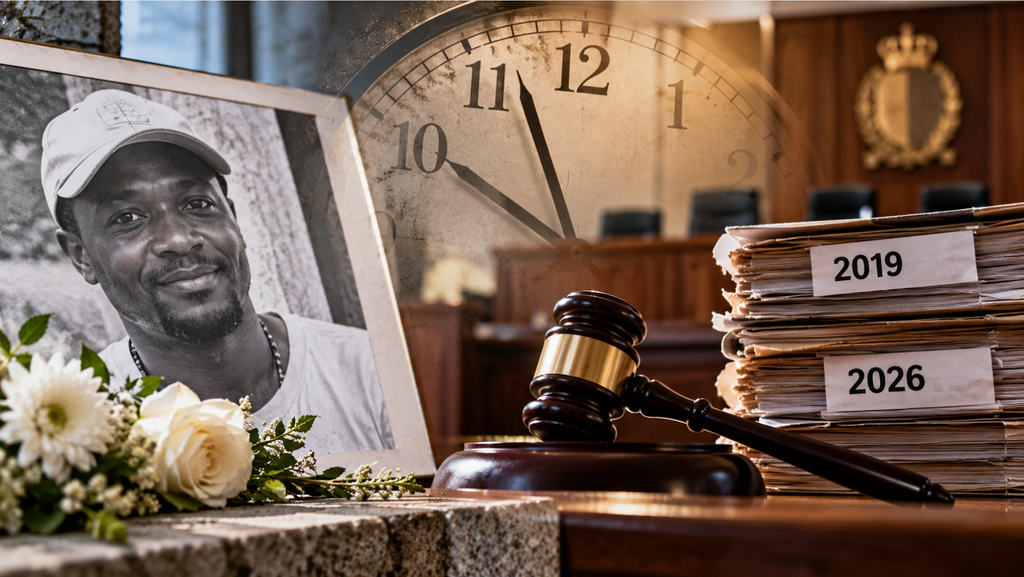
The opening of the trial over Lassana Cisse’s killing is welcome. But a criminal case that takes more than seven years to reach a jury raises questions that no verdict alone can answer.
The trial has finally begun. That is welcome news. It is also a reminder of how long justice can take in Malta.
Lassana Cisse Souleymane, a 42-year-old father of three from the Ivory Coast, was shot dead in Ħal Far on 6 April 2019. More than seven years later, a jury is hearing the case against former soldier Lorin Scicluna, who is accused of his murder and offences arising from attacks on three other people.
The prosecution alleges that the violence was racially motivated. Scicluna denies the charges, and his co-accused, Francesco Fenech, will face separate proceedings. The jury must determine the facts and reach its verdict on the evidence. No responsible commentary should attempt to do its job for it.
But there is another question that does not require us to prejudge the trial: why did it take so long to get here?
In April, MaltaToday reported that the prosecution had finished presenting its case in 2021, yet the trial had still not begun. Cisse’s mother had waited more than three years for her son’s body to be returned for burial. These are not incidental details in a legal timetable. They are the human consequences of a system that takes years to move from accusation to trial.
Justice is not simply a verdict. It is a process that must be fair, independent and reasonably prompt.
The presumption of innocence is fundamental. Anyone accused of a crime, however disturbing the allegations, is entitled to a fair trial and must not be condemned by public opinion before the evidence has been tested. But fairness also requires that criminal proceedings do not drag on without adequate justification. Witnesses grow older, memories fade and families remain trapped in uncertainty. The accused, too, have a legitimate interest in having their cases resolved.
None of this means that every delay is the fault of a particular judge, prosecutor or lawyer. Serious criminal cases can be complicated. Procedural safeguards exist for good reason, and the decision to try the two accused separately has been explained in terms of the evidential difficulties involved. Rushing a trial merely to satisfy public impatience would be no improvement.
Yet complexity cannot be the end of the discussion. If the prosecution’s case was already complete in 2021, the public is entitled to understand what happened during the intervening years. Were there unavoidable legal obstacles? Was the delay caused by the availability of court resources, procedural disputes or other factors? Without a clear account, confidence in the administration of justice is difficult to sustain.
The alleged racial motive makes this case particularly grave. If established, it would represent not merely an appalling act of individual violence but an assault on the principle that every person deserves equal protection under the law, regardless of skin colour or origin. The fact that the accused were serving members of the Armed Forces at the time also raises questions that the relevant institutions may need to confront once the legal proceedings permit it.
That is not a licence to condemn the Armed Forces collectively, any more than an allegation is proof against an individual. It is a recognition that institutions entrusted with protecting the public must take credible concerns seriously and be prepared to learn from proven failures.
There is a temptation to treat the opening of a long-awaited trial as proof that the system works. It is certainly better than a case that never reaches court. But the commencement of proceedings is not the same as justice delivered.
Malta needs a criminal justice system that protects the innocent, holds the guilty accountable and treats victims and accused persons with equal seriousness. Those objectives are not in conflict. They depend on one another.
The jury must now do its job without interference or prejudice. The rest of the state should also do its job: explain the delay, identify any failures and ensure that cases of such gravity do not take seven years to reach this stage again.
A fair trial is indispensable. A timely trial is part of what makes it fair.
Sources
TVM News – Trial starts against former soldier Lorin Scicluna accused of Lassana Cisse’s murder
MaltaToday – Seven years since the death of Lassana Cisse
Times of Malta – Live coverage of the trial and the prosecution’s allegations
The Malta Independent – Former AFM soldier faces trial by jury over the 2019 killing