
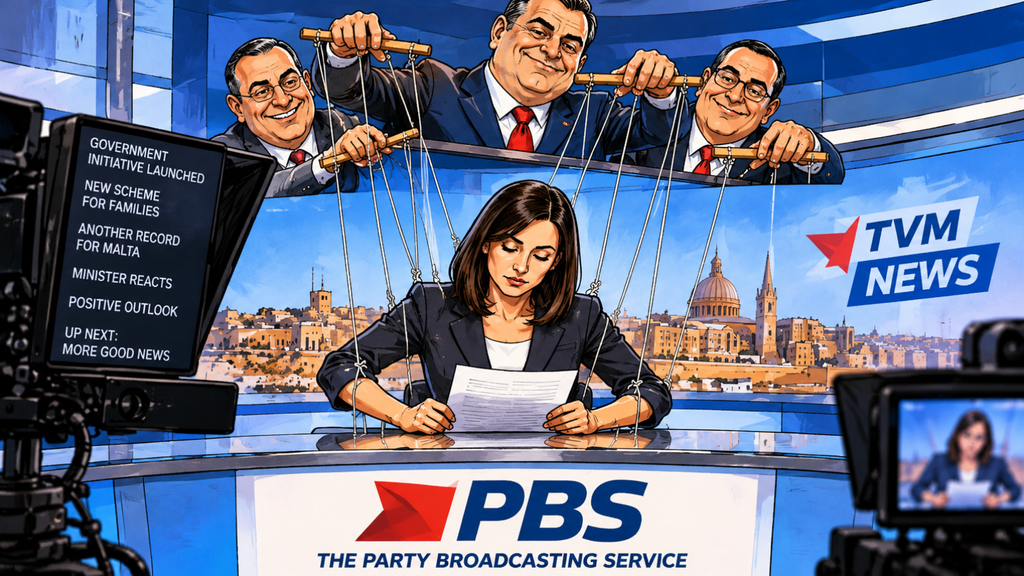
There is a difference between informing the public and selling the government to it. PBS appears to have forgotten where one ends and the other begins.
Between June 2025 and May 2026, PBS news bulletins carried 532 sound-on-tape clips featuring government representatives, against just 66 featuring the Opposition. More than eight to one. These figures, supplied in Parliament, are central to the constitutional case brought by the Nationalist Party against PBS and the Broadcasting Authority.
Labour’s defence is predictable: ministers have jobs to do, policies to announce and public services to explain. Of course they do. But government activity is not automatically public-interest journalism. A minister announcing a scheme is not the same as a journalist examining whether it works, what it costs and who benefits.
The distinction is fundamental. A government communication presents the government’s version of events. A public broadcaster is supposed to test it.
When the political establishment dominates the output of a broadcaster funded by taxpayers, the danger is not simply unequal airtime. It is that the government’s narrative becomes the default account of reality, while scrutiny and dissent are pushed to the margins.
That is not public broadcasting. It is political advantage financed by the public.
The figures alone do not settle every question of impartiality. News is not a mathematical exercise, and ministers will naturally feature when their decisions affect the country. But an eight-to-one disparity demands more than a shrug and an explanation about ministerial duties. It demands serious scrutiny of editorial choices, story selection and the regulator’s response.
The Broadcasting Authority cannot be reduced to a referee who occasionally blows the whistle while the same team carries on playing. If findings of imbalance produce no meaningful correction, what exactly is the point of regulation?
There is a further danger: viewers can become so accustomed to one-sided political messaging that they stop recognising it. Call it Pea-Brained Syndrome (PBS): swallowing the party line whole, mistaking repetition for evidence and propaganda for journalism. The barb is aimed not at everyone who watches PBS, but at the cultivated credulity that allows political communication to pass unchallenged as independent reporting.
Labour should understand the principle at stake. PBS does not belong to the party in government. It does not belong to the Opposition either. It belongs to the public, including those who voted Labour, those who voted PN and those who voted for neither.
A change of government should never mean a change of political master at the national broadcaster. The test is not whether PBS is friendly to Labour or hostile to the PN. It is whether it is sufficiently independent to make any government uncomfortable when the facts warrant it.
That requires more than solemn declarations of impartiality. It requires transparent standards, effective monitoring and a regulator willing to insist on corrective action.
The court must examine the evidence and determine the claims before it. But the broader democratic question is plain: a public broadcaster cannot fulfil its purpose if the party in power treats it as an extension of its own communications machinery.
PBS is not Labour’s noticeboard. It is the public’s broadcaster. It is time it started behaving like one.
Sources
- The Malta Independent: Hearing begins in PN’s broadcasting impartiality constitutional case
- MaltaToday: PN takes Broadcasting Authority and PBS to court, claiming systematic imbalance
- The Malta Independent: PBS aired 532 government and 66 opposition soundbites over one-year period
- MaltaToday : PBS denies PN claims of systemic bias in TVM news coverage