
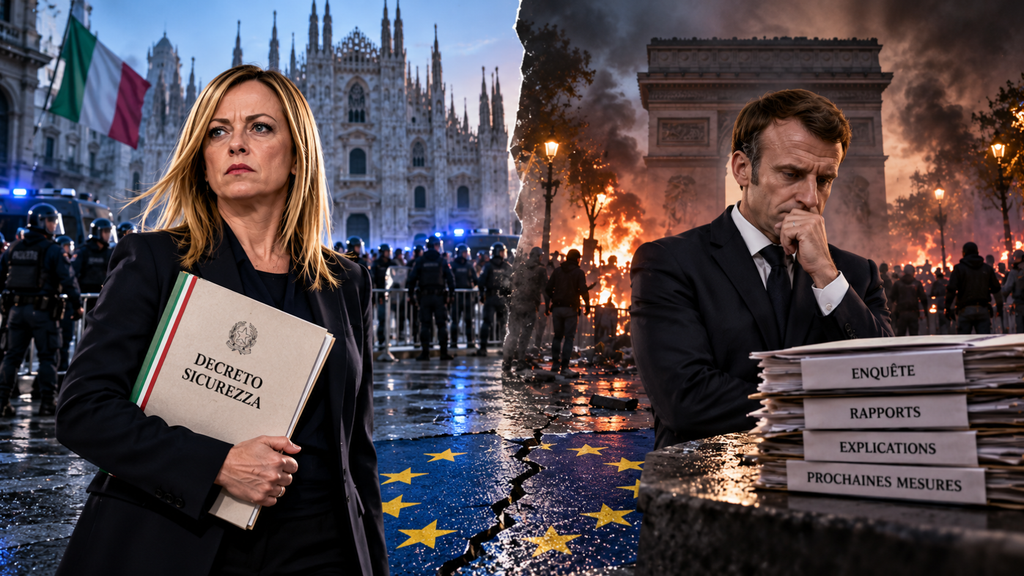
When riots turn peaceful protest into criminal disorder, governments are judged not only by their condemnation of violence, but by their willingness to restore order and prevent its repetition.
There is a familiar ritual when cities descend into violence. Shops are smashed, businesses looted, police attacked and public buildings set alight. Politicians condemn the scenes, promise investigations and insist that those responsible will face justice. Then the arguments begin over who is to blame.
What matters is what happens next.
The violence that swept across French cities over the weekend, including Paris, was a serious test of the state’s authority. Italy experienced its own disorder, particularly in Milan, where groups of young people vandalised property, looted shops and clashed with police. Yet the political responses have offered a revealing contrast.
On Tuesday, Giorgia Meloni’s government approved an emergency security decree introducing tougher penalties for violent participation in demonstrations, including prison sentences of up to five years and fines of up to €20,000 in specified circumstances. The package also targets the organisation of violent demonstrations online, introduces financial liability for parents whose children cause damage, and expands preventive powers concerning minors. Italy is also deploying an additional 500 troops to Milan.
These measures are not beyond criticism. New criminal offences do not automatically make streets safer, and preventive powers must be proportionate, legally justified and subject to safeguards. Italy’s own police unions have warned against shortcuts that substitute military powers for properly trained policing. A tough announcement is not the same thing as a successful policy.
Nevertheless, Meloni’s message is unmistakable: looting and assault are not legitimate extensions of protest. They are crimes, and the state intends to respond accordingly.
France, meanwhile, has not done nothing. Prime Minister Sébastien Lecornu called for local curfews, additional security deployments and action to prevent further disorder. The government has acknowledged failures in anticipating the violence, while Interior Minister Laurent Nuñez offered his resignation after admitting that the response had fallen short. President Emmanuel Macron declined to accept it.
But this is precisely where the uncomfortable question begins. Why did the authorities appear so poorly prepared for disorder on this scale, and why did it take the destruction of property and widespread violence to expose the weaknesses in their response?
A curfew imposed after streets have been trashed may help prevent another night of violence. An investigation may identify those responsible. Compensation may help businesses recover. None of these measures, however, answers the question of whether the state was adequately prepared to protect them in the first place.
Nor should the debate be reduced to a contest between compassion and repression. Citizens have every right to protest rising living costs, inadequate public services or unpopular government policies. Peaceful demonstrations are a normal and necessary feature of democracy. The state must protect that right, not treat dissent itself as a threat.
But the right to protest does not include a right to terrorise shopkeepers, torch public buildings or attack police officers. A business owner whose premises are destroyed is not an acceptable casualty of somebody else’s political anger. Neither is a police officer required to accept violence as an occupational hazard that must simply be endured.
The distinction is fundamental: a government can respect the right to dissent while insisting that criminal behaviour has consequences. Indeed, it must do both if public confidence in democratic institutions is to survive.
There is also a wider lesson for Europe. Governments cannot allow public order to become a partisan question, defending it only when the perpetrators belong to the political camp they dislike. Nor can they assume that condemning violence is sufficient. The public expects preparation, competent policing, consistent enforcement and consequences that are more than rhetorical.
Meloni’s decree may prove effective, excessive or some combination of the two. Its implementation and results must be judged against evidence, not political theatre. France’s measures may restore calm, but the government must explain how its preparedness failed and what will change.
The difference is not simply that one leader has adopted tougher language. It is that Italy has put a package of new measures on the table, while France is still dealing with the consequences of a failure its own ministers have acknowledged.
The rule of law is not demonstrated by the severity of a press conference or the number of new offences written into a decree. It is demonstrated when citizens can go about their lives, when peaceful protest remains possible, and when those who cross the line into violence are dealt with fairly and consistently.
A government cannot prevent every riot. It can, however, prepare for foreseeable risks, protect the public and learn from failure.
When order breaks down, explanations are necessary. But explanations alone do not restore it.
The state must be firm enough to protect the peaceful, competent enough to anticipate disorder and restrained enough to remain democratic. Anything less leaves ordinary citizens paying the price.
Sources
- Reuters, Italy’s Meloni approves tougher anti-riot laws after Milan violence
- ANSA, Government approves new security and youth crime decree after riots
- Reuters, French Prime Minister calls for partial curfews after weekend riots
- Le Monde, After weekend of violence, Macron leaves crisis resolution to PM