
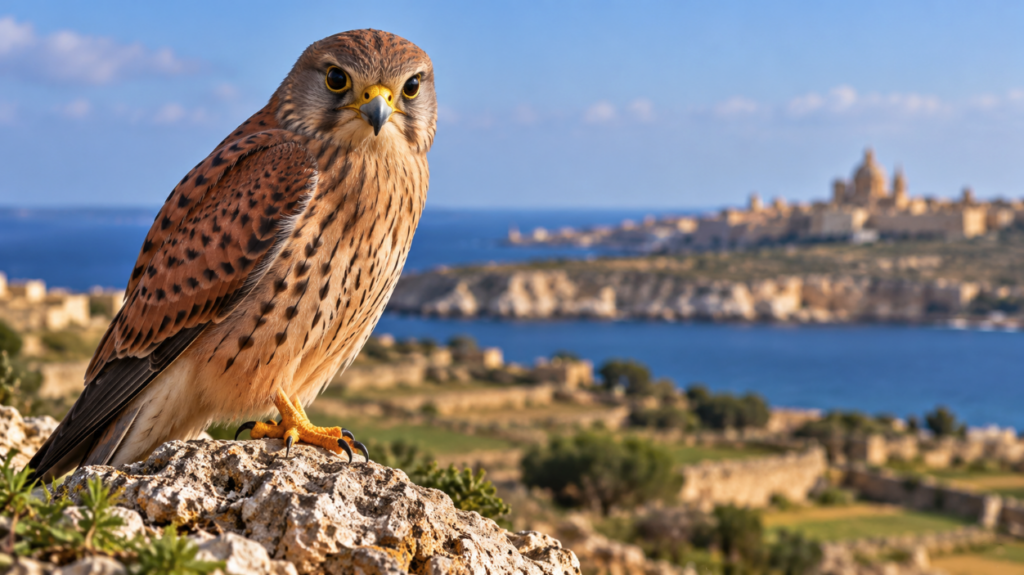
Għasri survived being shot. She was rescued in Gozo, treated, rehabilitated and released back into the wild. She crossed the Mediterranean, spent the summer in southern Italy and found her way back to Malta on 16 October.
Four days later, she was dead.
Her GPS tracker recorded her final movements near a trapping site and hunting hide in Fiddien. Later that evening, the device transmitted from the sea off Miġra l-Ferħa, suggesting that the bird’s remains had been dumped there. The authorities investigated, but the remains could not be recovered. Nobody has been publicly identified as responsible, and the precise circumstances have yet to be established.
Għasri’s story is heartbreaking. It is also an indictment of a country that continues to struggle with the illegal killing of protected birds while its political establishment considers making the penalties for hunting offences more lenient.
And before somebody reaches for the familiar defence of hunting as a Maltese tradition, let us get one thing straight: tradition is not a moral exemption.
Plenty of things were once traditional. That never made them right. A practice does not become immune from scrutiny because generations have indulged in it, because it has political supporters or because challenging it might upset an organised lobby.
The question is not whether hunting has a history in Malta. Of course it does. The question is whether that history entitles anyone to special treatment when the law protects the birds being shot.
It does not.
The latest controversy concerns proposals to amend penalties under the Conservation of Wild Birds Regulations. On 7 October, the ORNIS Committee approved proposals after being shown five PowerPoint slides rather than the actual wording of the legislative amendments. BirdLife Malta opposed the changes, while the hunting federation FKNK supported them. The Environment and Resources Authority abstained. The government has yet to determine its next steps.
The hunting lobby argues that reform is about proportionality, particularly for minor administrative breaches. That argument cannot simply be dismissed. A technical mistake should not automatically attract the same sanction as deliberately killing a protected species.
But that is precisely why the government should publish the proposed legislation and explain, line by line, what it intends to change. Why should a committee be asked to approve amendments without seeing their actual wording? Why is the public expected to trust assurances when the legal text remains unavailable for scrutiny?
And why, at a time when protected birds continue to be killed illegally, is reducing penalties even a political priority?
These are not abstract questions. In September, a hunter was apprehended after allegedly killing a protected kestrel in Ħal Farruġ, an incident BirdLife Malta said was caught on camera. The latest case involving Għasri adds to a deeply disturbing pattern of protected birds being targeted during migration.
Not every hunter breaks the law, and it would be wrong to accuse an entire community of crimes committed by individuals. But that observation must not become a convenient way of avoiding the real issue. Law-abiding hunters have nothing to fear from serious penalties for deliberate illegal killing. Those penalties protect the rules under which lawful activity is permitted in the first place.
A hunting licence is a privilege subject to conditions, not a hereditary entitlement. Nobody has a fundamental right to shoot a protected bird, and nobody should expect the state to make it easier to regain a licence after serious offences without a convincing, transparent justification.
The deeper problem is political. Malta’s governments have repeatedly treated hunting as a constituency to be accommodated rather than a public policy to be defended on its merits. Both major parties have offered assurances that hunting and trapping will be safeguarded. When political support becomes more important than the effective protection of wildlife, the law risks being negotiated around the interests of those it is supposed to regulate.
That is not respect for tradition. It is political timidity.
Malta lies on one of the Mediterranean’s important migratory routes. The birds passing over our islands are not targets delivered for the satisfaction of a local pastime. They are part of a natural world that crosses borders and belongs to no lobby. Their protection is a responsibility that Malta has accepted in law and should honour in practice.
Għasri was given a second chance by people who cared enough to rescue her. She survived a gunshot, recovered and made a journey across the sea. Four days after returning, her story ended in circumstances that demand a serious investigation.
We do not yet know who was responsible. We do know that weakening wildlife penalties would send precisely the wrong message while illegal killing remains a serious concern.
The government should abandon any proposal that weakens the deterrent against killing protected birds. Publish the legislation, strengthen enforcement and stop treating the demands of the hunting lobby as though they carry more weight than the public interest.
A tradition worth defending should be able to withstand scrutiny. If it depends on political protection from the consequences of breaking the law, it deserves neither deference nor special treatment.
Malta does not need to choose between its traditions and its natural heritage. It needs the courage to recognise that no tradition gives anyone the right to destroy it.
Sources
Times of Malta – Rehabilitated kestrel killed just four days after returning to Malta.
Times of Malta – Ornis backs hunting penalty changes without seeing law.
The Malta Independent – Hunter apprehended after protected Common Kestrel killed at Ħal Farruġ – BirdLife.