
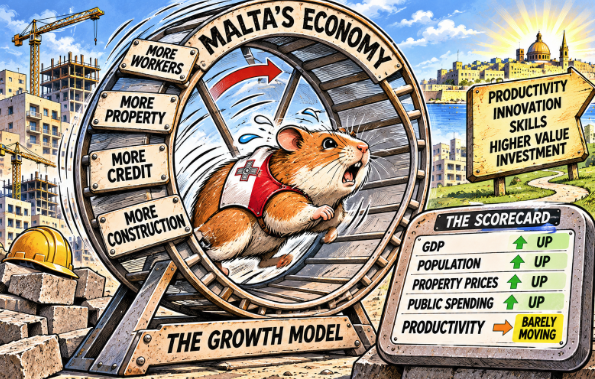
There is something distinctly hamster-like about Malta’s economic model. We keep running faster, adding more workers, building more apartments, extending more credit and pumping more money into an economy that must constantly expand simply to sustain its own momentum.
The wheel keeps turning. GDP keeps growing. Construction cranes keep multiplying. Yet are we actually getting anywhere?
That is the uncomfortable question raised by Central Bank Governor Alexander Demarco in his address to the Institute for Financial Services Malta on Friday. His warning was not that Malta is heading for an economic crash. Quite the opposite: he acknowledged the country’s resilience, the strength of its financial system and the solid performance of the economy. But he cautioned against complacency, arguing that Malta must rely less on expanding its workforce and more on productivity, smarter investment and less labour-intensive activity.
It is a message worth taking seriously.
Almost three-quarters of resident bank lending is now tied to mortgages and lending to construction, real estate and accommodation. Credit is growing faster than GDP, with particularly strong growth in these sectors. The Governor rightly pointed out that a banking system can be profitable and financially sound today without necessarily being well positioned to finance the economy Malta needs tomorrow.
There is nothing inherently wrong with property investment. Construction provides jobs, housing is essential and the property sector is an important part of our economy. Nor should we dismiss the contribution made by foreign workers, without whom many businesses would struggle to operate. The problem is not any one of these things in isolation. It is our growing dependence on the same formula.
More workers create demand for more housing. More housing requires more construction. More construction requires more workers, more credit and more infrastructure. A larger population means greater demand for transport, energy, water, waste management and public services. The economy expands, but so does the machinery required to keep it expanding.
This is where the hamster wheel becomes more than a convenient metaphor.
The European Commission’s latest economic forecast expects Malta to continue growing, but also points to a labour market heavily dependent on foreign workers, rising public expenditure and a deficit expected to remain at 2.8% of GDP over the next two years. Growth is not the problem. The question is whether the country is making the necessary changes to sustain it without continually increasing the demands placed on its limited resources.
Productivity must become more than a fashionable word in speeches and policy documents. It means producing greater value from the resources we already have. It means businesses investing in technology, automation, skills and better processes rather than simply recruiting another person whenever demand increases. It means making investment in productive enterprise more attractive than endlessly channeling capital into property.
And it means recognising that buying the latest software or installing an artificial intelligence tool does not automatically make a business more productive. As Demarco himself observed, technology must be accompanied by changes in working practices and investment in reskilling.
Government has an equally important responsibility. Infrastructure must anticipate economic activity rather than perpetually chase it. Public spending should be judged by the results it delivers, not the money allocated or the number of initiatives announced. Subsidies may be necessary to protect households and businesses, but they must be affordable, properly targeted and sustainable.
None of this requires an economic revolution, nor does it justify abruptly dismantling a model that has delivered prosperity. It requires something considerably more difficult: the willingness to question assumptions that have become politically and commercially convenient.
For too long, success has been measured by how much more we can accommodate, build, borrow and consume. We have become remarkably good at expanding the wheel.
But a hamster can spend an entire day running furiously and remain exactly where it started. Malta cannot afford to confuse the movement of its economy with the progress of its people.
The challenge now is not to run faster. It is to get off the wheel and decide where we actually want to go.
Sources
Central Bank of Malta – Governor Demarco’s official speech
PwC Malta – Economic update, spring 2026
Newsbook – Il-Bank Ċentrali jwissi dwar iż-żieda fis-self għall-proprjetà f’Malta
European Commission – Malta Economic Forecast