
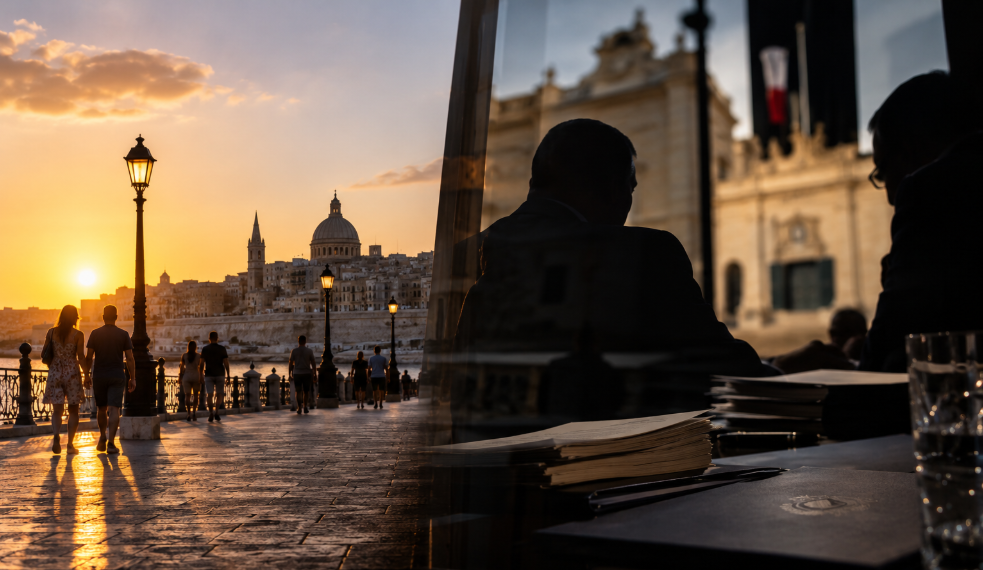
Malta ranks among the world’s safest countries. Yet its safeguards against excessive government power are deteriorating. Public safety matters, but so does the safety of citizens from those who wield power in their name.
There is a statistic the government will be happy to publicise: Malta ranks tenth in the world for order and security.
There is another it may be less eager to discuss. In the World Justice Project’s 2026 Rule of Law Index, Malta ranks 49th globally for constraints on government power — down from 39th in 2024 and 43rd last year. Within the European Union, EFTA and North America grouping, we languish in 27th place out of 31 countries.
So, Malta is “safe”. But safe from what, exactly?
If safety means being able to walk down the street without fearing violence, Malta performs well. That matters. Public security is a fundamental responsibility of the state, and we should not dismiss a strong result simply because it is inconvenient to a wider argument.
But safety is not just about what happens in the street. It is also about what happens in the corridors of power, behind closed doors and in the decisions taken with public money, public authority and public trust.
Corruption is not some lesser offence against society because it happens in an office rather than an alleyway. The abuse of public office, the misuse of taxpayers’ money and the bending of institutions to serve private or political interests can damage a country for years. When accountability fails, the public pays – sometimes financially, sometimes through lost opportunities, and sometimes through the erosion of trust in democracy itself.
The index does not prove that a particular politician has committed a crime. It does, however, measure whether the institutions meant to restrain power and sanction misconduct are doing their job effectively. And Malta’s results are troubling.
The score for legislative constraints on government power is just 0.48 out of one. The score for the effective sanctioning of official misconduct is also 0.48. On resistance to corruption in the legislative branch, Malta scores a dismal 0.33. These are not minor blemishes on an otherwise immaculate record. They concern the very mechanisms that should prevent public authority from becoming a shield for those who exercise it.
And the trend is going in the wrong direction. Malta’s overall ranking has risen to 29th out of 143 countries, but its overall score remains at 0.67. A better position in a league table is hardly a triumph when the underlying score has not improved and the safeguards against excessive power have slipped further down the rankings. The country may be doing well in one dimension of the rule of law while failing to make convincing progress in another.
A government cannot have it both ways. It cannot celebrate the state’s capacity to maintain order while treating scrutiny of that state as an irritation. A parliamentary majority is a mandate to govern, not permission to govern without effective checks. Independent institutions are not enemies of government. A free press is not an inconvenience to be managed. Parliamentary scrutiny is not a performance staged between elections.
Yet Malta’s political culture too often treats accountability as a weapon to be demanded when one’s opponents are in office and resisted when one’s own side holds power. The principle becomes negotiable. The standards change with the colour of the government.
That is precisely why institutional safeguards matter. They must work regardless of who is prime minister, which party commands Parliament or whose allies stand to benefit. Otherwise, accountability depends not on rules but on political convenience.
There are practical consequences. Citizens need to know that complaints against the state will be handled fairly. Businesses need confidence that decisions are made according to rules rather than connections. Taxpayers need assurance that public money is properly scrutinised. And anyone who believes that wrongdoing has occurred must be able to expect a serious, independent process — not a contest of political loyalties.
The government should respond to these findings with more than a list of reforms already announced or assurances that progress is being made. It should demonstrate that Parliament can scrutinise the executive effectively, that information held by public bodies is genuinely accessible, that oversight institutions have the resources and independence to act, and that proven misconduct carries meaningful consequences.
None of this requires us to declare Malta a failed state. It requires us to stop confusing a good public-safety ranking with a clean bill of health for democracy.
We should be proud when Malta is safe. But we should be equally unwilling to accept a system in which those who wield power are insufficiently constrained, wrongdoing is inadequately sanctioned or accountability becomes optional when politically inconvenient.
The real test of a safe country is not merely whether its citizens are protected from street criminals, but whether they are also protected from those who exploit public office, political influence or institutional weaknesses for their own ends.
Arguably, these are the more dangerous criminals: their actions are concealed behind respectable titles, wrapped in the language of public service and disguised as legitimate decisions, while the institutions meant to expose and punish wrongdoing may themselves be weakened, manipulated or circumvented.
The former may threaten our personal safety; the latter can undermine the very institutions meant to protect us. A country is not truly safe if those entrusted with power are not subject to the same laws, scrutiny and consequences as everyone else.
So, Malta, are we safe?
The answer depends on whether we are prepared to look beyond the reassuring headline and confront the uncomfortable question beneath it: who protects the public when the problem is not disorder on our streets, but the failure to hold power to account?
Sources