
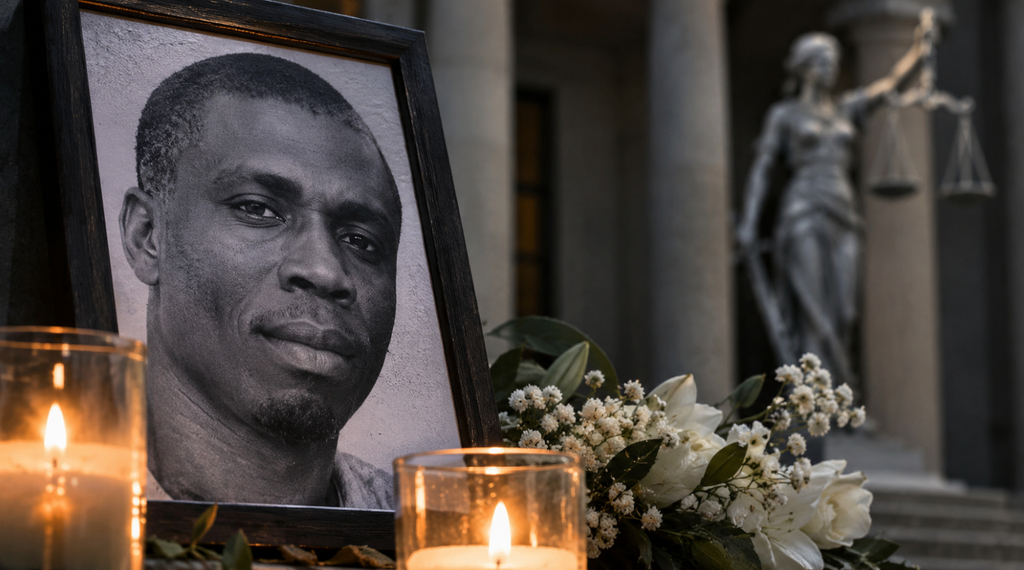
There are moments when a court verdict leaves a country struggling to understand what has just happened. The jury’s decision in the trial arising from the murder of Lassana Cissé is one of them.
More than seven years after a 42-year-old father of two from the Ivory Coast was shot dead in Ħal Far, former Armed Forces of Malta soldier Lorin Scicluna has been acquitted of his murder by an eight-to-one jury verdict. He was also acquitted of the attempted murder of three other men.
The jury did, however, find him guilty of grievously injuring May Malimi, by six votes to three, and of using a vehicle without registration plates, unanimously.
These are the findings. They must be respected. The presumption of innocence and the requirement to prove guilt beyond reasonable doubt are not optional principles that apply only when a verdict meets public expectations.
But respecting a verdict does not mean suspending the right to question what it means for public confidence in the justice system.
The evidence reported during the trial makes the outcome particularly difficult for many people to comprehend. Scicluna admitted that he and fellow former soldier Francesco Fenech had previously driven around Ħal Far looking for Black people to harass. He acknowledged being present on the night Cissé was killed, but maintained that Fenech had fired the shots without his knowledge or agreement.
The prosecution argued that Scicluna was criminally responsible for the killing, whether or not he had personally pulled the trigger. It pointed to the vehicle, the firearm recovered beneath his bed and the changing accounts he had given investigators. The defence argued that the evidence did not establish his guilt beyond reasonable doubt.
The judge specifically directed the jury that a person could be guilty of murder as an accomplice if there had been a common intention to kill, even if that person had not fired the weapon. The jurors were also reminded that Fenech was not on trial and that they had to decide the charges against Scicluna on the evidence before them.
They returned an acquittal.
It is important to understand what this means – and what it does not. It does not establish that the jury was wrong, that the judge failed in her duty, or that the accused was responsible for a crime of which he was acquitted. Nor does it settle the separate criminal proceedings against Fenech, who remains subject to the presumption of innocence.
But it leaves a series of questions that cannot simply be dismissed as public outrage.
Why did a case of such gravity take more than seven years to reach a jury? Were all investigative avenues pursued effectively? Was the prosecution able to present the strongest possible case? Did the legal process adequately address the evidence of racial hostility and the circumstances surrounding the attack?
And what does this verdict tell us about the ability of our justice system to deal with crimes motivated by racism?
Cissé was not simply the victim of a random act of violence. The prosecution presented the case as a racially motivated attack, and the trial heard testimony about the accused’s previous conduct towards Black people. The jury’s verdict must be understood within the specific charges and evidence it considered, but the broader issue of racism does not disappear because a murder charge ends in acquittal.
There is also a wider institutional question. This is the second high-profile jury acquittal in recent months to prompt calls for a review of Malta’s jury system, following the verdict in the Yorgen Fenech case. Civil society organisations have questioned whether the current system is sufficiently equipped to deal with complex, high-profile trials. Some have called for its abolition.
That debate deserves more than an emotional reaction. Jury trials are an important safeguard, but no institution should be beyond scrutiny. If the system is to retain public confidence, there must be a serious examination of its operation, the quality of investigations and prosecutions, and the way complex evidence is presented to jurors.
The answer cannot be to demand convictions whenever a case shocks the public. That would be a dangerous abandonment of the very principles that protect everyone from arbitrary justice.
But neither can the answer be to treat every acquittal as the end of the conversation.
Lassana Cissé’s family has waited more than seven years. The proceedings involving another accused person remain outstanding. The questions raised by this case therefore remain very much alive.
Justice must be impartial, regardless of the victim’s nationality, race or social standing. It must also be seen to be effective. When the public struggles to understand how a case of this magnitude has concluded, institutions have a responsibility to explain the process, examine its weaknesses and learn from it.
A verdict closes one chapter of a criminal case. It does not necessarily close the questions that the case has left behind.
And it certainly should not close the conversation about whether every person in Malta can expect the same protection, the same seriousness and the same commitment to justice.
Sources
Times of Malta – Lorin Scicluna acquitted of Lassana Cisse murder
MaltaToday – Lorin Scicluna acquitted of Lassana Cisse murder but found guilty of grievously injuring another man
The Shift – Jury clears former soldier in Lassana Cisse killing
Times of Malta – ‘End the jury system now’: Outrage over Lassana Cisse murder acquittal
The Malta Independent – Malta’s justice system has a serious problem; we cannot keep looking away – Repubblika
Times of Malta – Lorin Scicluna was offered a 30-year plea deal, but refused it