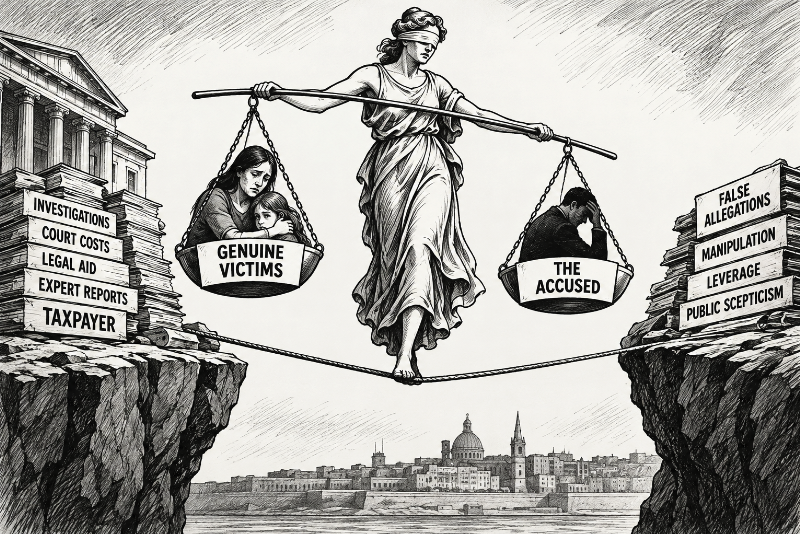
There is a difficult question at the heart of domestic violence proceedings: when a complainant asks for a case to be dropped, should the justice system simply close the file and move on?
The case involving Nazzareno Dalli, whose pregnant former partner asked the court to discontinue domestic violence proceedings after saying she no longer feared him and wished to reconcile, brings this dilemma into sharp focus.
The court granted her request. That decision does not establish that the original allegations were false, any more than the original complaint established guilt. But it raises questions that extend well beyond this particular case.
Domestic violence is rarely straightforward. Fear, financial dependence, children, pregnancy, emotional attachment and the hope that a partner will change can all influence a complainant’s decisions. Someone who reports abuse may later genuinely wish to reconcile. Equally, a withdrawal may result from intimidation, pressure or fear of the consequences of pursuing the case.
The justice system must recognise both possibilities without assuming either.
A complainant is not the property of the state, to be directed according to what officials consider best. Adults have the right to make decisions about their own lives, including decisions others may consider unwise. Yet domestic violence cannot always be treated as a private dispute that ends simply because one party wishes it to end. Where credible evidence of a criminal offence exists, the state has a legitimate interest in determining whether proceedings should continue.
That balance becomes more difficult when allegations are deliberately fabricated or legal proceedings are used to gain leverage in a personal dispute.
A false accusation can inflict damage that no subsequent acquittal or apology can fully repair. Reputations are tarnished, relationships destroyed and livelihoods jeopardised. Even when the truth eventually emerges, suspicion can linger long after the legal process has ended.
There is another casualty: the genuine victim.
Every demonstrably fabricated allegation gives ammunition to those who dismiss domestic violence complaints as exaggeration, revenge or manipulation. The next woman who reports abuse may find herself facing greater scepticism because somebody else abused the system. Genuine victims should not have to carry the burden of another person’s dishonesty.
This is why the distinction between a false allegation and an allegation that is withdrawn, unproven or impossible to prosecute is so important. These are not interchangeable categories. A case being discontinued does not prove that the complaint was fabricated, just as a complaint being made does not prove that the accused is guilty.
But where deliberate dishonesty or abuse of process can be established, there should be consequences.
There is also the question of who pays. Police investigations, court sittings, legal aid and professional assessments are funded by taxpayers, including people who may struggle to afford legal representation themselves. In April, a Maltese magistrate raised concerns about withdrawn domestic violence cases, the potential waste of public resources and the possibility of complaints being made in bad faith. She called for clearer powers to recover costs in appropriate circumstances.
The proposal deserves serious consideration. No complainant should be penalised merely for changing her mind or being unable to sustain an allegation. But where a court establishes deliberate fabrication or abuse of procedure, why should the public automatically absorb the cost?
Any such measures would need safeguards, due process and careful judicial scrutiny. Otherwise, the prospect of financial penalties could deter genuine victims from coming forward.
That would defeat the very purpose of the law.
Lady Justice must therefore walk a fine line. She must protect the vulnerable without treating them as incapable of making decisions. She must defend the accused without allowing genuine abuse to go unpunished. And she must safeguard public resources without turning access to justice into a privilege reserved for those who can afford it.
This is not a call to believe victims less. It is a call to take evidence more seriously, investigate properly and distinguish compassion from credulity.
Justice must protect the genuine victim without sacrificing the innocent accused. When either is abandoned, it is not only the individuals concerned who suffer. Public confidence in the entire system is put at risk.
Sources
- Times of Malta — Pregnant ex asks court to drop domestic violence case against Nazzareno Dalli
- MaltaToday — Court expresses concern over increase of withdrawn domestic violence cases
- Parliament of Malta — Gender-Based Violence and Domestic Violence Act