
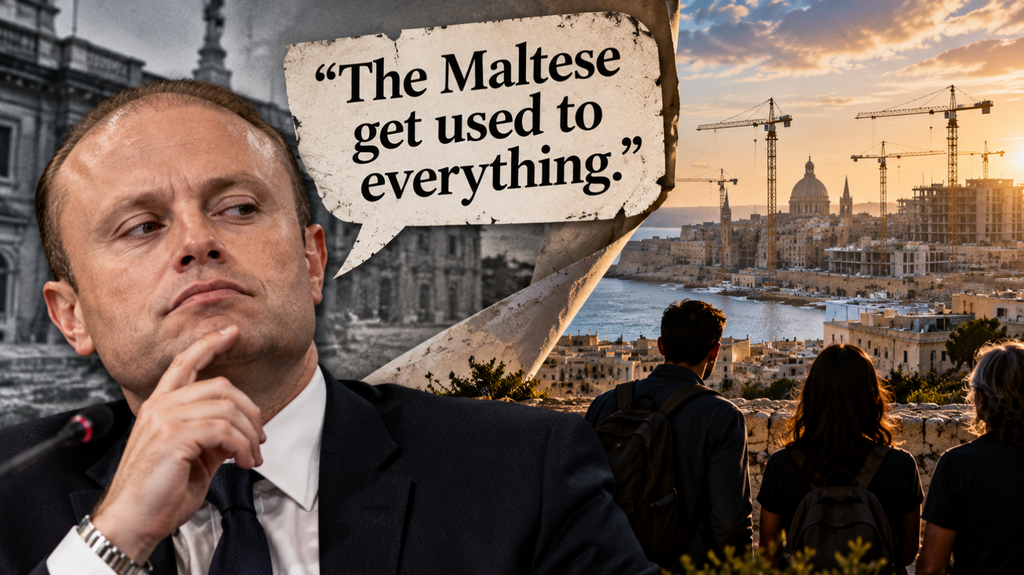
The former prime minister says he cannot remember telling environmental activists that Maltese people get used to everything. His response, however, is a reminder of a political habit that has outlived his premiership.
“The Maltese get used to everything.”
Eleven years after an alleged remark by Joseph Muscat at Castille, three environmental activists say they still remember it clearly. They recall warning the then prime minister about overdevelopment and overtourism, only to be met with a casual observation that the public would eventually tolerate whatever was thrown at it.
Muscat says he cannot recall using those words. He is entitled to that qualification. Memory is imperfect, and a recollection of a private meeting in 2015 is not a recording. He has also argued that the exchange needs context, suggesting that selective quotations, more than a decade later, can distort what actually happened.
Fair enough. Context matters. But it is worth examining the response, because it illustrates a familiar feature of Muscat’s public conduct: the remarkable ability to turn a question about himself into a discussion about everyone else.
The activists’ recollection is particularly striking because of the circumstances. The meeting concerned the proposed American University of Malta at Żonqor Point, a plan that provoked considerable opposition before the project was relocated to Dock 1 in Cospicua. The wider concerns included the relentless pressure of development and the transformation of Malta’s landscape.
These were not obscure anxieties invented by a handful of professional protesters. They were questions about the country Malta was becoming, the costs of economic growth and the extent to which citizens could influence decisions affecting their own surroundings.
If Muscat did say that Maltese people get used to everything, the remark would reveal a profoundly cynical understanding of public opinion. It would suggest that the test of a policy was not whether it was right, sustainable or democratically justified, but whether the population could eventually be conditioned to accept it.
There is a difference between resilience and resignation. A population that adapts to worsening conditions is not necessarily consenting to them. People tolerate traffic, construction noise, crowded roads and diminished open spaces because they have jobs to reach, children to raise and lives to lead. Their ability to endure inconvenience should not be confused with approval of the decisions that produced it.
Muscat’s reply, however, moves quickly beyond the substance of the allegation. He questions why the activists did not disclose the remark at the time, arguing that a statement made in such a strong exchange should not be selectively recalled eleven years later.
That is a legitimate question about recollection and credibility. It is not a complete answer. People may remember an encounter for years before deciding to recount it publicly; the delay does not, by itself, prove that their recollection is false. Nor does it establish that it is accurate. The sensible course is to consider what was said, the circumstances in which it was said and the credibility of those recalling it.
But Muscat has form when it comes to shifting the argument. His responses to uncomfortable questions have often involved challenging the motives of his critics, questioning the conduct of those raising concerns or widening the discussion until the original issue becomes almost incidental. The familiar tu quoque manoeuvre — effectively, “what about the other side?” — can be useful political theatre. It is not a substitute for an answer.
A person’s motives may be relevant. They do not determine whether the underlying criticism is valid.
This matters because Muscat was not an ordinary politician making an ill-judged comment at a public meeting. He was prime minister, occupying the highest executive office in the country. His administration presided over a period of rapid economic expansion, but also mounting concerns about planning, environmental degradation and the relationship between political power and private business.
Growth was real. So were the questions about its costs. To raise those questions was not to oppose prosperity; it was to ask what prosperity was supposed to achieve, and for whom.
The former prime minister may dispute the activists’ recollection. He may argue that the quotation has been stripped of context. Those are arguments he is entitled to make. But the more he concentrates on the timing and motives of his critics, the more he risks reinforcing the impression that scrutiny is something to be outmanoeuvred rather than answered.
Malta has spent years debating the consequences of a political culture in which the powerful could become accustomed to public criticism without necessarily allowing it to alter their behaviour.
Perhaps the activists remember the precise words. Perhaps they remember the substance rather than the exact formulation. Without a recording, we should be cautious about claiming certainty.
But the question their recollection raises remains entirely relevant. Does a government regard public tolerance as permission to continue, or does it recognise that citizens have a right to demand something better?
The Maltese may indeed get used to almost anything. That is not a compliment to those who govern them.
A democracy should never confuse the public’s capacity to endure with its willingness to consent.
Sources