
There is a particular irony when a politician whose public profile is built around questions of justice, accountability and the rule of law finds himself on the receiving end of an adverse finding by the very standards system he is expected to respect.
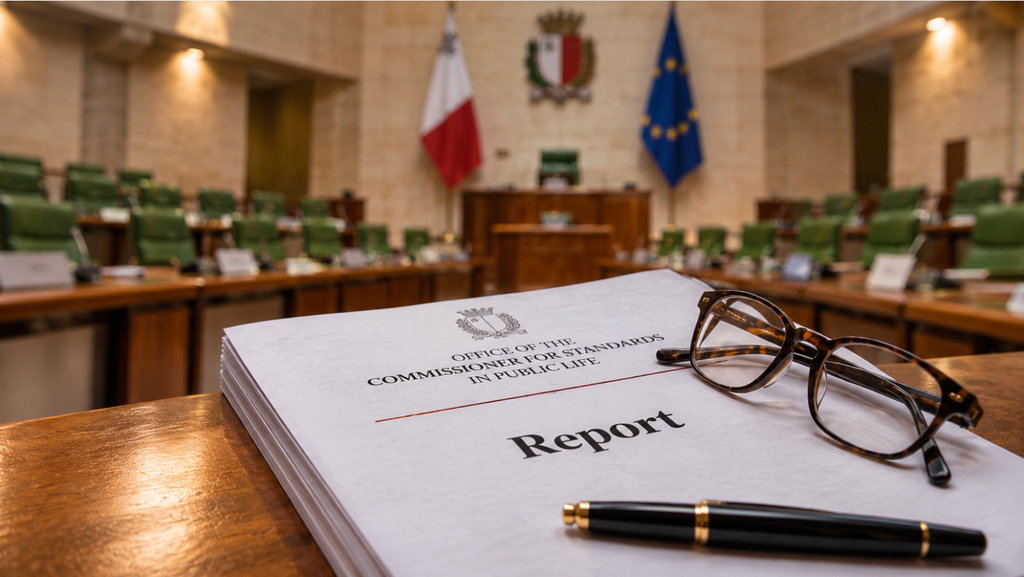
Joe Giglio, the Nationalist Party’s spokesperson on justice, has been found by the Commissioner for Standards in Public Life to have breached parliamentary ethics rules. His offence was failing to declare a professional interest while Parliament debated legislation that subsequently allowed two of his clients to settle tax-evasion proceedings and avoid criminal charges.
The circumstances deserve more than a passing mention.
In August 2025, Parliament debated legislation creating a route for people facing criminal proceedings over tax evasion and related offences to settle with the tax authorities. At the time, Giglio was representing Nigel and Mikaela Scerri, who were facing proceedings involving alleged tax evasion and money laundering of approximately €1.5 million. They subsequently reached a settlement using the new law, and their criminal proceedings were dropped.
Giglio voted against the legislation. That is an important fact, and the Commissioner treated it as a mitigating factor. But it does not answer the question at the heart of the finding: why was his professional connection not declared before Parliament considered the bill?
Giglio’s defence is that the interpretation of conflict-of-interest rules is almost absurd. If the principle were applied too broadly, he argues, MPs who are doctors, lawyers or members of other professions could find themselves declaring interests whenever legislation touched their professional fields.
It is a convenient argument, but it is not quite the argument the Commissioner made.
The distinction is between legislation affecting an entire profession and legislation conferring a direct and considerable benefit on specific clients represented by a particular MP. The Commissioner explicitly recognised that distinction. He also concluded that Giglio could have declared his professional interest without identifying his clients or disclosing confidential information.
In other words, this was not a demand that a lawyer reveal the contents of his clients’ files. It was a requirement to disclose that he had a professional connection relevant to the legislation being debated.
The Commissioner considered the breach sufficiently minor to propose a written apology and an undertaking to observe the rules in future. Giglio refused.
That refusal has become almost as important as the original omission. An independent finding was made. A relatively modest remedy was proposed. Rather than accept it and move on, Giglio has chosen to challenge the interpretation and the reasoning behind it. He is entitled to disagree. But disagreement does not erase the finding, nor does it make the underlying questions disappear.
There is a wider lesson here, particularly for politicians who make accountability and institutional integrity central to their public arguments.
Standards of conduct cannot be invoked selectively. They cannot be demanded of political opponents while being treated as unreasonable technicalities when they apply closer to home. Nor can the credibility of an independent Commissioner depend on whether the person under investigation happens to agree with the conclusion.
This is not an allegation of corruption, nor is it a claim that Giglio supported legislation from which his clients benefited. The Commissioner did not make either finding. It is a question of transparency and the obligation of elected representatives to disclose interests that could reasonably affect public confidence in their parliamentary conduct.
The Nationalist Party has every right to demand accountability from government. Indeed, that is one of the Opposition’s essential responsibilities. But the credibility of such demands rests partly on the willingness of its own representatives to submit themselves to the same standards.
The moral authority of public life is not established by the strength of one’s accusations against others. It is established by the consistency with which one accepts scrutiny… particulary on oneself.
Joe Giglio has spent much of his political career discussing the importance of justice and accountability. His response to this finding has now placed those principles under a different kind of scrutiny.
And that, perhaps, is the most uncomfortable part of this sordid affair.
Sources
Times of Malta – Joe Giglio breached ethics rules by not declaring interest in tax evasion bill
The Shift News – PN shadow Minister refuses to apologise following breach of ethics complaint by Caruana Galizia