
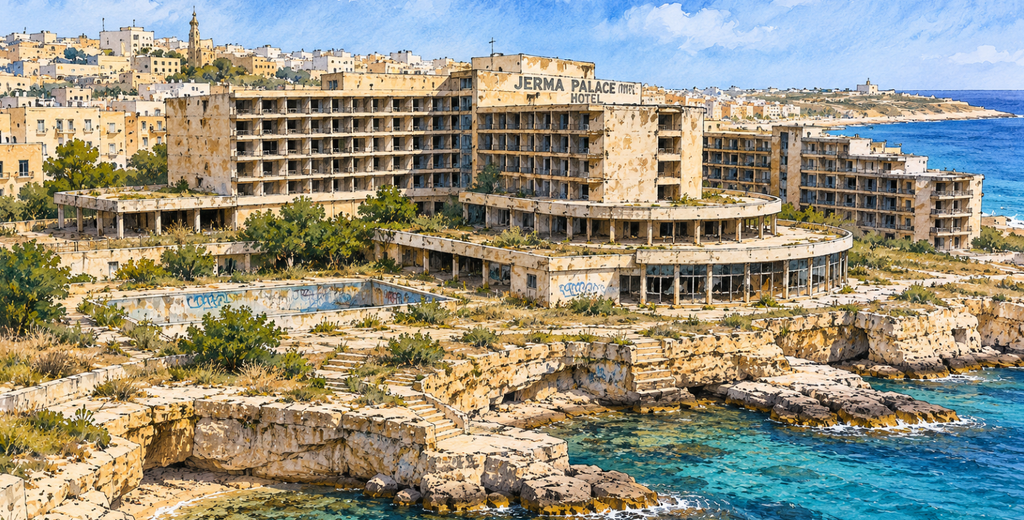
The proposed redevelopment of the former Jerma Palace Hotel is a major project, and there is nothing unreasonable about wanting to regenerate a site that has stood derelict for years. But before debating whether the scheme should be approved, there is a rather more basic question: can the documents assessing it be trusted to describe the project accurately?
Because something here simply does not add up. At least, that is what a formal submission by the Marsaskala Residents’ Network is alleging. And the discrepancies are far from trivial.
The group has identified conflicting figures in the environmental impact assessment. The official project description lists 134 hotel rooms, 155 residential units, 258 serviced apartments and 570 parking spaces. Yet other sections reportedly refer to 90 hotel rooms and 146 homes. Parking figures vary between 570 and 594 spaces, while elsewhere the documents refer to 330 spaces and 191 garages.
It gets worse. An ecological report apparently contains several paragraphs about a proposed waste-treatment facility beside the Magħtab landfill. One wonders how that particular project found its way into an assessment concerning Jerma.
These are not the only concerns. The Residents’ Network has questioned the traffic and air-quality modelling, the impact of extensive excavation on geology and heritage, and whether the surrounding infrastructure can cope with the additional demands. These are not peripheral details. They are precisely what an environmental impact assessment is supposed to establish.
Consider the scale of the proposal: a five-star hotel, 258 serviced apartments, 155 residential units, commercial facilities, a shopping mall, 570 parking spaces and 13,600 square metres of public open space. The consultation is due to close on 10 November. Yet the public is being asked to comment on documentation that apparently cannot agree on what is actually being proposed.
None of this automatically proves that the development is unsound, or that anyone deliberately misled the public. Large projects evolve; plans change and documents are revised. Discrepancies can happen. The developer and the consultants responsible deserve an opportunity to explain them.
But explanations must be provided, not presumed.
A public consultation is not a bureaucratic ritual to be completed before the machinery of approval moves on. It is meant to allow residents, local representatives and other interested parties to understand a proposal, scrutinise the evidence and make informed representations. They cannot do that properly when the basic figures contradict one another, or when passages from an apparently unrelated project appear in the assessment.
There is a wider issue here. Jerma needs regeneration. Investment is welcome, and the promise of substantial public open space deserves serious consideration. But regeneration is not a blank cheque, nor should the prospect of investment excuse inadequate scrutiny.
The Residents’ Network has also raised questions about the additional demands on water, wastewater and road infrastructure, and who will foot the bill. A private development should not quietly transfer the cost of making itself commercially viable to the surrounding community or the taxpayer. Those obligations must be established before decisions are taken, not negotiated after the fact.
A pro-growth planning system should welcome investment. It should also demand reliable evidence, clear obligations and competent regulation. That is not anti-development. It is what separates responsible investment from development at any cost.
The Environment and Resources Authority should require the applicant and the authors of the assessment to reconcile the conflicting figures, remove irrelevant material and clarify the assumptions underpinning their conclusions. If the corrections affect the findings, the public must be given a proper opportunity to examine the revised assessment. The consultation deadline should not become an excuse to rush past unresolved questions.
The people of Marsaskala are not asking for a veto over development. They are asking a rather straightforward question: what exactly is being built, what will it cost the surrounding community, and what will its impact be?
If those responsible cannot provide consistent answers to the most basic questions, perhaps the problem is not the residents’ opposition to development.
Perhaps it is the paperwork.
Sources
The Shift News – Jerma or Magħtab? Residents question reference in hotel redevelopment study
The Malta Independent – Jerma redevelopment EIA should not be accepted in present form, residents’ group says
Newsbook – Appell lill-ERA biex ma jaċċettawx l-istudju tal-EIA dwar is-sit ta’ Jerma Palace
Government of Malta – Public consultation on the Jerma EIA, PA 00437/23
Environment and Resources Authority – Jerma Palace project file and EIA documentation