
Are we the only ones who find this whole affair extraordinarily convoluted? Or, to put it less politely, a little incestuous?
Let us get the sequence straight.
In 2017, Clyde Caruana was heading Jobsplus, the government’s own agency responsible for employment. At the request of then Prime Minister Joseph Muscat, he undertook a study of Malta’s population growth and its implications for housing, healthcare, education, infrastructure and the labour market.
He says he did so in a personal capacity, as an economist, outside his normal working hours. The exercise took approximately a year and produced a report of almost 300 pages.
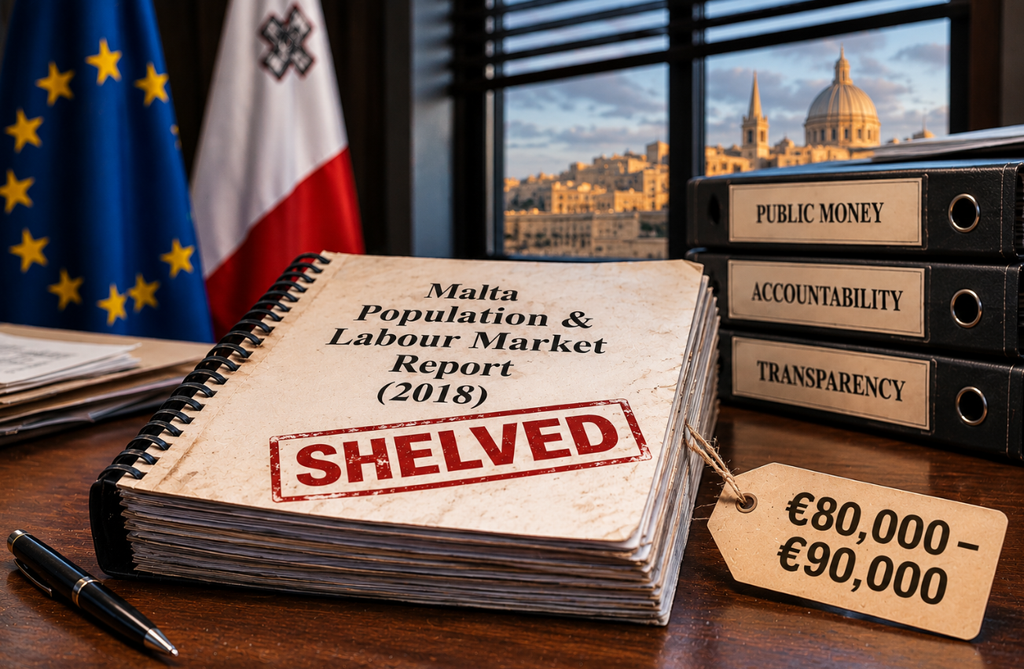
By his own admission in Parliament, for this work, he was paid between €80,000 and €90,000.
The report was submitted to the Office of the Prime Minister in late 2018. Joseph Muscat has confirmed commissioning and receiving it. Yet the document was never published, never discussed by Cabinet and, by all accounts, disappeared into the administrative equivalent of a black hole.
The explanation offered is that the timing was unfortunate. There was a European Parliament election approaching, followed by the political turmoil that eventually brought down Muscat’s administration, and then the pandemic.
Apparently, there was always something more pressing than examining a 300-page report about the future of the country.
But the questions do not end with Joseph Muscat.
First, why was the chief executive of the country’s employment agency separately commissioned, in another professional capacity, to produce a report on a subject so closely connected to the responsibilities of the institution he headed? Caruana insists that he worked outside office hours and in a personal capacity. That is his explanation. The arrangement nevertheless deserves scrutiny.
More importantly, what exactly did the taxpayer receive for up to €90,000? A report that was never published, never formally debated and apparently never translated into policy? If the research was important enough for the Prime Minister to commission and the government to pay for, why was there no mechanism to ensure that its findings were properly considered?
And if the report was considered unsuitable, why was it not challenged, rejected or superseded through a transparent process?
Instead, we have a former Prime Minister who confirms receiving it, a present Prime Minister who says he has never seen it, and an author who says he cannot publish it without written permission. The public paid for the research, but apparently has no right to read it.
Then comes the part that makes Caruana’s own account particularly difficult to swallow.
He has since become one of the most vocal critics of Malta’s population-driven economic model. He has warned about the consequences of uncontrolled growth and imported labour. He says he spent years knocking on doors, trying to open people’s eyes and warning colleagues about the direction in which the country was heading.
And what did he do when those warnings apparently fell on deaf ears?
He stayed.
Caruana has explained that he is not someone who quits. He preferred to fight from within rather than resign.
What a convenient definition of courage.
There is a fundamental difference between standing by one’s convictions and clinging to one’s position while claiming to be fighting for those convictions. If he genuinely believed that the country’s economic model was unsustainable, that population growth was creating pressures the government was unwilling to confront, and that his own research had identified the danger, then at what point did he decide that the principle mattered more than his political career?
He could have made the report public. He could have demanded a proper debate. He could have refused to lend his credibility to an administration that, by his own account, was ignoring the warnings. He could have resigned and explained precisely why.
Instead, he remained part of the political establishment. He continued his journey through government and eventually became Finance Minister.
Perhaps he believed that he could achieve more from within. Perhaps he thought he could change things. But the public is entitled to ask whether this was really about principle, or whether political survival and advancement took precedence.
It is easy to present oneself as the man who saw it coming. It is considerably harder to explain why, having apparently seen it coming, one remained on the inside while the country continued in the same direction.
Caruana cannot have it both ways. He cannot claim the foresight of the report’s author while distancing himself from the political failure to act on it. He cannot portray himself as the lone voice of reason while asking us to overlook the fact that he chose to remain part of the very government he now says would not listen.
And he certainly should not expect applause for refusing to quit.
There is nothing inherently courageous about staying in office. Sometimes it takes considerably more courage to walk away, particularly when doing so might cost you influence, status or the next step in your political career.
We are not dealing with an obscure academic exercise. We are talking about the country’s economic model, its population trajectory and the pressure placed on practically every public service.
There is something profoundly wrong when government commissions expensive research, pays for it, apparently shelves it, and then continues governing as though the questions it raised do not exist.
Eight years later, the taxpayer is still being denied access to the report. The former Prime Minister confirms receiving it. The present Prime Minister says he has never seen it. And the author, now a senior figure in government, tells us he is not its custodian.
Perhaps the most revealing question is not who has the document.
It is who had the courage to stand by what it said… and who decided that staying in power was more important.
The public paid for the report. The public deserves to read it. And those who commissioned it, received it, shelved it or failed to act on it should have to explain themselves.
Eighty to ninety thousand euros is a considerable sum to spend on 300 pages of advice. It is an even more extraordinary sum if the man who wrote it now wants credit for having warned us, but none of the responsibility for having stayed while those warnings were ignored.
Sources
Times of Malta – Caruana received between €80,000 and €90,000 for unpublished population report
Times of Malta – ‘Labour shelved my 300-page warning on population growth’: Clyde Caruana
Times of Malta – Joseph Muscat confirms existence of Caruana’s 2018 population report
Times of Malta – OPM says Caruana never gave Robert Abela the population report
Malta Independent – Caruana refuses to table 300-page report