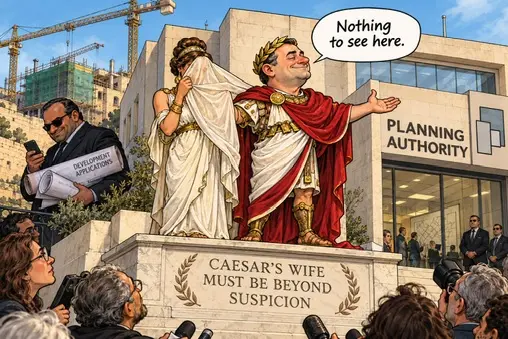
Robert Abela’s defence of Johann Buttigieg misses the point. Asked whether he still trusted the Planning Authority chief after the publication of his exchanges with Yorgen Fenech, the Prime Minister said Buttigieg was “doing a very good job”. When pressed on whether he trusted him not to repeat his closeness to business interests, Abela declined to answer and referred journalists to Buttigieg himself.
That is not really good enough.
Let us be clear about what this is not. There is no suggestion here that Buttigieg has been convicted of a crime. Nor should anyone confuse an association, an embarrassing conversation or a questionable judgement with proof of criminal wrongdoing. That is precisely why the argument needs to be made on a different level.
The head of the Planning Authority is not an ordinary civil servant. He heads the institution entrusted with decisions that can make or destroy fortunes, transform neighbourhoods and determine how Malta’s limited land is used. The authority’s legitimacy depends not merely on its decisions being lawful, but on people believing those decisions are made independently and in the public interest.
And this is where the published exchanges with Fenech become difficult to dismiss.
The messages show the two discussing planning-related projects while Buttigieg was at the helm of the regulator. In one exchange, Fenech suggested that they could “do a bit of business” together. Buttigieg replied that he would go into business with him wherever he wanted.
Buttigieg has since argued that the controversial exchange came shortly before he left the PA. A Times of Malta fact-check established that the particular conversation actually took place in March 2019 — around seven months before his departure.
That matters. Not because it proves a crime. It doesn’t. It matters because standards for public office are higher than the criminal threshold.
A judge deciding whether someone committed an offence asks whether the evidence meets the legal test. A government deciding whether someone should head a powerful regulator has a different responsibility: whether that person’s conduct, judgement and relationships inspire sufficient confidence in the institution they lead.
Those are not the same question. And Malta has learnt, at considerable cost, what happens when we insist on reducing every question of public ethics to the words “but is it illegal?”
Something can be legal and still be inappropriate. Something can be technically permissible and still destroy confidence. Something can fall short of a criminal offence and nevertheless make a person the wrong person to occupy a particular office.
That is not cancelling due process. It is recognising that public office carries obligations beyond avoiding prosecution.
The government may genuinely believe Buttigieg is doing a good job. It may point to the Planning Authority’s performance, its backlog reduction or other achievements. Those things deserve to be considered.
But the question is not simply whether Johann Buttigieg is competent. It is whether the Planning Authority can command public confidence with Johann Buttigieg at its helm… and that is a different test.
And it is one the government cannot outsource to Buttigieg himself. The regulator cannot be the judge of whether the public should trust the regulator.
If the government wants to keep him, then it should do more than repeat that he is doing a good job. It should explain, openly and convincingly, why the conduct now in the public domain is compatible with the standards expected of the person running Malta’s planning regulator.
Because in an institution as powerful and politically sensitive as the Planning Authority, the appearance of independence is not some cosmetic extra. It is an inherent part of the job.
Sources
- Times of Malta — fact-check dating the Buttigieg–Fenech exchange to March 2019.