
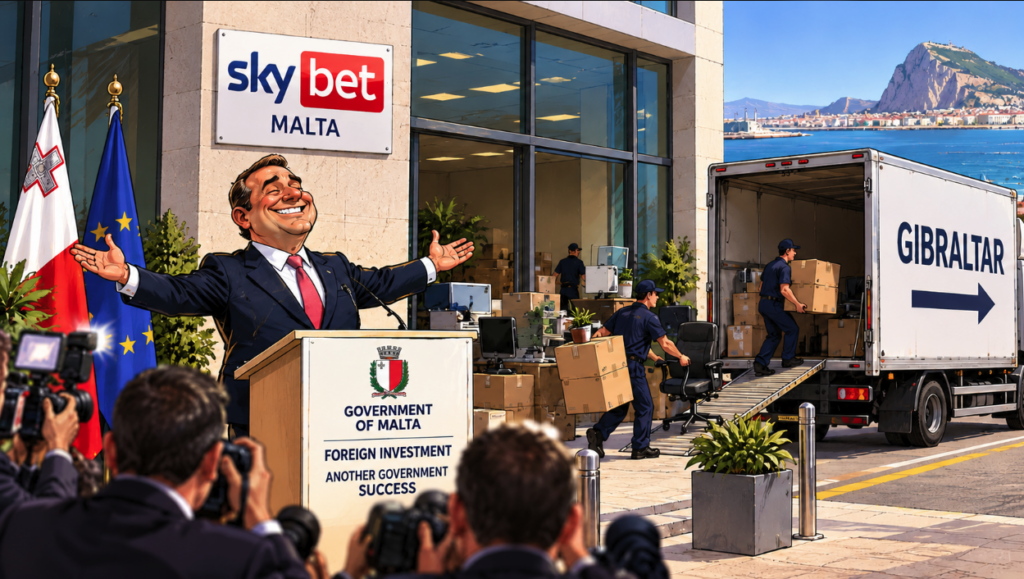
Malta’s economic success has become remarkably easy to announce. A company arrives, a minister smiles for the cameras, a press release speaks of confidence in Malta, and another investment is added to the government’s collection of achievements.
Then, sometimes before the applause has even faded, the company changes its plans.
Less than a year after Sky Bet’s commercial operation was moved to Malta, its parent company, Flutter Entertainment, is reportedly preparing to close the local office and transfer the operation to Gibraltar. Around 50 employees are said to be affected.
So much for the triumph.
The government cannot reasonably be expected to prevent every business from relocating. Companies make commercial decisions, markets change and international groups restructure. Nobody serious would demand a guarantee that every investor who arrives will stay forever.
But that is not the point. The question is why government is so eager to claim credit when companies arrive, yet so rarely held to account for the substance behind its economic announcements.
Every relocation becomes a vote of confidence. Every new office is evidence that Malta is thriving. Every corporate announcement is presented as another endorsement of the government’s economic model. Ministers are happy to stand beside the executives, collect the headlines and add another success story to the political brochure.
What happens afterwards is less photogenic.
In November 2025, Sky Bet’s relocation was presented as a significant development for Malta. Now, barely eleven months later, the operation is reportedly being dismantled. The story deserves attention not because one company is leaving, but because it exposes the weakness of a political culture that confuses announcements with achievements.
An investment announcement is not an economic strategy. A press release is not a guarantee of jobs. And a photograph with a corporate executive is not proof of lasting prosperity.
To be fair, Flutter’s wider restructuring is also being driven by substantial increases in British betting and gaming duties. The company has announced that up to 1,400 jobs could be affected across its UK and Ireland business. Its decision must therefore be understood within a broader commercial context, rather than presented as a straightforward verdict on Malta.
That qualification matters. It does not, however, excuse the government from answering a more fundamental question: what, precisely, was Malta supposed to gain from this relocation, and how durable were those gains ever likely to be?
How many jobs were genuinely created rather than transferred? How much decision-making authority was brought here? What expertise was developed locally? What commitments, if any, extended beyond the initial announcement? And what does government actually measure when it declares an investment a success?
These are perfectly reasonable questions. They are also the questions ministers should be answering before they celebrate, rather than after the company has decided to leave.
The people affected are not props in an economic success story. They are employees whose livelihoods and plans may now be disrupted. Their interests deserve more than a passing reference in a news report about corporate restructuring.
Nor should Malta confuse attracting internationally mobile operations with building a resilient economy. We need foreign investment, and we should welcome companies prepared to employ people, develop skills and contribute to the country’s productive capacity. But if our economic model depends excessively on activities that can be shifted elsewhere at short notice, the government should be honest about that vulnerability instead of dressing it up as an uninterrupted success story.
This requires more than another slogan about competitiveness. It requires investment in education, infrastructure, professional skills, regulatory predictability and the conditions that allow businesses to grow beyond the lifespan of a particular tax advantage or corporate calculation.
Above all, it requires government to stop taking credit for decisions it does not control while evading scrutiny over the policies it does.
If ministers wish to claim the credit when companies arrive, they should be prepared to explain what those investments delivered, what risks were involved and what lessons emerge when the plans change. That does not mean blaming government for every departure. It means demanding evidence rather than accepting self-congratulation as a substitute for economic policy.
Malta deserves an economy built on more than the next announcement and the next ministerial photo opportunity. It deserves an honest account of what creates lasting prosperity, what leaves us exposed and what government intends to do about it.
A company arriving in Malta is news. A company leaving is news too. Neither, on its own, proves that the government is succeeding or failing.
But when every arrival is advertised as proof of genius and every departure is treated as somebody else’s problem, we are no longer discussing economic policy. We are discussing political marketing.
And Malta has had quite enough of that.
The government does not need to guarantee that every investor stays. It does need to explain why its economic triumphs so often come with an expiry date.
Sources
MaltaToday – Flutter Entertainment closes Sky Bet offices in Malta
Flutter – Flutter announces restructure of UKI business.
NEXT.io – Exclusive: Flutter shuts Sky Bet Malta HQ —