
Malta has spent years using public money to attract airline routes and fill aircraft seats. If we believe that policy makes economic sense, we should judge Delta by the same standards as Ryanair, easyJet and Wizz Air.
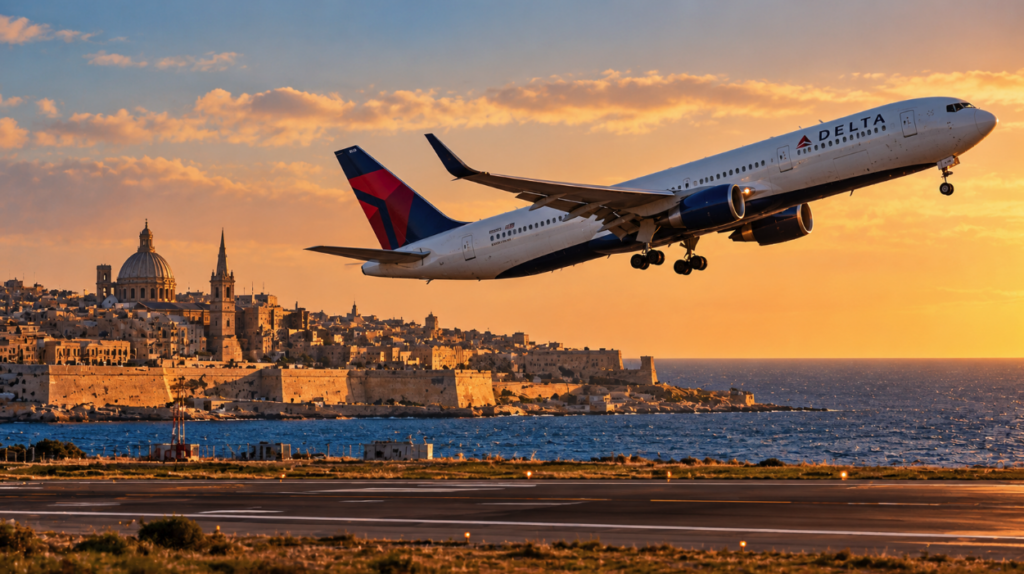
Apparently, when a low-cost airline receives public money to bring tourists to Malta, it is called route development. When an American airline seeks financial assistance to maintain a direct transatlantic connection, it suddenly becomes a matter of public outrage.
We might want to pause before joining the chorus.
According to The Shift, Delta Air Lines has asked the Maltese government for a multimillion-euro package of marketing and route-development assistance to continue its Malta-New York service in 2027. The airline reportedly received no government subsidy during its inaugural season this year. Questions sent to Delta and the Malta Tourism Authority by The Shift remained unanswered when the report was published.
Before we decide that this is an outrageous demand, let us remember that Malta has been using financial incentives to attract airlines since 2006. The arrival and expansion of low-cost carriers helped transform our connectivity, with successive governments embracing the principle that more routes and more passengers bring economic benefits.
Ryanair, easyJet, Wizz Air and other carriers have operated within an environment in which public authorities have used marketing and route-development agreements to encourage air connectivity. These arrangements have been described as marketing incentives rather than subsidies, but changing the label does not change the essential question: what does the taxpayer receive in return?
We have spent years accepting the principle that public money can be used to attract airlines, increase passenger numbers and support tourism. It is therefore difficult to understand why the same principle should suddenly become objectionable because the airline involved is Delta.
If we believe in the policy, we should defend it consistently. If we believe the policy is wrong, we should question it consistently too.
That does not mean Delta is automatically entitled to a cent. Nor should the history of airline incentives shield previous agreements from scrutiny. It means that the request should be assessed on its merits, rather than treated as scandalous simply because it involves a different airline, a longer route or a potentially larger financial commitment.
There is, in fact, a reasonable strategic argument for the New York connection. Delta launched three weekly flights between JFK and Malta in June. The government reported an average seat occupancy of 84% up to 21 September. The United States is a relatively small source market for Maltese tourism, but American visitors spend more per visit on average than tourists overall.
These figures are encouraging, although they do not prove that the route is profitable, that every passenger represents additional tourism, or that public assistance would generate a sufficient return. We should not confuse a full aircraft with a complete economic assessment.
Nevertheless, a direct transatlantic connection offers potential benefits beyond the immediate number of tourists arriving. It can improve accessibility for business travellers, strengthen commercial and cultural links, and help Malta compete for visitors who might otherwise choose another European destination. If the government wants to diversify tourism towards higher-value markets, maintaining such connectivity may be a legitimate objective.
The proper question is whether the proposed support is proportionate to the benefits expected.
How much is Delta asking for? What additional economic activity would the route generate? What commitments would the airline make in return? Would assistance be conditional on operating frequency, duration, passenger numbers or measurable marketing results? What happens if the promised benefits fail to materialise?
These are legitimate questions. Indeed, they are the questions that should have been asked consistently of every airline benefiting from public support.
A 2023 National Audit Office report examined airline incentive arrangements and found that auditors could not fully establish the basis on which certain payments had been determined. That is precisely why transparency matters. A policy can be economically defensible while its administration remains open to criticism.
We should also be wary of the familiar Maltese habit of treating every public expenditure decision as either an act of visionary economic management or an indefensible scandal, depending on who is making it.
Public money should not be distributed merely because an airline threatens to withdraw a route. But neither should government refuse to negotiate simply because the word subsidy makes for an attractive headline.
The principle is straightforward: support connectivity when the demonstrable public benefit justifies the cost, publish the terms, establish measurable objectives and evaluate the results.
If that is good policy for Ryanair, easyJet and Wizz Air, it can also be good policy for Delta. If previous agreements failed those tests, we should examine them too.
The scandal, if there is one, will not be that Delta asked for assistance. It will be if Malta cannot explain why public money is being offered, what taxpayers stand to gain, and whether the same rules apply to everyone.
Consistency is not a favour to Delta. It is the minimum standard we should expect from government – and from those who scrutinise it.
Sources
- The Shift – Delta seeks financial assistance to keep Malta flights in 2027
- Office of the Prime Minister – Prime Minister meets leading international companies to strengthen Malta’s connectivity and attract further investment
- Malta Tourism Authority – Route Development
- Journal of Air Transport Management – The impact of low cost airline operations to Malta