There is nothing particularly objectionable about the Leader of the Opposition having an office in Valletta.
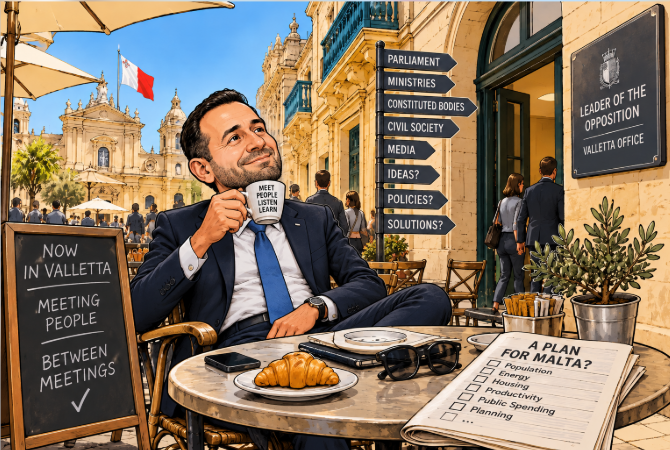
In fact, there is a perfectly good argument for it. The leader of a parliamentary opposition should be close to Parliament, government departments, civil society and the various organisations whose views ought to inform political decision-making. If Alex Borg wants to spend more time in Valletta meeting constituted bodies, listening to people and developing policy, good.
But admittedly, the fuss surrounding the office is slighlty baffling.
The Leader of the Opposition even posted a video explaining that the new location means he can now meet people in Valletta between meetings.
And there, perhaps unintentionally, lies the problem.
Is this really what we have come to regard as political news?
A politician can now meet people in Valletta between meetings. Congratulations. The Opposition has discovered the geographical and logistical advantages of Valletta.
The problem isn’t the office. Nor is it the fact that Borg is meeting people. The problem is when the physical act of meeting people starts being presented as though it were itself a political achievement.
Meeting people is not an achievement in itself. It is what politicians are supposed to do. And meeting constituted bodies is not, by itself, evidence of an effective Opposition. It is the beginning of the work.
The important question is what happens afterwards.
What did they tell you? What are you going to do about it? What legislation will you propose? What government policy will you challenge? What alternative will you offer?
That is where opposition becomes politics.
There is a danger in modern politics of confusing activity with achievement. A photograph of a politician sitting across a table from a delegation looks busy. A video announcing a new office looks busy. A succession of meetings looks busy.
But politics isn’t supposed to be measured by how busy politicians look.
It should be measured by what changes as a result.
This matters particularly for the Nationalist Party because the PN does not merely need to defeat Labour. It needs to persuade people that it is capable of governing Malta differently.
That requires considerably more than being physically closer to Parliament.
Malta is dealing with serious questions about population growth, foreign workers, infrastructure, energy security, housing, productivity, public expenditure, taxation, planning and the size and role of the state.
These are not problems that will be solved by another round of meetings. They require choices. Some of those choices will be unpopular.
An Opposition preparing to govern has to be prepared to say not only what it is against, but what it would actually do – and what it would stop doing.
That is the standard by which Alex Borg should ultimately be judged. Not by the address on his office door. Not by how many constituted bodies he manages to meet between appointments.
But by whether, after listening to all those people, he can articulate a coherent alternative to the government he wants to replace.
There is nothing wrong with the PN having an office in Valletta.
There is something wrong if the office becomes a substitute for substance.
And this is where we say this as much to the PN as to any other political party: stop confusing political activity with political achievement.
Malta does not need politicians who are merely accessible.
It needs politicians who have something to say when they get there.
The PN has moved its office closer to Parliament. Now it needs to move its politics closer to substance.
Because changing the address without changing the political proposition is not renewal.
It is simply switching inanities for substance.
Sources
- Times of Malta — Alex Borg starts holding meetings in Valletta office
- MaltaToday — Alex Borg plans to move office out of PN headquarters to Valletta
- The Malta Independent — PN Leader’s office to move to Valletta
- Malta Daily — Alex Borg on the difference between the two roles
- MaltaToday — PN backs call for free chemotherapy