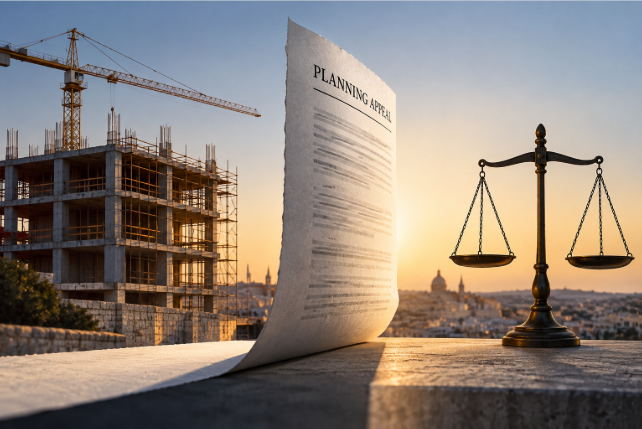
Malta’s planning appeals system has long suffered from an absurdity: a permit can be challenged in law while the building it authorises continues to rise. By the time the challenge succeeds, the damage may already be done.
The government is expected to consider legislation later on today (Tuesday) to address this anomaly. It is a welcome development, but one that has taken far too long.
In May 2023, the Prime Minister promised to suspend construction during planning appeals. A draft was approved by Cabinet later that year, yet the reform never materialised. It subsequently became entangled in a much broader and deeply controversial package of planning changes. That package was shelved after public opposition.
Now the government is returning to the original principle. The question is whether it will finally translate that promise into effective law.
The case for reform is straightforward. A legal right of appeal is of limited value if development can proceed to the point where a successful challenge becomes practically meaningless. What good is a court ruling that a permit was wrongly granted if the building has already been completed?
New figures published by MaltaToday last week make the case for taking public appeals seriously. An analysis by property-data platform Pedament found that 41% of third-party planning appeals decided between 2021 and 2025 were fully or partly upheld. In 2025, just 1.8% of permits granted attracted a third-party appeal.
These figures do not mean that every objection is justified. Nor should developers be forced to endure endless proceedings brought without merit. But they hardly support the notion that public appeals are routinely a nuisance designed to obstruct legitimate investment.
A functioning planning system must protect the rights of developers and objectors alike. Property rights matter. So does the right to challenge decisions that affect one’s home, neighbourhood or environment. Neither should automatically trump the other.
The answer is an appeals process that is both effective and swift. The proposed legislation would suspend permits during appeals and introduce deadlines for proceedings. That is a sensible starting point.
There is evidence that the system is already becoming more efficient. Pedament found that the median time from first hearing to tribunal decision fell from 18.2 months in 2020 to 7.8 months in 2025. But the court stage remains a bottleneck. Deadlines written into legislation will achieve little unless the institutions responsible have the resources and capacity to meet them.
There is also a question of principle. The consultation draft reportedly allowed Cabinet to modify or lift a suspension in cases of strategic importance or the national interest. If such an exception survives in the final bill, its scope and safeguards will matter enormously. The government cannot preach the need for an automatic safeguard while retaining a political escape hatch broad enough to weaken it.
The same principle must apply regardless of who is in office or who stands to benefit from a particular development. The rule of law cannot depend on whether a project is politically convenient.
Nor should this reform be mistaken for a complete solution to Malta’s planning problems. Suspending works during appeals will not, by itself, resolve poor planning policies, inconsistent decisions or inadequate enforcement. But it would correct a fundamental imbalance in the system.
The government has promised this reform before. It now has an opportunity to deliver it, with clear rules, realistic deadlines and safeguards that apply equally to everyone.
Development should not be held hostage to endless litigation. But neither should the right to challenge a planning decision be defeated by the speed of a bulldozer.
An appeal must be more than a piece of paper. If the law gives people the right to challenge a decision, it must also give that challenge a meaningful chance of succeeding before the damage is irreversible.
Sources:
MaltaToday – Cabinet to discuss upcoming planning appeals reform bill on Tuesday
MaltaToday – Planning appeals: Public wins in 41% of cases
Times of Malta – Public consultation on planning appeals reform wraps up
MaltaToday – Reform unveiled to stop construction works until all planning appeals are decided
Government of Malta – Summary document on the Environment and Planning Review Tribunal reform