
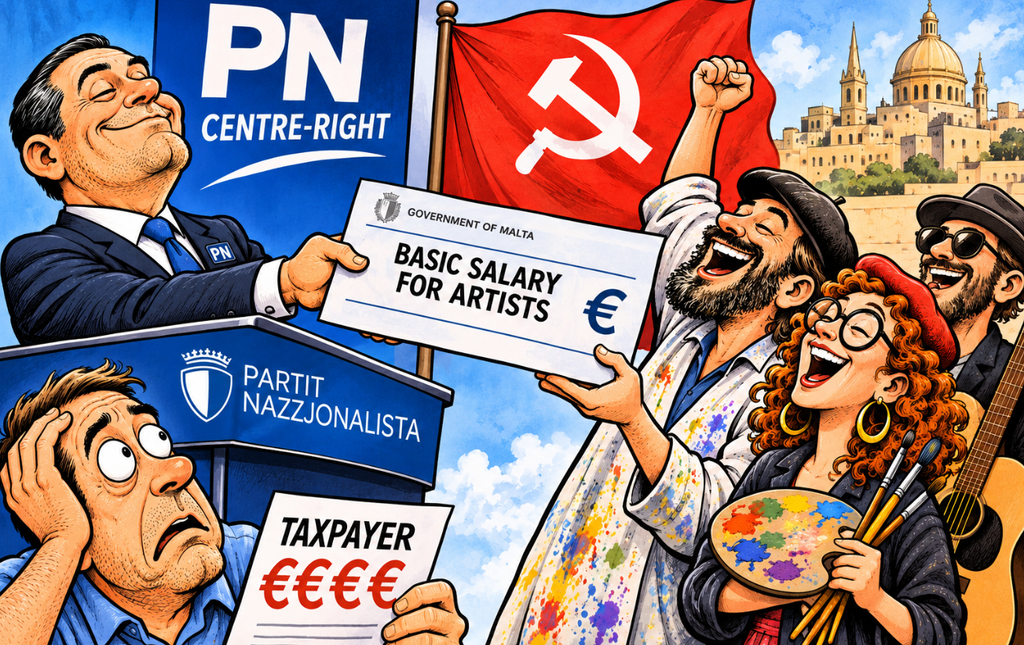
There are moments when a political proposal tells us rather more about the party making it than about the problem it claims to solve. The Nationalist Party’s endorsement of a publicly funded basic salary for artists is one of them.
Opposition leader Alex Borg has announced that the PN supports the Malta Entertainment Industry and Arts Association’s proposal for a basic income for professional artists and cultural practitioners. The association envisages a defined, time-limited pilot, providing regular income to selected beneficiaries. Borg argues that this recognition would encourage artists to do more for the country and help develop Malta’s creative economy.
We have no difficulty recognising the contribution artists make to society. Art matters. Culture matters. A country that neglects its creative life impoverishes itself in ways that cannot be measured simply in economic terms.
But none of that answers the fundamental question: why should the taxpayer be expected to provide someone with an income simply because that person has chosen to be an artist? Moreover, who will be deciding which artist is worthy to be chosen for this scheme, and which one isn’t?
Artists are not the only people pursuing uncertain careers. Freelancers, independent consultants, small business owners, tradespeople and countless others work without guaranteed incomes, often taking considerable financial risks to build something of their own. Many struggle to make ends meet. Yet we do not generally propose that the state should pay them a basic salary because their chosen profession is difficult, unpredictable or socially valuable.
Why should artists be treated differently?
The argument that artists deserve recognition is equally unconvincing as a justification for a guaranteed income. Recognition does not have to mean remuneration by the state. Nor does the cultural value of a profession automatically create an entitlement to public funding for the people practising it.
There is, of course, a legitimate role for government in supporting culture. Public funding can preserve heritage, encourage education, commission work of public value, provide opportunities for emerging talent and support projects that might otherwise struggle to attract private investment. Grants, competitions, production incentives and accessible cultural infrastructure can all serve worthwhile objectives.
But there is a fundamental difference between supporting artistic work and guaranteeing the income of those who produce it. One invests in a cultural outcome. The other creates an expectation that the public purse should assume responsibility for an individual’s livelihood.
And the word pilot should not lull anyone into thinking this is a harmless experiment. Once a scheme creates beneficiaries who come to depend on regular public payments, it acquires a constituency with a vested interest in its continuation. An administrative structure develops around it. Expectations become established. Its withdrawal becomes politically difficult, regardless of whether the original objectives have been achieved.
Temporary schemes have a habit of becoming permanent when the people benefiting from them are organised and the people paying for them are not.
There is also a question of principle that the PN should have considered before endorsing the proposal. What exactly is the party’s economic philosophy? Is it one of individual responsibility, enterprise, opportunity and a state that enables people to succeed? Or is it increasingly one in which every occupational group can make a case for its own publicly funded income guarantee?
A centre-right party should be particularly cautious about creating new entitlements. It should be asking how to make the creative industries commercially sustainable, how to attract private patronage and investment, how to open up opportunities and how to ensure that public funding delivers measurable cultural and economic value.
Instead, it appears to have embraced the idea that the answer to professional insecurity is a salary paid by everyone else.
The creative economy is not built by turning artists into public beneficiaries. It is built by creating an environment in which talent can develop, audiences can grow, businesses can flourish and people can earn a living from the work they produce.
We should support the arts. We should make it easier for artists to work, create, exhibit, perform and reach audiences. But we should resist the idea that choosing an artistic profession entitles someone to a regular income from taxpayers who have their own livelihoods to finance.
Being an artist is a vocation and, for many, a profession. It is not a social entitlement.
If this is the direction in which the Nationalist Party intends to take its economic thinking, perhaps it should explain what, precisely, remains centre-right about it.
Sources