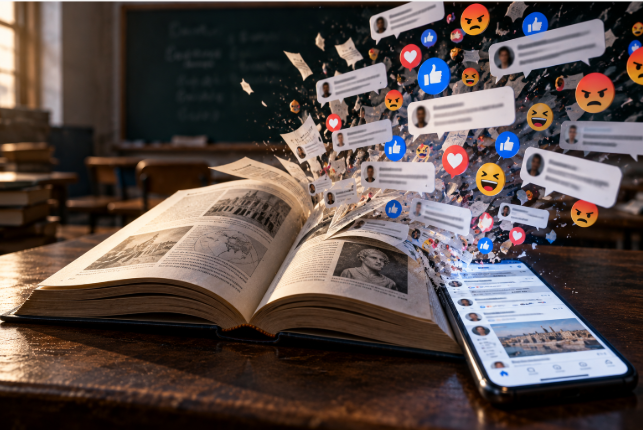
Malta does not merely have an education problem. It has a thinking problem. And sooner or later, the two become everybody’s problem.
Scroll through Facebook on any given day and the symptoms are difficult to miss. Confident assertions presented as facts. Conspiracy theories shared without a moment’s verification. Political slogans mistaken for arguments. Personal abuse offered as a substitute for evidence. People who cannot distinguish a source from a rumour nevertheless feel qualified to pronounce on everything from economics to constitutional law.
The internet did not invent ignorance. It gave ignorance a microphone, an audience and a share button.
We should be careful about blaming schools for every foolish opinion expressed online. Education does not automatically make people wise, and qualifications are no guarantee of common sense. But a country that takes education seriously should be asking an uncomfortable question: are we teaching young people how to think, or merely how to get through the system?
Malta’s latest PISA results give us little reason for complacency. Only 52% of our 15-year-olds reached the minimum proficiency level in reading, compared with an OECD average of 69%. In mathematics, the figure was 56%, against 65%. In science, it was 63%, against 74%. All three results deteriorated compared with 2022.
These are not abstract numbers in an international league table. Reading comprehension is the ability to understand what someone has actually written, rather than what we imagine they wrote. Scientific literacy means distinguishing evidence from speculation. Mathematical competence involves more than arithmetic: it teaches us to recognise patterns, assess claims and question implausible conclusions.
These are among the very skills citizens need to navigate a world saturated with misinformation, manipulated images, propaganda and, increasingly, AI-generated nonsense.
When people cannot reliably assess information, they become easier to mislead. When they cannot construct an argument, they are more likely to substitute outrage for reasoning. And when public debate rewards whoever shouts loudest rather than whoever makes the strongest case, democracy itself becomes poorer.
No, a bad Facebook comment is not a PISA statistic. But neither should we ignore the connection between the intellectual habits education is supposed to cultivate and the quality of public life those habits help sustain.
A functioning education system must produce more than examination results. It must produce people who can read carefully, think independently, challenge authority, recognise manipulation and change their minds when the evidence demands it.
That requires teachers who are properly supported, curricula that develop genuine understanding, and standards that mean something. It also requires an education administration capable of identifying failures and addressing them before another generation pays the price.
Recent concerns raised by the Malta Union of Teachers about specialist vacancies, the Curriculum Department and educators being informed of developments through the media deserve serious answers. If the professionals responsible for delivering reform are not adequately consulted or supported, how exactly is that reform supposed to succeed?
Government can announce new strategies, launch consultations and promise transformation. None of these things, by themselves, teaches a child to read critically or solve a problem. A press conference is not a curriculum. A slogan is not a teaching method. And a policy document is not evidence of improvement.
There is, of course, a danger in sounding elitist. Education should open doors, not become a weapon for humiliating people who struggled at school. Nor should we confuse eloquence with intelligence or academic achievement with moral worth. The point is not to sneer at those who have had fewer opportunities. It is to demand that every child, regardless of background, receives the tools to participate confidently and intelligently in society.
That is precisely why falling standards matter. They do not simply disadvantage individual pupils. They weaken our collective ability to make sound decisions, resist manipulation and hold those in power accountable.
We cannot demand a more informed electorate while treating educational outcomes as a public-relations exercise. We cannot complain about misinformation while neglecting the critical thinking that helps people resist it. And we cannot expect better public debate if we fail to equip the next generation to participate in it.
The next time a Facebook thread descends into a swamp of misinformation, abuse and spectacularly misplaced certainty, we can blame social media. We can blame politicians. We can blame the people posting.
But we should also ask what our schools are doing to prepare citizens for a world in which ignorance is no longer silent.
Education should not merely teach people how to pass an exam. It should teach them how not to fail themselves — or the society they live in — when they are finally left to think for themselves.
Sources
Times of Malta – Malta’s education miracle exposed as myth after OECD results
MaltaToday – Education ministry ill-equipped for curriculum reform, MUT warns
OECD – PISA 2025 Results: Malta country note
OECD – PISA 2022 Results: Malta country note
OECD – The state of learning and equity in education